


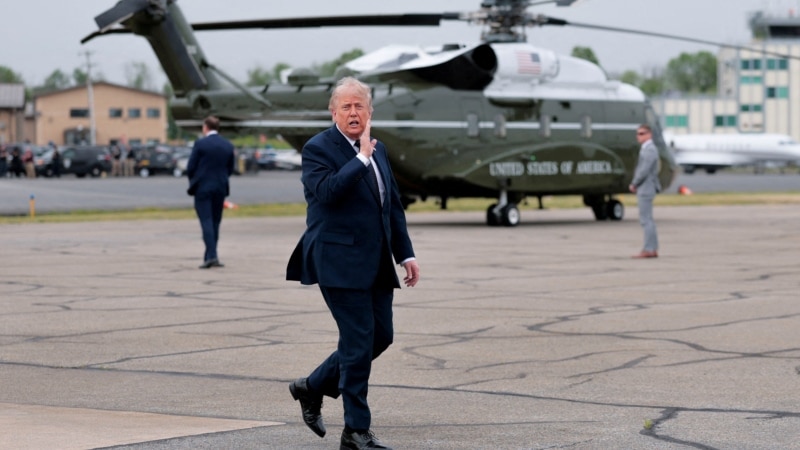
US President Donald Trump on May 23 said an agreement with Iran to end the war “has been largely negotiated” and that “final aspects and details” are being discussed, but Tehran quickly hit back to dispute some of the president’s claims.
“An Agreement has been largely negotiated, subject to finalization between the United States of America, the Islamic Republic of Iran, and the various other Countries,” he posted on Truth Social.
“Final aspects and details of the Deal are currently being discussed and will be announced shortly. In addition to many other elements of the Agreement, the Strait of Hormuz will be opened,” he added.
Trump said he had participated in a phone call with the leaders and other officials of Saudi Arabia, the United Arab Emirates, Qatar, Pakistan, Turkey, Egypt, Jordan, and Bahrain.
Trump also said in the posting that he had separately spoken with Israeli Prime Minister Benjamin Netanyahu and that the call had gone “very well.”
Trump has often suggested that a deal was imminent to end the conflict, which began with US and Israeli air strikes on February 28, only to later reject an Iranian proposal and again threaten to launch massive attacks.
Tehran did not immediately comment on Trump’s remarks, but Iran’s Fars news agency, which is close to the hard-line Islamic Revolutionary Guards Corps (IRGC), said the Strait of Hormuz would remain under Tehran’s management and that Trump’s announcement of its reopening as part of the deal was “incomplete and inconsistent with reality.”
With many of Iran’s leaders killed during the US-Israeli air strikes, the IRGC has bid to increase its already strong influence over regime decision-making. Earlier, Iranian officials had suggested progress in the negotiations, conducted through Pakistani mediators.
Iranian Foreign Ministry spokesman Esmaeil Baqaei cited what he labeled “a trend toward rapprochement.” But he added that “it does not necessarily mean that we and the United States will reach an agreement on the important issues.”
“Our intention was first to draft a memorandum of understanding, a kind of framework agreement composed of 14 clauses,” Baqaei said on state TV.
A formal US response to the latest Iranian proposal handed to the Americans through Pakistani mediators is expected to come on May 24, Reuters quoted two unnamed Pakistani sources familiar with the negotiations as saying.
A Pakistani official involved in the negotiations told Reuters that an interim deal to end the war was in its final phase and was “fairly comprehensive.”
“It is never over till it is done,” the official cautioned.
Even Odds On Peace Or War
Trump earlier on May 23 said there were even odds that Washington would secure a “good” deal with Iran or renew its bombing campaign targeting the country.
“I think one of two things will happen: either I hit them harder than they have ever been hit, or we are going to sign a deal that is good,” Trump said, according to Axios.
Iranian President Masud Pezeshkian and powerful parliament speaker Mohammad Bagher Qalibaf held talks in Tehran with Pakistan’s army chief, Field Marshal Asim Munir, on May 23 as part of a widening diplomatic push involving Pakistan, Qatar, Gulf states, and Western countries amid growing fears that the conflict in Iran could reignite.
Qalibaf, who has emerged as one of Tehran’s top negotiators since US-Israeli strikes on Iran began, said following his meeting with Munir that Iran would not compromise on its “national rights” and accused Washington of negotiating in bad faith.
The renewed mediation effort comes amid reports that Iran and the United States are exchanging messages and draft proposals through intermediaries in an attempt to establish a formal framework for future negotiations.
The diplomatic activity has accelerated amid growing tension over the Strait of Hormuz, which Iran has effectively restricted since the conflict began.
The waterway is a critical transit route for oil, liquefied natural gas (LNG), and commercial shipping, and the disruption has rattled global energy markets and intensified pressure on countries dependent on Gulf trade routes.
Iran has proposed creating a Persian Gulf Strait Authority that would regulate shipping traffic and impose transit fees, according to regional officials and diplomats involved in the talks.
Gulf States Alarmed
The proposal has alarmed Gulf Arab states and Western governments, which fear Tehran is attempting to establish long-term control over one of the world’s most important maritime chokepoints.
Five Gulf states — Bahrain, Kuwait, Qatar, Saudi Arabia, and the United Arab Emirates — have reportedly written to international maritime authorities warning against recognizing any Iranian-controlled shipping mechanism in the strait.
Iran has pushed for a phased process focused first on a permanent cessation of hostilities, sanctions relief, and guarantees against future military action before broader nuclear negotiations proceed.
The United States has favored a more comprehensive agreement negotiated simultaneously, including limits on Iran’s nuclear program and the future status of uranium enrichment.


