

Axpo is counting on SMEs to help expand wind power
Keystone / Urs Flueeler
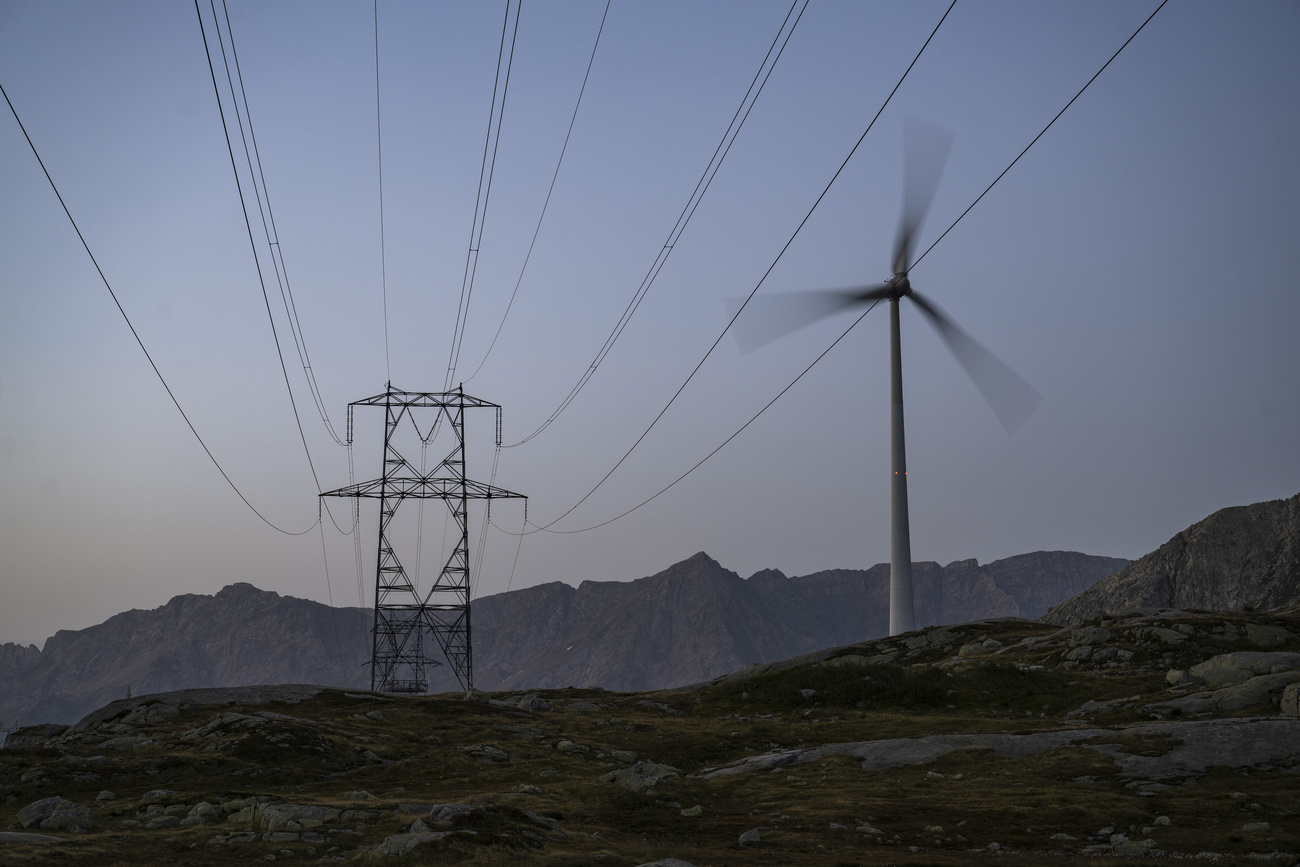
Wind power has faced an uphill political battle in Switzerland. Now energy company Axpo wants to accelerate wind energy development with the help of small and medium sized enterprises (SMEs).
Private households are unlikely to buy a wind turbine, but for SMEs such an investment appears attractive.
Every wind power project begins with a wind measurement mast. One such mast is situated in Rossrüti, a meadow in the hilly countryside north-east of the town of Wil in canton St Gallen. Here, wind speed, wind direction, temperature and air pressure are measured.
+ Why do wind turbines windup so many emotions?
Existing data from Wind Atlas Switzerland, a federal database that measures wind speed and direction, was insufficient, according to Cédric Aubert, head of wind power at Axpo, which is planning to build a wind farm in this location.
“The topography is a crucial factor. That’s why we always have to take really precise measurements for every project,” he told Swiss public broadcaster SRF.
For the environmental impact assessment, Axpo must also monitor the activity of bats and birds. Axpo plans to erect three large wind turbines, which will generate enough electricity to power around 5,000 households, particularly in winter.
+ Alpine nimbyism freezes Swiss green energy dreams
Aubert says the measurements taken at the mast in Rossrüti have been promising so far. And, in principle, the site is ideal. “Because there is wind and because the electricity could be consumed locally,” Aubert said.
Energy security
Aubert hopes that, in addition to the surrounding local authorities, smaller companies from the region will also participate in the project. “Investing in wind power is ideal for SMEs because a wind farm has a lifespan of around 25 years,” he said.
“Anyone who invests in a wind farm can purchase electricity for this period at a fixed price. That means planning and supply security. You receive the electricity and are not exposed to the geopolitical situation or highly volatile electricity prices,” Aubert added.
Aubert is convinced that SMEs would be willing to pay a little extra for planning and supply security. Currently, a kilowatt-hour of wind power costs CHF0.02 to CHF0.03 ($0.025 to $0.037) more than the average price of electricity.
+ Read more: Switzerland needs energy, but what kind?
“In addition, electricity from wind turbines is renewable and clean. SMEs also need to consider their carbon footprint,” he said.
Axpo is in talks with various SMEs about potential investments. Aubert does not yet wish to name any specific companies. But one thing is clear to him: “If local industry gets involved, people will see this has a benefit – an economic one too – for the region. That would help with acceptance.”
The three wind turbines near Rossrüti could start generating electricity in 2031 at the earliest. Currently, only around 50 of these large turbines are in operation across Switzerland, producing well under 1% of the country’s electricity.
Similar to solar boom
According to the energy strategy, wind is set to contribute significantly more (7%) to the electricity mix by 2050. That sounds challenging, if not impossible. But Aubert is hoping for a similar development to that seen with solar energy.
“Fifteen years ago, solar power was also at 0.2%. Today, solar installations generate more than 14% of Switzerland’s electricity. Back then, everyone said it was impossible.”
However, this expansion is still far from certain. No fewer than two popular initiatives, which aim to severely restrict the construction of wind turbines, are expected to be put to a vote in 2027.
More

More
Two initiatives on wind turbine construction launched in Switzerland
The Wind AtlasExternal link measures wind direction and speed at various locations in Switzerland.
The planning tool from the Swiss Federal Office of Energy (SFOE) also highlights areas with particularly high wind potential.
For comparison, the Wind Atlas also displays a map of Switzerland showing the various federal interests in the area.
This map highlights, for example, building zones (with noise protection) or protected areas that would need to be taken into account when constructing a wind turbine.
Translated from German, sub-edited by Matthew Allen/amva
