

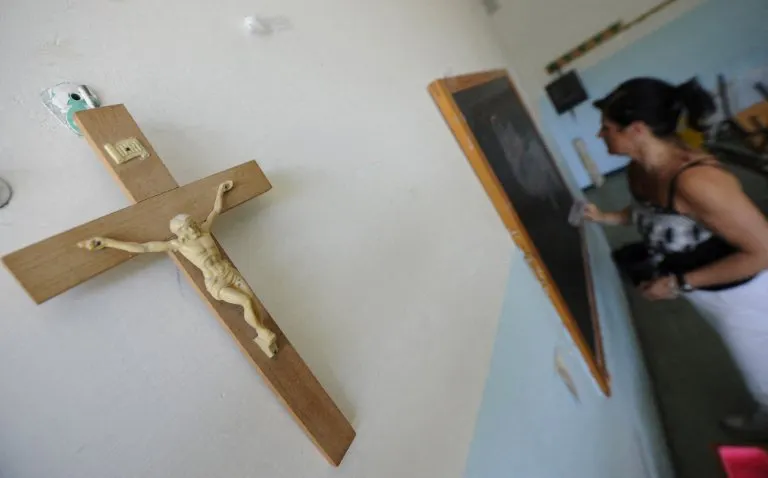
As kids across Spain start school this week, many foreign parents who are new to the country may be wondering if Catholicism still plays an integral part of the education system.
Spain is a Catholic country, although there is evidence to suggest its people are more ‘culturally Catholic’ than devout these days, as The Local has covered previously.
Is this shift visible in Spain’s schools as well? The influence of religion on education in Spain is evident through the strong network of Catholic schools that live on in the country, as well as religion being taught as a subject in secular state schools.
However, Catholicism more generally is declining in Spain, and that is reflected in the number of students opting to take religious studies.
In very broad terms, Spain, like many countries around the world, has seen declining religiosity over time.
In May 1978, 90.5 percent of Spaniards described themselves as Catholic. By October 2021, however, that figure had fallen to 55.4 percent, according to the CIS, Spain’s sociological research centre.
Catholic schools and concertado schools
Catholic schools still have a strong presence in Spain.
According to the latest report from the Spanish Bishops’ Conference, there are 2,402 state-subsidised Catholic schools in Spain, with 1,498,182 pupils enrolled.
The majority of their teachers are lay people, accounting for 97 percent, while 3 percent are members of religious orders.
For many foreigners in Spain, the idea of semi-private schools, or partially-funded or ‘state-assisted’ schools (known as colegios concertados in Spanish) can seem strange.
Though there are some fully private Catholic schools in Spain, the vast majority or religious schools are colegios concertados (94 percent).
READ ALSO: The differences between Spain’s public, private and ‘concertado’ schools
These aren’t your usual private schools, rather parents will provide some funding for uniform and resources, backed up by money from the state.
Some parents choose concertados not for their Catholicism but educational quality and focus on discipline, among other factors.
Are these schools very religious?
As for the actual religiosity of the schools themselves, that will depend on the individual school.
How ‘strict’ or religious individual centres are (how often they pray, attend Mass, or take Communion, and so on) depends on a school-by-school basis and it’s recommended that parents visit the school beforehand to get an idea.
Put simply: some Catholic schools in Spain are more devout than others, just like in other countries. Some may have students going to Mass or praying every day, whereas other schools might be otherwise normal schools that have a particular Catholic ethos (Marists, La Salle, Jesuits, Salesians etc).
Public schools and the influence of the Church
Despite a strong presence of semi-private Catholic schools in Spain, religion still plays a role in the public sector — albeit a declining one.
According to the research paper Religion in State Schools: Questioning, Rationale and Challenges in Spanish Law by legal scholar Zoila Combalía, “Catholic religion is compulsory in schools and voluntary for pupils”.
That means that public schools must offer it as a subject but the pupils don’t have to take it.
However, this comes as religion (Catholicism) as a subject is in decline in Spain, and against the backdrop of an effort by the political left in Spain to have it taken out of classrooms.
Students in Spain can also opt to study other religions, such as Islam, although availability is very limited in practice.
The decline in religious studies in Spanish public schools has accelerated in recent years following the passing of the current education law, known as Lomloe.
In fact, the subject has lost 369,807 pupils over the past five years – a decline 10 times greater than the fall in the total number of pupils over the same period due to demographic trends, according to figures in the document Education Figures in Spain 2026.
The decline in pupil numbers and the reduction in the number of weekly hours allocated to the subject in much of Spain since the Lomloe came into force, coupled with the fact that the number of religious education teachers has remained virtually unchanged (12,554, according to the latest official figures).
This means that many religious studies teachers don’t have the pupils or classes they are contracted for.
LISTED: The changes to schools in Spain for the 2026/2027 academic year
Furthermore, a political campaign by the Spanish left has called to remove religion from the classroom.
“In recent decades, Spain has witnessed a social and political debate regarding the justification and/or appropriateness of religious education in state schools,” wrote Zoila Combalía, a Professor of Law and State Ecclesiastical Law at Zaragoza University.
Earlier in 2026, the Spanish government’s far-left coalition partner Sumar tabled a motion in the Congress of Deputies to remove religion from state schools and also from concertado schools.
The proposal called for state-subsidised schools with Catholic roots would lose the ability to teach this subject during school hours, with it being relegated to an extracurricular activity.
Although this has not come to fruition, it does reflect the demands of part of Spanish society to make education in the country increasingly secular.
