


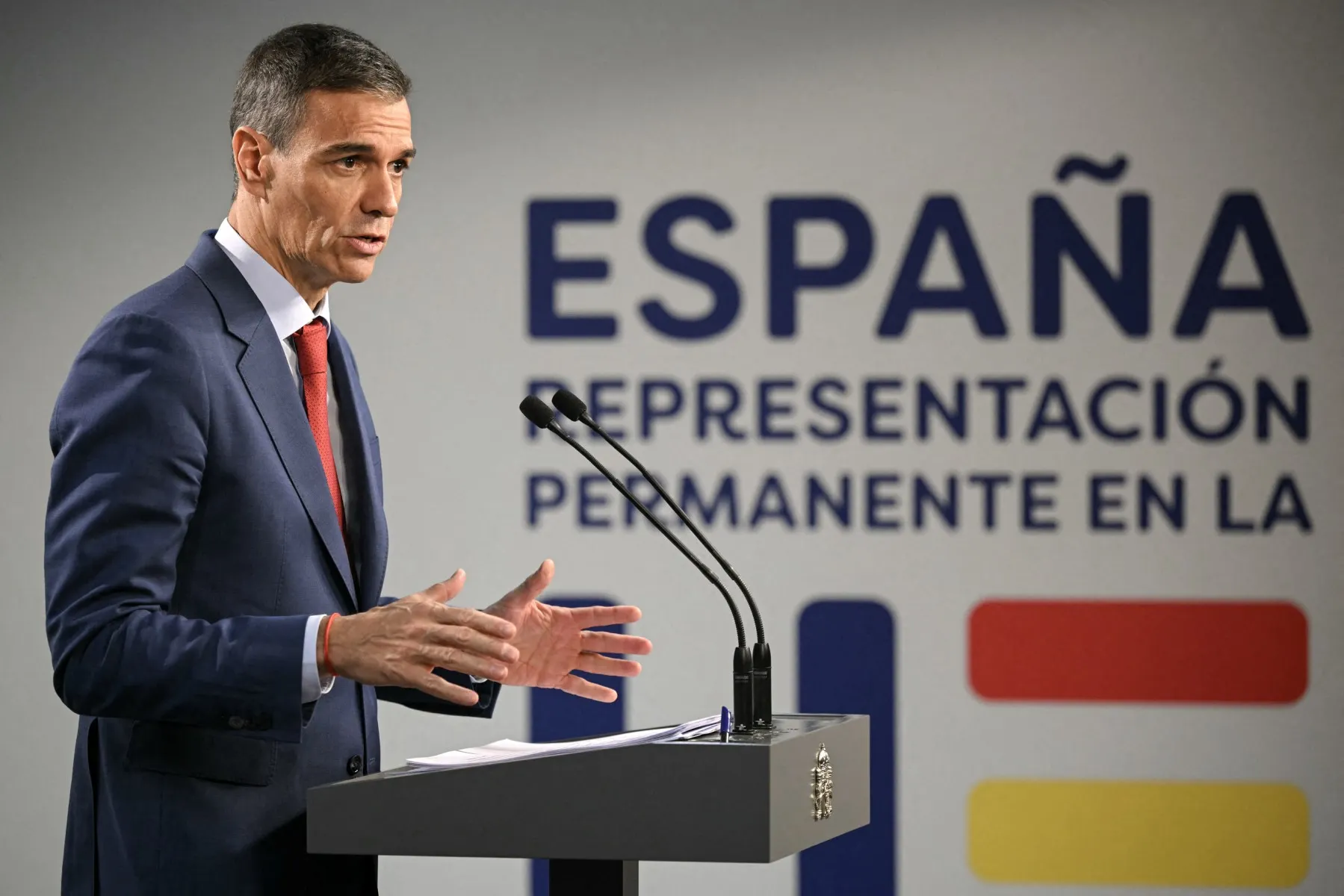
Prime Minister Pedro Sánchez on Tuesday unveiled a new €505-million plan to help migrants integrate into Spanish society through language lessons, traineeships and more, confirming as well that more than one million migrants have applied for the country’s amnesty.
The Spanish premier presented on Tuesday his government’s new “Integration and Citizenry Plan”.
It is to be launched this year with a budget of €505 million and aims to implement a series of measures that will contribute to the “coexistence” of Spain’s growing migrant population.
Sánchez stressed that the plan will be launched “to take advantage of the opportunities presented by immigration and respond to the challenges it is generating,” confirming in the same presentation that more than 1 million undocumented migrants who were already living in Spain have applied for the mass regularisation.
READ ALSO: Spain’s undocumented migrant amnesty ends with 1.3 million applications
“The more than one million applications submitted… show how necessary this recognition of rights and responsibilities was,” the PM told an event in Madrid.
“When we condemn a person to invisibility, I think we make our country a worse country. We all lose”.
The strategy, structured around four main pillars and 16 measures, includes the creation of a State Mobility Agency to “simplify” migration management, as well as employment and training measures for immigrants, €30 million to help migrants learn Spain’s co-official languages, and plans to eliminate “barriers” for migrants in terms of accessing certain rights.
Sánchez is currently the European leader promoting the most open immigration policies, having long argued that immigrants are needed to sustain Spain’s economy, the welfare state and pensions amid Spain’s ageing population and depopulation in rural regions.
“This is our model for integration: order and legality, decent work, and a clear framework for coexistence based on effective access to rights and obligations,” the Socialist leader declared.
The plan will come into action this year with a budget of €505 million, and will be reviewed annually based on the implementation of the measures and the results obtained.
It will be managed through an Interministerial Commission chaired by Spain’s Minister of Inclusion, Social Security and Migration, Elma Saiz .
“Living together is not free of tensions, we know that, which is why integration means recognising those challenges,” the Prime Minister argued, after highlighting that the wide-reaching plan is the result of months of work by several ministries, charities, employers and work unions.
Sánchez announcement comes on the very day Spain’s widely reported mass migrant amnesty concludes, which will provide residency and the right to work to undocumented migrants who can prove they were living in the country before January 1st 2026 and who don’t have a criminal record.
Let’s look in more detail at what Spain’s new migrant integration plan includes.
Moving to Spain legally
The PM referred to the finalising migrant regularisation as the “first pillar” of the new plan, as it addresses the challenge of supporting immigrants who already live and work in the country.
“Many of the challenges associated with migration stem precisely from administrative exclusion, because it prevents people from working legally, developing their own talents, contributing to the welfare state, and exercising their rights and obligations,” he stated.
Spain’s leftist government also intends to act in the countries of origin of migrants through the creation of a new State Agency for Human Mobility.
This will offer alternatives before migrants embark on the clandestine journey to Spain and instead provide “legal, safe, and orderly channels”.
READ ALSO: Most undocumented migrants in Spain do not arrive in boats
Ideally, having such a plan in place would also meet the needs of Spanish businesses and the economy overall, so that migrants could cross the border into Spain with a work contract and a life plan already in place.
Sánchez added that this new agency will clarify the functions and resources that are currently “dispersed” – as is fairly standard with Spanish bureaucracy – uniting international protection, residency, or border security under one roof.
‘Decent work’
The second pillar positions “decent work” as the main tool for integration, with a total investment of €185 million.
Sánchez was referring to the fact that undocumented migrants have long been exploited and underpaid by employers as they had no official work rights or welfare protections.
Studies have also shown that immigrants – including those with papers – suffer a much higher rate of overqualification in the workplace than the native population – 54 percent compared to 33 percent.
Immigrants in Spain also earn on average 29 percent less than Spaniards.
The €185 million will fund programmes to facilitate access to employment in high-demand sectors and rural areas.
Up to €35 million have been allocated for entrepreneurship programmes for migrants, and another €50 million will fund 100,000 vocational training places adapted to the labour market.
Learn Spanish languages and norms
The third focus of the plan is on coexistence, aiming to strengthen immigrants’ access to both their rights and their obligations.
According to Sánchez, this involves “understanding integration as a reciprocal process.”
With a budget of nearly €30 million, the government will implement programs to reinforce the learning of co-official languages and knowledge of Spanish laws and values.
“Those who arrive must respect our laws and our official languages, because integration is not just about living in a neighbourhood, but about becoming part of the community, and for that, shared rules are necessary,” Sánchez stated.
This matter of “co-official languages” has been highlighted in the Spanish press as it seems to indicate that the funds would go to learning Catalan, Basque, Galician, Valencian and Aranese, but not Spanish.
However, castellano (Spanish) is classified as a co-official language in some regions, so it’s just a matter of wording and that Spanish will form part of these language programmes.
It’s worth noting too that Spanish-speaking Latin Americans make up the bulk of Spain’s migrant population and those applying for the latest amnesty.
A plan will also be implemented to strengthen the prevention of hate speech and provide greater support for victims of discrimination.
Accessing all their rights
The fourth and final pillar of the plan aims to guarantee immigrants their “real” access to their rights as citizens.
This pillar receives a budget of over €260 million, which will be used to “eliminate” cultural, social, and administrative barriers that, as Sánchez emphasized, prevent many people from accessing the country’s public services on equal terms.
In this regard, public services will be strengthened to guarantee equal opportunities, for example, by combating school segregation, emphasising the reinforcement of language learning from an early age, addressing potential discrimination in access to housing, and guaranteeing effective access to the healthcare system.
The Socialist plan appears to be a clear response to the right’s national priority pact, which aims to put Spaniards first for benefits and state aid in the regions in which they govern.
READ MORE: What is the Spanish right’s ‘national priority’ policy for Spaniards?


