

Geneva | Palais des Nations
Report by Sara Shadab Arab
UN HRC62 side-event Caste, Gender and Power, Dalit Voices for Justice
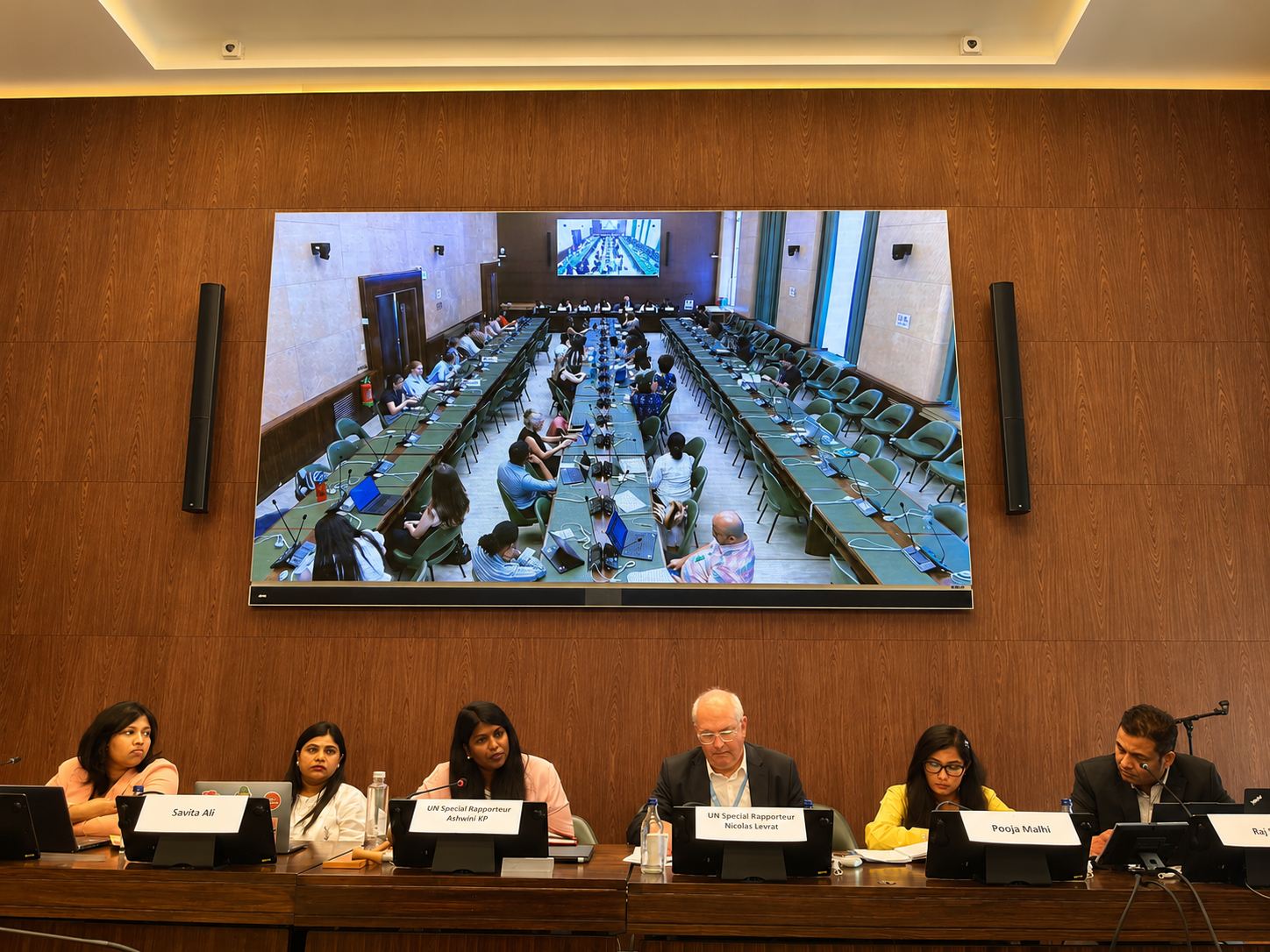
A side-event organized by International Dalit Solidarity Network (IDSN) at the 62nd Human Rights Council in Geneva brought together panelists from South Asian states – India, Pakistan, Bangladesh, Sri Lanka and Nepal. Ashwini K.P., UN Special Rapporteur on contemporary forms of racism, racial discrimination, xenophobia, and related intolerance, alongside Prof. Nicolas Levrat, UN Special Rapporteur on Minority Issues, presented their insights on caste discrimination and the intersections of caste and gender.
The discussion – “Caste, Gender and Power, Dalit Voices for Justice”- was convened by the International Dalit Solidarity Network (IDSN) and moderated by Meena Varma. It brought together Savita Ali from Eva Foundation, India, Dharsika Sivapragasam of Human Development Organisation, Sri Lanka, Pooja Kumari of Pakistan Dalit Solidarity Network, Pakistan and Raj B.K. from Jagaran Medical Centre, Nepal. Interventions from the floor were made by Provati Das from DALIT, Bangladesh and Chandrashekar from Thamate, India.
The event addressed pertinent and timely issues as crimes against religious and caste minorities are rising in parts of South Asia. South Asian nations are grappling with incidents of violence against caste minorities, especially women, in contemporary times. Caste discrimination continues to prevail across the globe as marginalized communities face caste stigmas across the diaspora and digital spaces.
The Problem of Definition
As UN Special Rapporteur Dr Ashwini KP aptly noted in her opening remarks, there is no International Human Rights framework that defines and acknowledges ‘caste’. This leaves a gap in the discourse on caste discrimination, as caste inequalities are neither properly defined nor understood. The General Recommendation No. 29 (2002) of the UN Committee on the Elimination of Racial Discrimination (CERD) included recommendations on caste, which is a promising development.
Both UN Special Rapporteurs Levrat and Ashwini highlighted the unique position of Dalit women as being doubly oppressed because of their caste and gender. The experiences of Dalit women cannot be studied in isolation but as part of larger systemic discrimination and patriarchal domination. Ashwini rightly pointed out the significance of ‘lived experiences of Dalit women as expertise’. Thus, the agency of Dalit women as human rights defenders, documenters of justice and activists must be recognized. Prof. Levrat expressed that the encroachment on Dalit women’s rights should be addressed as a minority issue. To put in perspective, the Dalit community is one of the largest caste-oppressed communities existing predominantly in South Asia and Dalit women are at a higher risk of violence within the sphere of occupational roles, be it in factories, sanitation or other forms of manual labour.
Political participation and Legal mechanisms
The panelists highlighted the lack of enforcement of existing laws in ensuring timely justice for Dalit women. In India, the Prevention of Atrocities Act is a landmark law designed to protect marginalized communities. However, as articulated by Savita Ali, due to social control and pressure from influential castes, crimes either remain unreported or convictions are deferred or absent.
Likewise, in Sri Lanka, Malayaga Tamils, predominantly engaged as plantation workers, face challenging socio-cultural and economic disadvantages. Dharsika Sivapragasam recommended establishing a minority rights commission in Sri Lanka to advance gender justice and women’s empowerment. Besides, although there are reservations to ensure the representation of women from minority groups in legislatures, measures should be taken to make their participation meaningful. Thus, women’s representation should not only be about filling quotas but also about selecting eligible candidates who can make a profound contribution to their constituencies.
Political participation was a pertinent theme across the panel discussion. Raj B. K. from Nepal focused on the challenges faced by women parliamentarians despite the implementation of gender quotas. While quotas have increased representation at national and local levels, this numerical growth has not always led to substantial political influence. It is observed that patriarchal norms, political party dynamics, and traditional gender roles that prevent women from effectively advancing feminist policies.
Pooja Kumari reminded that Dalits remain a minority within a minority in Pakistan and suffer several inequalities due to their caste status. Due to the lack of robust legal mechanisms and their implementation, Dalit children and women are disproportionately lacking in securing suitable education and employment, besides facing caste-based discrimination. In April 2026, UN expertsexpressed serious concern over the continued and widespread patterns of abduction and forced religious conversion through marriage affecting women and girls belonging to minority communities in Pakistan.
Giving Voice to the Silenced
Caste, when acknowledged as caste and recognized as the root cause of civic, social and economic inequalities by governments, judicial systems and public opinion, will pave the way for stronger social protection and equal rights. Thus, the panelists agreed that formal recognition by the international community, including the UN could be a promising step in this direction. Besides, the global acknowledgement of caste as a basis of discrimination is the need of the hour. Seattle, as the first US city to ban caste discrimination in employment, housing, and public accommodations, is a good example.
Overall, the event effectively drew attention to the historical and contemporary challenges faced by Dalit communities, especially women, across South Asia and globally, in the context of occupational roles, domestic roles, political participation, and the lack of redressal mechanisms. It also underscored significant recommendations for addressing caste exploitation, intersectional discrimination and gendered violence.


