

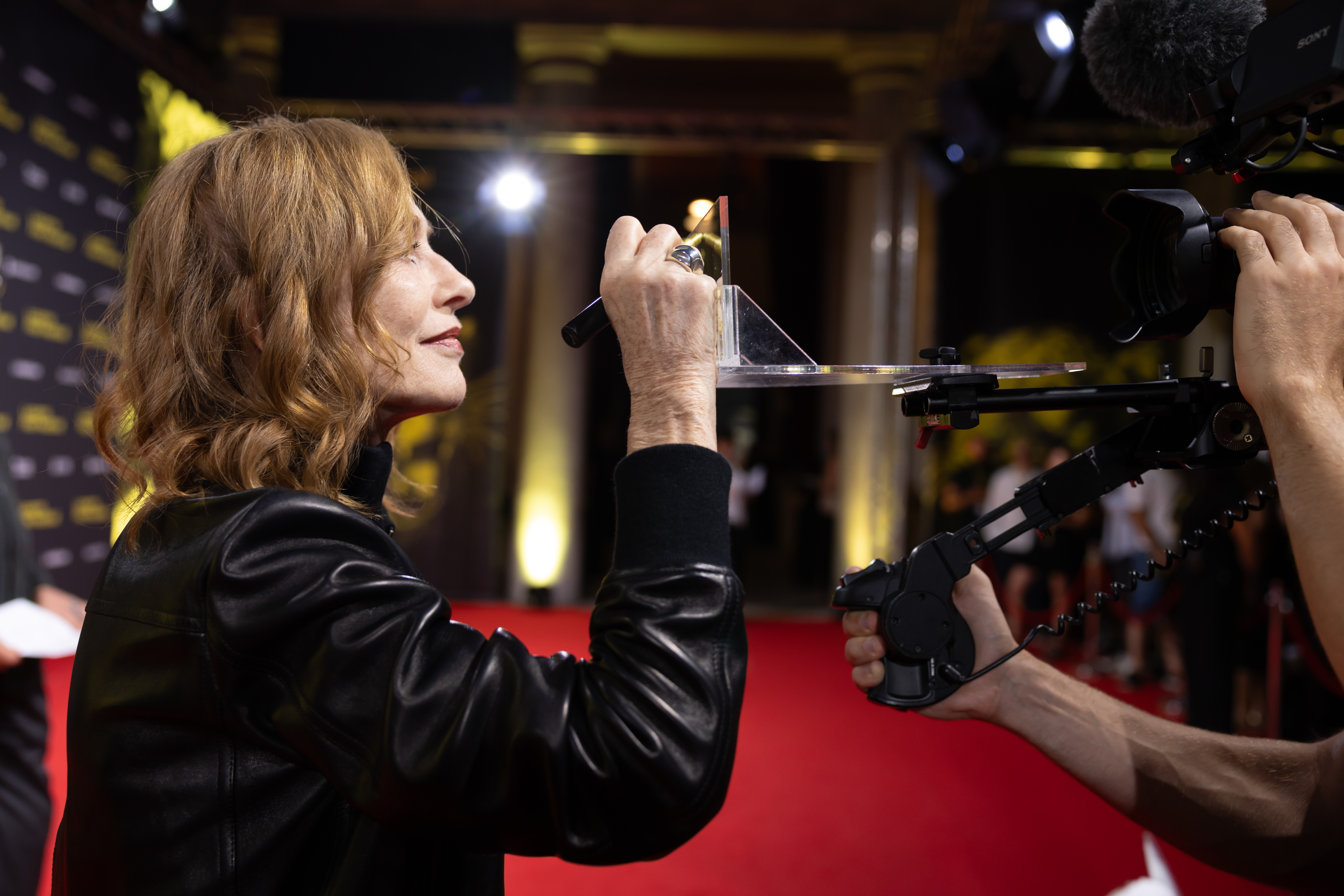
Isabelle Huppert signing an autograph on the red carpet at the Locarno Film Festival.
Locarno Film Festival / Ti-Press
At the Locarno Film Festival, Marc Fitoussi presented a comedy in which reality and fiction constantly mirror each other. In an interview on the eve of the world premiere, Isabelle Huppert, Sandrine Kiberlain and the filmmaker discussed acting, self-deprecation and the workings of the star system.
The Locarno Film Festival has long been celebrated for its rich and diverse programme, showcasing filmmakers with radical perspectives, often considered too adventurous for the selections of other prestigious international festivals such as Cannes and Venice.
This focus on making Locarno a showcase for independent art-house cinema does not mean that the festival’s artistic direction takes an exclusive, cinephile approach. One of Locarno’s most iconic sections remains the Piazza Grande. Aimed at a wider audience, with thousands of spectators gathering there every evening in front of one of the world’s largest screens, it features mainly world or international premieres attended by illustrious guests.
On a particularly cheerful and uplifting note, the festival came to a close with the world premiere of Marc Fitoussi’s Ni vue, ni connue (All About Corinne) (2026).
Starring Isabelle Huppert and Sandrine Kiberlain, two stars of French cinema, Fitoussi has made a comedy about the film world, infused with meta-humour, that explores the work of film extras – the invisible yet indispensable force behind every shoot.
From his first feature film, La vie d’artiste (2006), to the miniseries Ça, c’est Paris!, the world of show business and entertainment has been an integral part of the filmmaker’s work. However, it was above all his contributions to the third and fourth seasons of the multi-award-winning series Dix pour cent (2015-2020) that left a lasting mark on his artistic universe.
All About Corinne seems to continue this idiosyncratic exercise in self-deprecation, in which Kiberlain and Huppert had already both hilariously indulged by playing themselves in the episodes of Dix pour cent directed by Fitoussi.
External Content
When fiction meets reality
All About Corinne, however, puts a twist on its meta approach: alongside actors such as Sandrine Kiberlain, Diane Kruger and Ana Girardot, who play fictionalised versions of themselves, Isabelle Huppert is cast as Corinne Maclou, a determined extra with an overbearing personality who desperately seeks the role that will finally allow her to prove her talent.
After meeting on a film set, the two women begin spending time together, forging a friendship full of tension and humour arising from the asymmetry in their personalities and their professional, economic and social status.
Seeing Huppert – arguably the most prolific actor in French cinema today, having delivered countless unforgettable performances for Claude Chabrol, Michael Haneke and Paul Verhoeven – struggling as a mere extra from one shoot to the next is, to say the least, surprising and amusing.
The illusion created through fiction does not remain intact for long. When we meet the actor at the Hotel Belvedere on the eve of the premiere, the distant, almost indifferent expression on her face is a testament to the extent of her talent for bringing to life a determined and endearingly awkward Corinne. Accompanied by filmmaker Fitoussi and Kiberlain, no less professional but somewhat warmer than her co-star, Huppert seems, at that moment, to be thinking about anything but answering our questions.

Isabelle Huppert (left) and Sandrine Kiberlain in a scene from *Ni vue, ni connue*.
Avenueb – Jerome Prebois
The gap between reality and fiction is certainly one of the film’s key themes. Like most films that reflect on the material conditions of filmmaking – the most famous example arguably being François Truffaut’s Day for Night (1973) – All About Corinne delves deeply into the escapist dimension of the world of cinema.
According to Fitoussi, wanting to make films in itself implies a desire to be in reality: “an improved reality, in any case, as we would like to see it, with the necessary distance that cinema allows.” Isabelle Huppert, meanwhile, stresses that there is a distinction between the reality experienced by actors and that of audiences: “When you are an actor, on the contrary, you are at the heart of reality, in the very making of a film.” Her brief response nevertheless conveys the conviction with which she approaches her profession.
Getting self-deprecation right
As Corinne Maclou, Huppert seems to have greater freedom to shape her character. The task is more complex for the other actors, starting with Kiberlain: despite the film’s obvious self-deprecation, is there not a risk that their roles could be seen as caricatured, implausable versions of themselves?
Yet the filmmaker maintains that “audiences today are used to self-deprecation and actors know how to play with their public image. An actor such as Vincent Dedienne is willing to take on such an unflattering role, while still being credited under his own name”, adding: “It is also a sign of intelligence. I believe that actors ultimately become more like us, almost more approachable.”
Huppert, clearly an admirer of Kiberlain’s approach, says she felt a sense of sisterhood in the way they acted: “It was a good idea to bring us together. I feel that in our acting, we constantly practise self-deprecation, even in the most tragic or melodramatic films. It is something I like to recognise in an actor. You know, people often say that comedy is never far from drama, and drama is never far from comedy. Putting this idea into practice means that we are never completely in one genre or the other, and that also gives the audience a great deal of flexibility.”
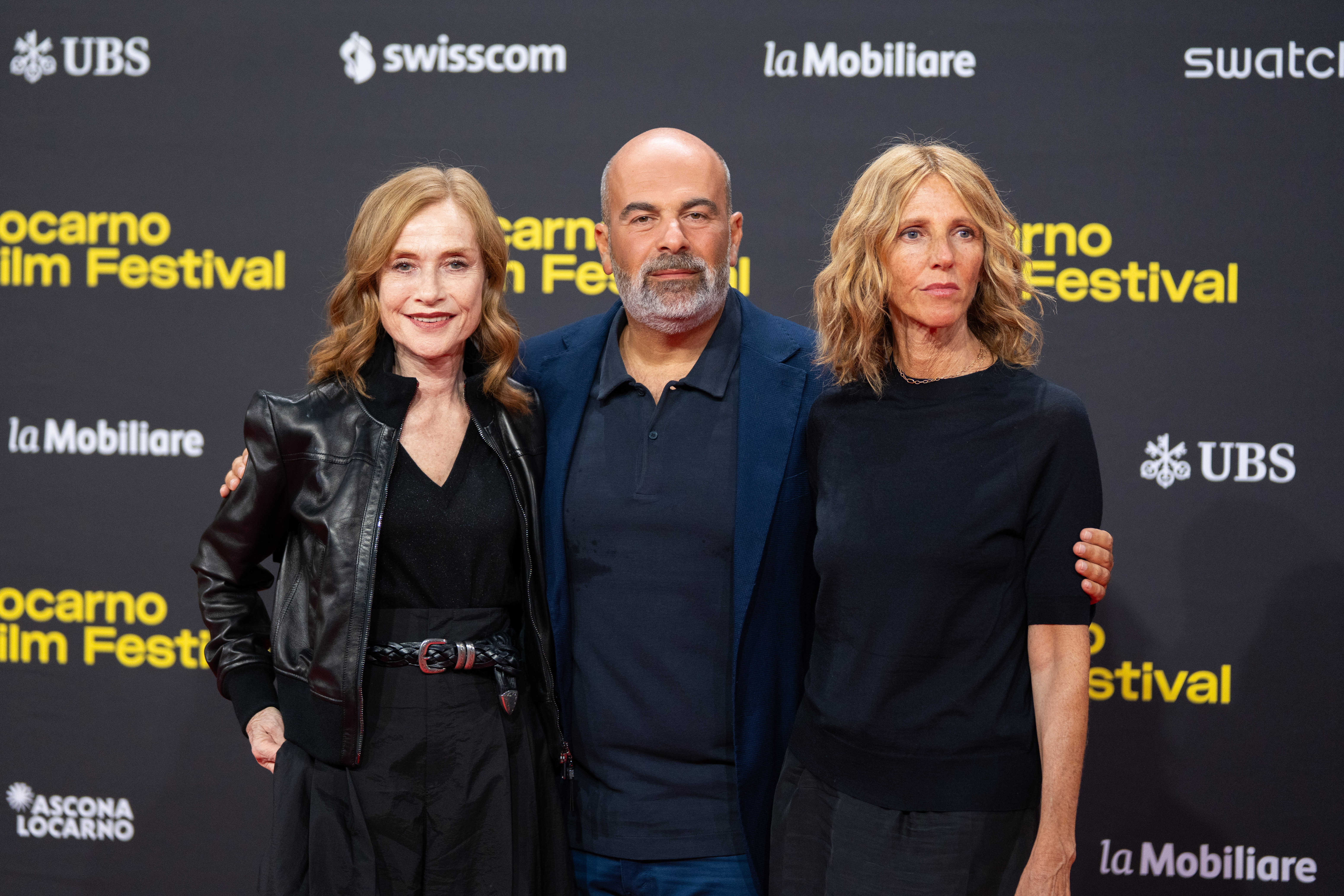
Marc Fitoussi and his stars on the red carpet at Locarno.
Locarno Film Festival / Ti-Press
As for the film’s humorous tone, Kiberlain praises Fitoussi’s writing and his ability to tailor his humour to each character: “We very quickly realised that not everyone shared our sense of humour. We were very careful because we knew what kind of humour Marc had used in making the film. But there were times when we realised that this or that person could not take the same distance from things as we could. It is a very subtle balance that Marc managed to strike.”
Challenging stereotypes through humour
The film is about more than simply offering a fictional glimpse into the world of cinema. The filmmaker and his two regular collaborators are keen to stress that, above all, it tells the story of a meeting between two people, whose repercussions extend beyond their professional lives.
“The pitfall we wanted to avoid was female rivalry. There is a somewhat persistent cliché in cinema that actors are imagined as tearing each other apart. Yet Corinne is not trying to take Sandrine’s place, and when Sandrine is upset to learn that Diane Kruger has landed a role, she does not seek revenge,” Fitoussi explains of his female protagonists.
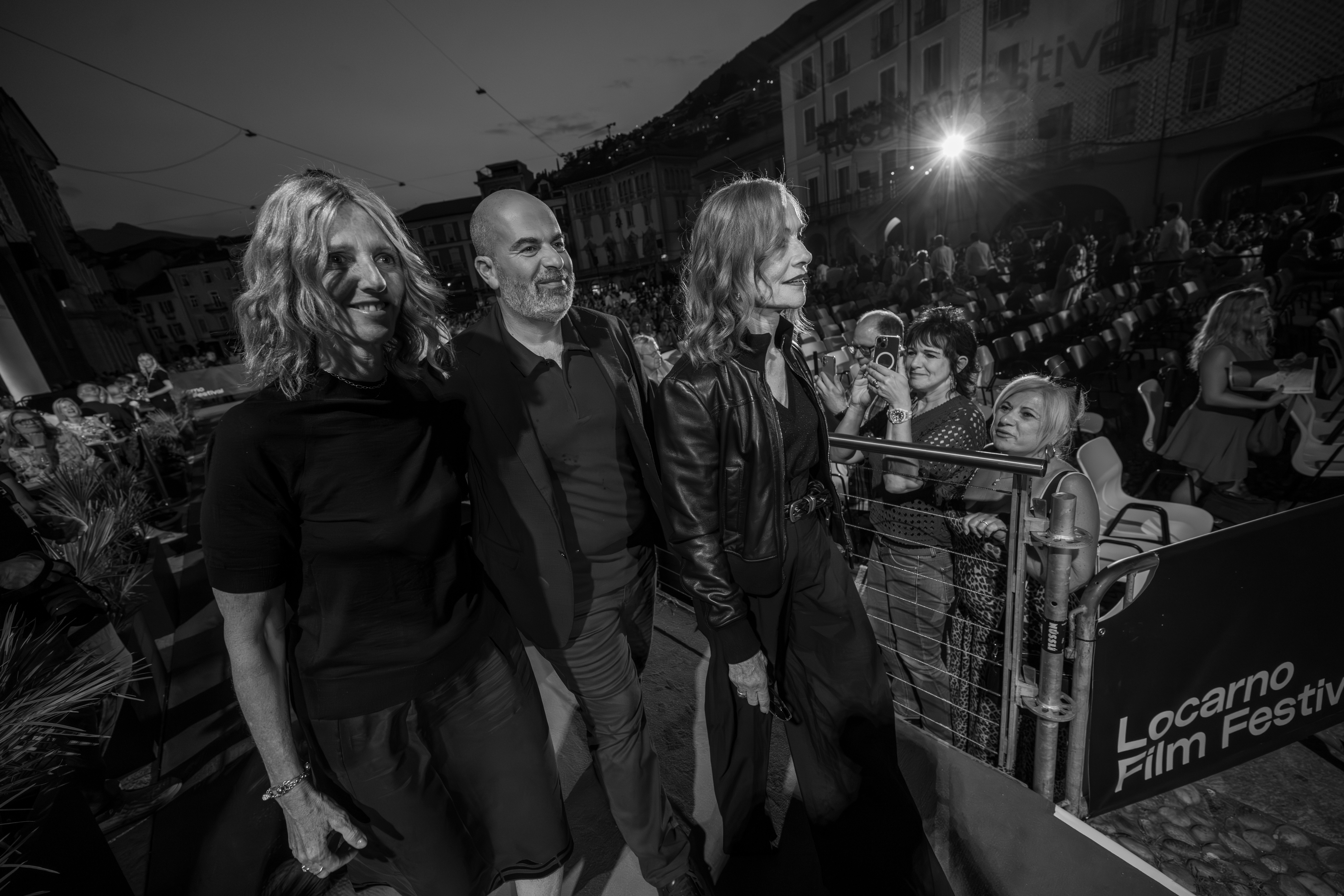
Gala at the Piazza Grande: the film brought the 79th Locarno Film Festival to a close in front of nearly 8,000 spectators at the world’s largest open-air cinema.
Locarno Film Festival / Ti-Press
The film acknowledges and denounces social determinism and the consequences it can have, regardless of the characters’ intentions. “But to make people smile!” Isabelle Huppert insists. “What I like about Marc’s films, even though he portrays characters living in a certain degree of precarity, somewhat down on their luck, is that he goes beyond the simple opposition between victims and winners. What I find really interesting about my character is that she is never portrayed as a victim. From the very first scene, her constant reactions highlight the inequalities. It is also a purely dramatic device, but one that elicits reactions that are both funny and violent.”
More
More
Changing everything, changing nothing: Locarno Festival keeps offbeat at 79
Edited by Samuel Jaberg. Translated from French by Patrick Huwyler/ac
