


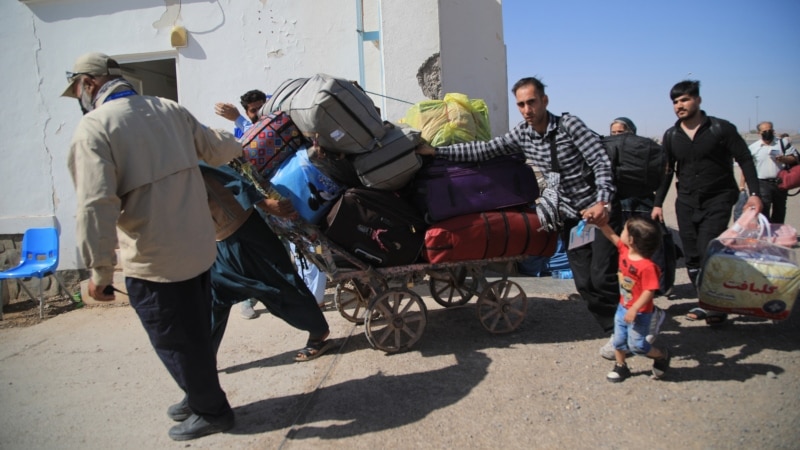
Every morning, Faisal stands along a road on the outskirts of the Iranian capital, Tehran, waiting for a day job.
The 27-year-old migrant from neighboring Afghanistan used to find manual work on most days, earning up to 10 million rials ($7.50), most of which he sent to his wife and five children back home.
But the informal manual work Faisal relied on to eke out a living has dried up since the United States and Israel launched a bombing campaign of Iran on February 28. The 11-week war has devastated Iran’s already-battered economy, left much of the country’s infrastructure and industries in tatters, and seen prices for basic food items skyrocket.
The economic fallout from the conflict has hit the estimated 4 million Afghan refugees and migrants in Iran — many of whom fled war, poverty, and persecution in Afghanistan — especially hard. Many Afghans have no legal status and are deprived of basic rights in the Islamic republic.
“On most days, I don’t find any work. When I do, the pay is half of what I used to get for the same work,” Faisal, who spoke on condition that his full name not be used for security reasons, told RFE/RL.
The war has also created a securitized atmosphere in Iran, deepening Afghans’ fears of arrest or deportation. Iranian authorities have responded to the conflict by deploying security forces in major cities, cutting off the Internet to many Iranians, and arresting critics.
‘Everything Became More Expensive’
Many Afghans in Iran work as day laborers, street vendors, and construction workers.
Among them is Hafizullah Nayebi, who moved to Iran in 2024 with his wife and four children. Living in Iran’s central city of Isfahan, Nayebi said the prices of basic food items have soared since the war began.
“The price of flatbread went from 30,000 rials ($0.02) to 200,000 ($0.15),” Nayebi, a welder from Afghanistan’s northern Faryab Province, told RFE/RL.
“The price of chicken increased by more than four times,” he added. “My salary stayed the same, but everything else, like rice and cooking oil, has become more expensive.”
The conflict has exacerbated the economic crisis in Iran, which was already grappling with rising inflation and unemployment. In March, the cost of food surged by 110 percent compared to the same month in 2025.
‘People Are Scared’
Afghans who spoke to RFE/RL said the authorities were no longer extending visas for migrants, leaving some in limbo.
More than 1 million Afghans have been deported in recent years as part of Tehran’s plan to expel all undocumented migrants. Afghans suffer widespread abuse and discrimination in Iran, where they have often been blamed for insecurity and unemployment.
Faisal said he fears the war could trigger a new crackdown on Afghans. A former member of Afghanistan’s security forces under the Western-backed government, he fled when the Taliban seized power in 2021. He has since lived in Iran without a residency permit.
“I live here, trying to hide from the authorities. I live in constant fear of being caught,” he said.
In January, Faisal said he tried to leave Iran for Turkey but was turned back at the border. Returning to Afghanistan is not an option. He fears retribution by the Taliban, which has been accused of arresting, torturing, and killing former members of the security forces.
Despite the risks to Afghans, Iran has continued to deport them in large numbers. Over 120,000 Afghans were deported from Iran in the first three months of 2026, according to official Iranian government data.
“People are scared,” said Basija Saeedi, an Afghan rights activist based in Iran. “They don’t know if they will be able to stay another day.”


