


By Justine Irish D. Tabile, Senior Reporter
THE PHILIPPINE government should maximize public-private partnerships (PPP) to help narrow the country’s infrastructure gap while easing fiscal pressure from rising debt levels, the Asian Development Bank (ADB) said.
Despite the government’s infrastructure catch-up programs, gaps remain as rapid urbanization and economic growth continue to drive demand, ADB Country Director for the Philippines Andrew Jeffries told BusinessWorld on Wednesday.
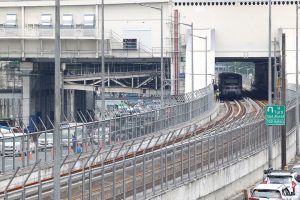
“There is an infrastructure gap in the Philippines… The population of Metro Manila has grown so much over a few decades, so investment in urban transport needs to catch up,” he said.
Mr. Jeffries said both the current administration’s “Build Better More” program and the previous administration’s “Build Build Build” initiative were aimed at addressing years of underinvestment.
“As the Philippines grows, population-wise, gross domestic product (GDP)-wise, transport needs to keep growing as well,” he said.
“And with what’s happening now with diesel fuel prices and all, alternatives for public transport become part of that longer-term solution,” he added.
However, Mr. Jeffries said infrastructure catch-up efforts are facing challenges from fiscal pressures and budget constraints.
“The government is keeping a very close eye on public debt levels, so how to bring the private sector into some of these investments as opposed to just government budget and borrowing, I know, is very important to this government,” he said.
The country’s debt-to-GDP ratio reached 65.2% in the first quarter, the highest level since 2005. This comes as the National Government’s outstanding debt climbed by 1.8% to P18.49 trillion as of end-March from P18.16 trillion at the end of February.
Mr. Jeffries said that bringing in private investment ensures that “public debt levels can be maintained or reduced over time as opposed to that being the only funding source.”
“There is a lot of private infrastructure already in this country. And the key is how to make sure it’s done well so that the government and the people are getting the best value for money,” he added.
According to the PPP Center, the PPP pipeline as of May 19 consists of 250 projects valued at P3.13 trillion. The railway sector accounted for P1.97 trillion of the project pipeline, followed by land transport (P277.26 billion) and property development (P221.46 billion).
TRANSPORT PROJECTS
Meanwhile, Mr. Jeffries said transport projects will continue to account for a significant share of ADB’s financing portfolio in the Philippines in the near term.
The multilateral lender’s portfolio of projects under construction and implementation in the Philippines is valued at $12.5 billion.
“Our transport portfolio exceeds $7 billion, so that’s obviously a nice large percentage of our overall portfolio in the Philippines,” he said.
“That is really because of some extremely large projects we are funding… From a dollar point of view, transport is clearly our largest in our portfolio here in the Philippines,” he added.
These projects include the North-South Commuter Railway, Bataan-Cavite Interlink Bridge, Laguna Lakeshore Road Network Project, and Davao Public Transport Modernization Project.
Asked if ADB is considering additional transport projects, Mr. Jeffries said that “because they (the projects) are so large and it takes considerable time, we’re funding those in time-sliced tranches.”
“So, we have a robust pipeline going forward, just seeing those projects through to completion… We are focusing a lot on implementing what we already have,” he added.
Mr. Jeffries said the government is exploring ways to attract more private investment into the transport sector amid fiscal pressures stemming from the Middle East crisis.
“With the fiscal issues with this Middle East crisis and so on, the government is also looking actually at how to bring more private sector investment into this sector,” he said.
“So, we don’t have new big projects specifically in our pipeline at this time,” he added.
Mr. Jeffries said transport projects are likely to remain a major part of ADB’s Philippine portfolio over the next few years as the government prioritizes completing existing projects.
“I think that proportion will stay more or less the same for the next few years, especially now that the government is very worried about the trade-offs and the fiscal and the public debt levels,” he said.
“They want to focus on implementation and reaching completion of what is already ongoing because until they are done and in operation, they are not benefiting the people,” he added.
FINANCING GAP
The infrastructure and investment gap is not unique to the Philippines. In its Asian Transport 2035 Outlook, the Asian Transport Observatory (ATO) said annual investment demand for transport infrastructure in Asia and the Pacific is expected to more than triple over the next decade.
“Annual investment needs across all transport modes will climb from roughly $800 billion per year during 2000-2025 to approximately $2.6 trillion per year between 2025 and 2035,” the ATO said.
“That is equivalent to 2.3% of LMIC (lower- and middle-income countries’) GDP per year,” it added, referring to those in Asia and the Pacific.
However, the ATO said the projection remains conservative as it only reflects current trends and existing project pipelines.
“Actual needs, accounting for the full cost of the energy transition, the climate adaptation backlog, and the SDG (Sustainable Development Goals) access deficit, are likely to be considerably higher,” it added.
Despite this, the ATO said the region still faces a large financing gap.
“Development banks can do things commercial investors cannot — blend concessional and market-rate lending, absorb early project risk, and attach technical assistance to pipelines that would otherwise stall at the feasibility stage,” it said.
“But there is a limit to what external finance can do. The long-run answer to Asia’s transport financing gap is stronger revenue systems and public finance reform. We are not just facing an infrastructure gap, but also an investment and governance gap,” it added.

