


A scene from “Ghosts and Guests” (1989), a long-forgotten work by Swiss filmmaker Isa Hesse-Rabinovitch. The festival screened two of her films restored by the Cinemathèque Suisse to great acclaim.
Cinémathèque Suisse
The 79th edition of the Locarno Film Festival combined coming-of-age tales with radical film poetics as record industry attendance pointed to a new wave of rising private investment in independent cinema.

Young audiences are returningExternal link to movie theatres, raising industry’s hopes that the massive impact of streaming services, video games and social media can be offset by a renewed appetite for shared cultural experiences.
Coincidence or not, a remarkable number of films at this year’s festival – many of which by debutante filmmakers – explore adolescence, coming-of-age experiences, and the social and political realities facing younger generations. Fittingly, Locarno’s top prize went to one of them.
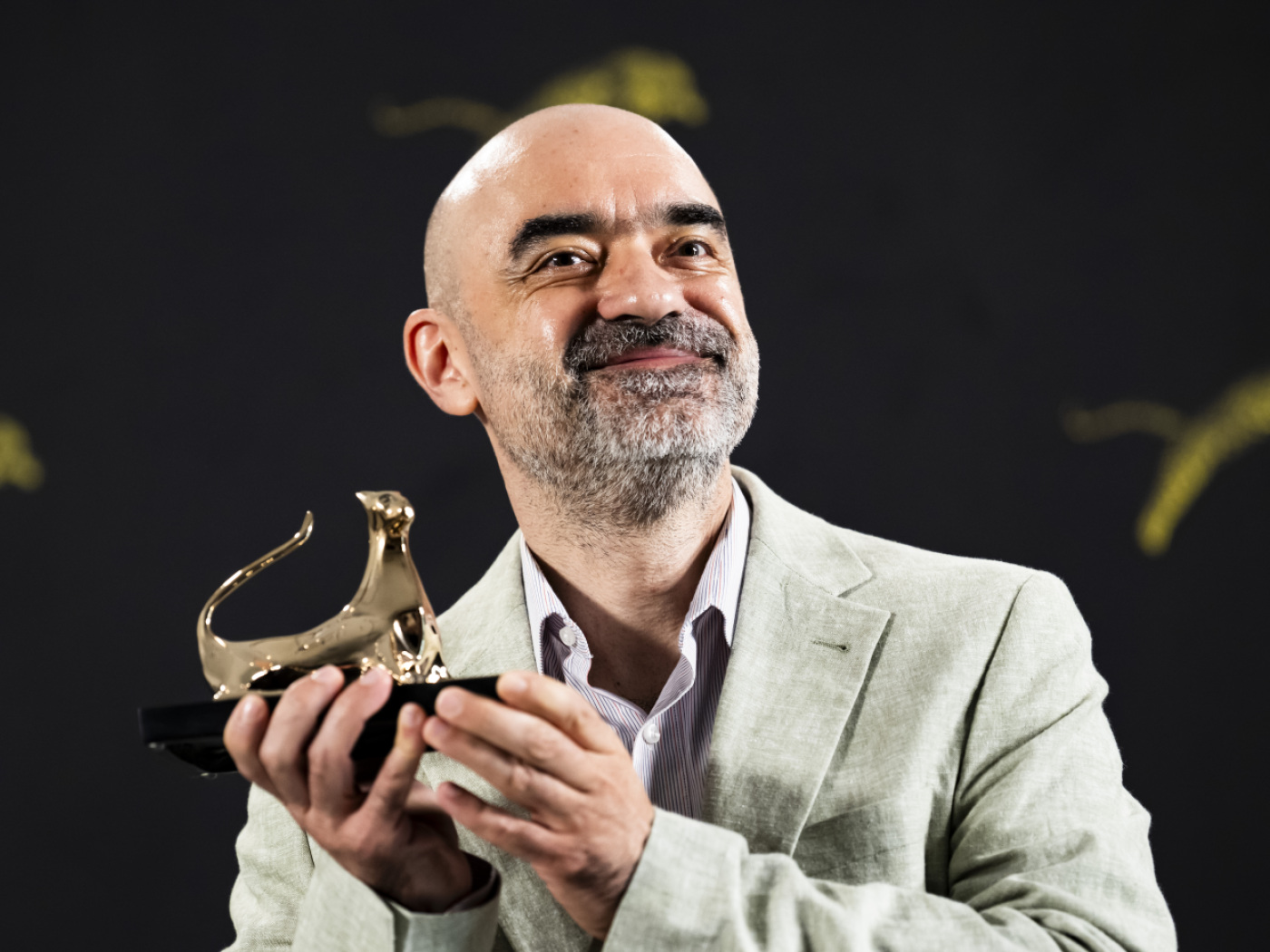
Florin Șerban’s Romanian drama You Don’t Belong Here follows a widowed father unaware of the night-time activities of his teenage son who has joined a group of masked vigilantes.

The Romanian film “You Don’t Belong Here” took this year’s Golden Leopard.
Fantascope Films
The trend is seemingly global: from Argentina (The days Off, The Illusion of an Everlasting Summer) to Canada (Manhunt) and the United States (Destroy All Girls), to Ghana (Ego Reach We All) and Central African Republic (Congo Boy), as well as several European productions (the Swiss Portuguese Crocodile; the Italian Ketticè). From Ukraine, I Rarely Wake Up Dreaming adds gender themes to this mix, set against the backdrop of war.
Roughly half of the 32 films in Locarno’s two main competitions touch on youth, identity or coming of age. The subjects vary widely, but the pattern suggests a generation keen to see its experiences reflected on screen.
More
More
Florin Serban’s ‘You Don’t Belong Here’ wins Golden Leopard at Locarno
New ventures in town
The film industry appears to be paying attention. Media outlets tracking acquisitions and sales during the festival said attendance at Locarno Pro, the festival’s marketplace for producers, distributors and financiers, rose 10% from 2025 to a record of 2,140 accreditations – already building on what had been considered an all-time high the year before.
A closer look, however, revealed a new guest: venture capital. According to VarietyExternal link, private investors are discovering the value of the independent movie business despite its risks and unpredictable returns. “Shrinking broadcaster funding, international distributor investment and now state aid” are opening opportunities for private investors and forcing “the whole system to adapt to new players that will change the rules”, it wrote.
How that will reshape the sector remains unclear, especially for independent productions that don’t follow mainstream industry conventions. Rather than backing individual projects, investors are increasingly targeting the entire portfolios of well-established companies that include production, distribution and sales, such as Paris-based mk2, the online platform Mubi, or Red Bull Studios, the film arm of the energy drink conglomerate.
Lineup breakdown
Every year, critics debate the quality of Locarno’s official selection. While the section devoted to film classics, rarities, and critics’ choices is usually undisputed, the two main competitions – the Concorso Internazionale (international competition) and Cineasti del Presente, for authors’ first or second features – attract more debate.
Artistic director Giona A. Nazzaro assembled an eclectic main competition featuring both emerging filmmakers and established auteurs, such as Hong Sangsoo (South Korea), Nelson Yeo (Singapore), Gurvinder Singh (India) and Denis Côté (Canada). One of his boldest choices was to place Brazilian first-time directors Enock Carvalho and Matheus Farias (The Riverbank) in the main competition rather than Cineasti del Presente.
More

More
Brazil in Locarno: ‘The Riverbank’ sets Recife’s mangroves against the gospel of power
Nazzaro’s bet paid off: The Riverbank took the Special Jury Prize, reinforcing Locarno’s reputation as a platform for revealing new talent in Brazilian cinema, from Glauber Rocha to Kleber Mendonça Filho.
Cineasti del Presente pushed even further towards unconventional forms of storytelling. The Argentinian Alessandra Sanguinetti, worldwide renowned as a photographer, presented The Illusion of an Everlasting Summer, a documentary drawn from a more than 20-year photography project about two cousins as they grow up in the countryside of Buenos Aires.

“The Illusion of an Everlasting Summer” took the Golden Leopard in the Cineasti del Presente section. The film was an instant hit among critics and public and, contrary to the main competition, its award was no surprise at all.
Alessandra Sanguinetti
The Brazilian Ana Vaz, who moves fluidly between fine arts and experimental film, presented Hanabi, also a project of over ten years in the making, about the Fukushima nuclear fallout (and planetary disaster).
A hybrid work blending cinema, literature and visual art, Hanabi can be easily categorized as ‘experimental’ – a label its creator Ana Vaz would firmly contest. “I don’t accept this inability of cinema to become anything other than what is defined by certain cinematic canons within the tradition of documentary cinema, essay cinema or fiction cinema,” she told Swissinfo.

Brazilian filmmaker Ana Vaz at Locarno’s award ceremony.
Locarno Film Festival / Ti-Press
Film poetics, real cinema
While Ana Vaz welcomes Nazzaro’s decision not to separate mainstream narratives from alternative, or so-called experimental, ones, she believes this puts such films at an unfair competitive disadvantage, as their chances to win prizes are considerably lower. Despite this Hanabi won a Special Mention prize.
For spectators, Sanguinetti’s and Vaz’s inclusion in the festival programme reinforced Locarno’s standing as a cinephile paradise. This year’s edition was especially rich with outstanding poetic works (due to the lack of a better word than ‘experimental’), starting with the homage to Swiss artist, graphic designer, photographer and filmmaker Isa Hesse-Rabinovitch (1917-2003), with the screening of two recently restored films, Siren Island (1981) and Ghosts and Guests (1989).

Isa Hesse-Rabinovitch (right) with singer and composer Véronique Müller, who wrote a song for the film ‘Siren Island’, whose poster hangs on the wall; January 1982.
KEYSTONE/Str
Hesse-Rabinovitch was recognised during her lifetime as a pioneer of feminist filmmaking rather than being defined by her connection to literary giant Hermann Hesse (he was her father-in-law), a fate that befell many women artists of her generation. The screenings offered only a glimpse of a wider body of work currently being restored by the Cinémathèque Suisse which hopefully will reach audiences soon.
Asphalt Guerrilla (Guerrilha no Asfalto), by the Portuguese director Edgar Pêra, also belongs on this poetic list, included in the “Out of Competition” section. Pêra’s poetics deliver a genuine punk punch, a multilayered mockumentary purposedly blurring the lines between (auto)fiction, documentary, and film essay.
Framed as a restoration of an old project focused on Portuguese urban guerrillas in the aftermath of the Carnation Revolution (1974) that brought down 50 years of a fascist regime, Pêra confounds the register of political guerrilla with guerrilla filmmaking, evolving into a reflection on the development of film-making in the last 50 years up to a critical, scary use of artificial intelligence.

Don’t take this picture seriously, this is not the real director: scene of Edgar Pêra’s mockumentary “Asphalt Guerrilla”, which in fact made cinema great again.
Edgar Pêra
Made in Switzerland
Basil da Cunha’s O Jacaré (Crocodile), the final chapter of his “Reboleira Trilogy”, is the Swiss film representative in the main competition. Da Cunha’s art and life blend closely in the trilogy, that started with O Fim do Mundo (The End of the World, 2019), followed by Manga d’Terra (2023).
Son of Portuguese immigrants in Switzerland, da Cunha studied film before moving to Portugal. Arriving there penniless, he ended up in the Reboleira district, a shanty town north of Lisbon, mostly inhabited by Cape-Verdean immigrants and their offspring. He soon began making films with residents, drawing on the experiences of friends and neighbours.
Over almost 20 years, a genuine community of collaborators has gathered around da Cunha, even though the Reboleira of the first films doesn’t exist anymore, swallowed by urban expansion and real estate speculation beyond the Portuguese capital, with the inevitable evictions and dispersion.

Family man: Basil da Cunha in Locarno.
Locarno Film Festival / Ti-Press
In Cineasti del Presente, Mateo Ybarra’s Small Talk is a story set in Switzerland’s last finishing school and will certainly attract a wide audience fascinated by the universe of luxury and its codes.
None of them won a prize this year – in fact, the last Swiss film to take a major prize in Locarno was Milagros Mumenthaler’s Abrir puertas y ventanas (2011); before her, you have to go back to 1985, with Fredi Murer’s Alpine Fire.
But it was a Swiss film, Petra Volpe’s first English-speaking movie Frank & Louis, that won this year’s Prix du Public, the prize awarded to the most popular film shown in Locarno’s open-air Piazza Grande screen, voted by the audience. A perfect example of direct democracy in action.

A scene from “Frank & Louis”, the public’s choice.
2026 Zodiac Pictures Ltd / Frank &Amp; Louis Laundry Services Ltd
Edited by Mark Livingston/sb


