


Around five million people – or 47 per cent of the population – are currently experiencing crisis or worse levels of acute food insecurity (Phase 3 and above).
Meanwhile a further 1.4 million people are trapped in the “emergency” phase, with the number expected to grow as the year progresses.
“Families are being pushed beyond their coping capacity by the combined effects of economic collapse, climate shocks, disrupted livelihoods and declining humanitarian support,” the Food and Agriculture Organization (FAO), the World Food Programme (WFP) and the UN Children’s Fund (UNICEF) said in a joint statement.
Hunger set to deepen
The lean season from June to September is expected to push the number facing emergency conditions to 1.5 million.
Looking further ahead, the post-harvest period from October to December 2026 is unlikely to bring meaningful recovery with number of people in Emergency conditions (IPC Phase 4) expected to further increase to 1.8 million.
Food insecurity remains a major driver of Yemen’s high malnutrition burden following well over a decade of war between Houthi rebels and the internationally recognized Government.
Reduced dietary diversity, poor household food consumption, limited access to essential preventive nutrition services, and worsening living conditions are increasing the risk of acute malnutrition, particularly among pregnant and breastfeeding women and young children.
Economic decline and aid cuts
Irregular salaries, high food and fuel prices, reduced income opportunities and constraints on agricultural production are limiting families’ ability to meet even basic food needs.
Around 60 per cent of Yemeni households depend at least partly on farming, yet harvests face mounting pressure from extreme weather, pest outbreaks and disrupted supply chains.
At the same time, humanitarian food assistance and humanitarian interventions in the areas of nutrition, health, and water, sanitation, and hygiene (WASH) are expected to decline sharply because of critical funding shortfalls, removing support at the moment it is needed most.
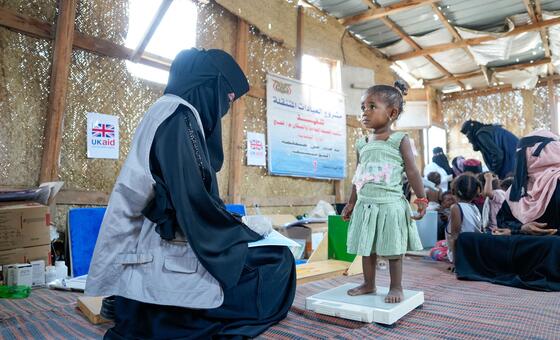
A young child is tested for malnutrition at a clinic in Yemen.
Mobile teams reach underserved areas
Against this backdrop, the WHO, in coordination with its local partners in Aden and Marib, is bringing healthcare directly to people in displacement camps to respond to increasing malaria risks.
In Al-Shaab camp in Aden, where many displaced families live in difficult conditions, health challenges are part of daily life.
Overcrowding, poor environmental conditions and limited access to services increase the risks of malaria and other vector-borne diseases, especially for women and children.
For 21-year-old Abeer Abdulwarith Mohammed Saeed, the challenges are all too familiar. “Sometimes, at night, a child suddenly gets a fever, diarrhoea or vomiting, and there are no emergency services available for us,” she said.
“If I, my husband or my children get sick, we cannot get treatment because of our limited means,” she added.
‘We are healthy’
The teams are implementing a strategy, through mobile clinics that move across camps, to detect and diagnose cases early, especially in areas that are far from health services.
For Ms. Saeed and her family, the mobile team’s visit brought reassurance.
“The medical team helped us today with malaria and dengue tests for me and my children,” she said. “We waited for the results and thank God, there was no malaria. We are healthy.”
Urgent funding needed
The core UN aid agencies involved are calling on the international community to urgently scale up funding for humanitarian food assistance, nutrition services, health, agriculture and resilience programming.
Without immediate, sustained and scaled-up action, millions of vulnerable people risk falling deeper into hunger, malnutrition and irreversible livelihood loss.

