


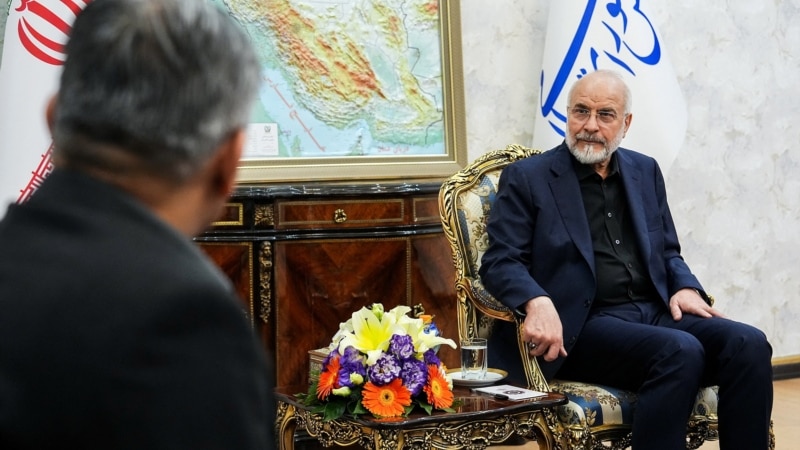
Iran has appointed influential parliament speaker Mohammad Baqer Qalibaf as its special representative for China affairs, a move analysts say carries a message that extends well beyond bilateral ties, and may be as much about Washington as it is about Beijing.
There has been no formal government announcement. The appointment was first reported by Tasnim and Fars news agencies — both affiliated with the Islamic Revolutionary Guards Corps (IRGC) — citing informed sources. Both outlets said Qalibaf, a former IRGC commander, was appointed at the proposal of President Masud Pezeshkian and with the approval of Supreme Leader Mojtaba Khamenei.
Tasnim’s sources said the role differs from those held by Qalibaf’s predecessors “in terms of the level of authority,” without elaborating.
Previous holders operated under separate mandates: the late Ali Larijani, killed in an Israeli strike in March, served as the supreme leader’s representative for China affairs, while Abdolreza Rahmani Fazli acted as the president’s representative. Qalibaf’s appointment effectively merges those two tracks into a single, more powerful brief.
As Tasnim puts it, Qalibaf is “Iran’s special representative,” not the president’s or the supreme leader’s.
Amir Chahaki, a Germany-based Iranian political analyst, told RFE/RL’s Radio Farda that the appointment should be read primarily through the lens of the stalled US-Iran negotiation track.
“In my view, this will strengthen Qalibaf’s position in negotiations with America,” Chahaki said, adding that the intent appeared to be giving the parliament speaker “a more prominent role in any potential negotiation with the United States.”
He also underscored China’s growing importance to Tehran as a diplomatic backstop, saying Beijing had “now even surpassed Russia” as a strategically vital mediator for Iran.
For analysts close to the Iranian establishment, the appointment is a deliberate strategic signal.
Ehsan Khanduzi, a conservative former economy minister, described it on X as “a new card in the complex arena of Iran-America confrontation,” arguing that Iran now needed to rapidly design a “strategic partnership package” with Beijing and build an agile, fully empowered body to deliver it.
Mostafa Najafi, a Tehran-based analyst whose views reflect establishment thinking, pointed to a record of underperformance in the China file.
“Over the past years, various individuals and institutions were tasked with advancing Iran-China relations as a strategic file,” he wrote on X. “However, each of the previous representatives failed to bring this file to a satisfactory conclusion.”
He argued Qalibaf’s executive background and familiarity with large-scale infrastructure and economic projects made him better suited to engage Beijing, noting that China “typically works more comfortably” with people who have “the capacity to execute projects and make operational decisions.”
Iran signed a 25-year comprehensive cooperation agreement with China in 2021, but implementation has been halting, with few of the deal’s promised investments materializing.
The appointment comes as Iran navigates a fragile cease-fire with the United States following 40 days of fighting, with peace talks stalled and Pakistan continuing to mediate.
Qalibaf led Iran’s delegation in the single round of direct talks with Washington held in Islamabad in April. His elevation to the China brief suggests Tehran is consolidating its most trusted operator across both its eastern partnerships and its western confrontation simultaneously.


