

Extremely hot weather and lack of rain means that most Swiss regions are suffering from drought right now, with no relief in sight in the near future. Will this situation affect your own water supply?
In a dispatch dated July 9th, MeteoNews weather service wrote that the current drought is manifesting itself “in the levels and flows of major lakes and rivers, which are sometimes reaching historically low levels for this time of year, as well as in the historically low filling rates of reservoirs across Switzerland.”
As the red areas on the map below indicate, pretty much most of the country is at Level 4 “High Danger” of drought.
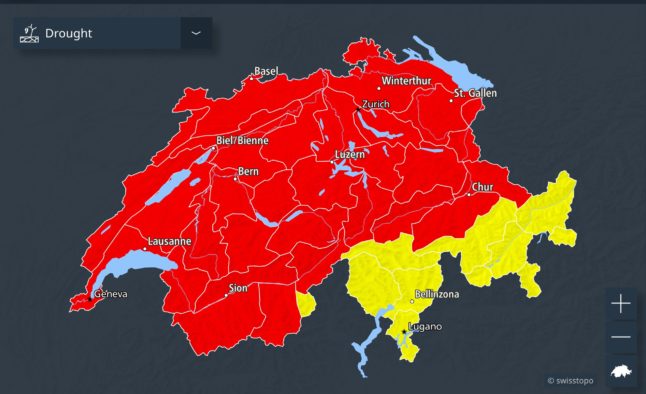
Image: Swiss government’s Natural Hazards Portal. https://www.natural-hazards.ch/#hazards-tab=drought
According to Swiss authorities this “high danger” means: “A significant increase in drought conditions is expected. Local or regional restrictions on water use are likely, e.g. shutting off fountains, hosepipe ban for watering gardens or washing cars. The risk of forest fires may be seriously elevated.”
READ MORE: How bad is the drought situation in Switzerland right now?
If heatwaves continue, how will Switzerland’s water supplies be affected?
According to the government, “Switzerland will remain rich in water, but climate change is reshuffling the cards.”
Consequently, water will become scarcer in summer, “precisely when the population, agriculture, and nature need it most.”
Researchers predict more frequent local shortages and an increase in conflicts of use between drinking water supply, agriculture, and energy production.
Therefore, the general advice is to use water consciously and sparingly.
This dire scenario is, however, still in the future, though possibly the near one.
Looking at the situation right now, will you have enough water for your personal use this summer?
In Switzerland, drinking water comes from three different sources. Approximately 40 percent comes from groundwater, another 40 percent from springs, and 20 percent from lakes and rivers.
In general, the country has enough drinking water supplies, though prolonged heatwaves – as is currently the case – are depleting reserves.
But the good news is that tap water – the one you use for drinking, cooking, and showering – is at the present time sufficient to meet daily needs of Switzerland’s households.
What if the drought continues in coming days or even weeks?
According to a federal ordinance, four litres of drinkable water per person per day is the minimum guaranteed to Swiss households from the fourth day of a Level 4 shortage.
“The calculation of the total quantities of drinking water to be made available is based on current data relating to the number of inhabitants, farms and businesses producing vital goods in the supply area,” the law states.
This would, of course, be bottled water rather than from a tap.
This means that while you may not be able to shower, wash your clothes or dishes, or even flush the toilet, you will at least have enough potable water.
The bottle ordinance, however, is the minimum mandated on the federal level.
The law states that “the cantons can prescribe the provision of additional quantities of drinking water.”
Should you keep a stock of bottled water, just in case?
This is an excellent idea and the government urges you to do so.
In fact, on its list of essential reserves to be kept by everyone in Switzerland for emergencies, the Federal Office for National Economic Supply (FONES) includes 9 litres of water per person per week.
Though water itself does not go bad if it remains unopened, the plastic bottle does, so it is best to drink it within one to two years.
As you consume your stockpiled water, replace it immediately with new bottles.
READ MORE: What residents in Switzerland need to stockpile in case of crisis

