


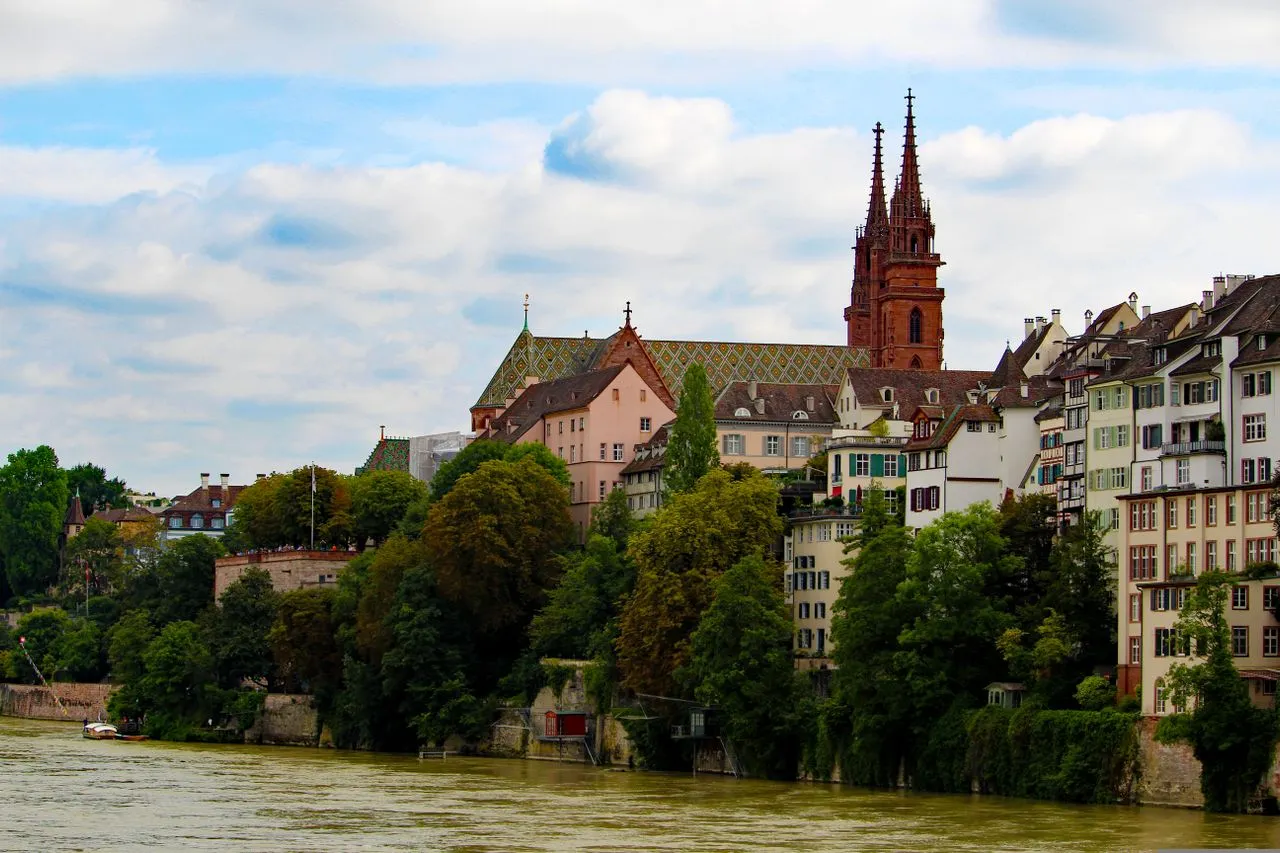
Though all of Swiss regions have sweltered under the extremely hot weather for nearly three weeks this month, Basel bore the brunt of the heatwave.
The record for the hottest-ever June day was measured at the Basel/Binningen station at 1:30 pm on June 27th, breaking the previous June heat record of 38.8C, set at the same station a day earlier.
READ MORE: Switzerland breaks June heat record for third day at 39C
Normally, the more south a city or a region lies, the hotter it gets.
Basel, however, is located in the north of Switzerland, so it should be cooler than cities in the southern canton of Ticino, but the highest temperature there was ‘only’ 35C.
Why is the Basel area the hottest in Switzerland?
Chalk it down to location, location, location – in the worst sense of the word.
Concretely, Basel is situated at about 270 metres lower than the Plateau.
According to meteorologist Olivier Duding from MeteoSwiss, this means that the region lies in “a sort of basin where hot air stagnates when there is little wind.”
Basel’s proximity to France plays a role as well.
The Rhine corridor exposes the city and canton to hot air from Alsace and Burgundy, said another meteorologist, Vincent Devantay from MeteoNews.
“Air from these regions, also exposed to temperatures approaching 40C, rushes into this corridor to reach Basel,” he pointed out. “It then stagnates in this famous ‘basin’ and accumulates there for days.”
Unfortunately, the situation will not improve in the future.
To the contrary, “Climate analyses conducted by the canton for the year 2030 indicate that heatwaves and prolonged periods of drought will become more frequent, particularly in the city of Basel,” the canton’s website says.
Are Basel authorities doing anything to counteract the heat?
The answer is yes.
Basel-City does have a strategy to this effect in place.
It includes preventive measures for climate protection and what is known as ‘adaptation’ – that is, adjusting to the inevitable consequences of climate change, particularly through measures to reduce heat.
They include, for instance, publicly accessible spaces that offer protection from summer heat vulnerable people – some of which were already inaugurated in the summer of 2025.
Looking ahead, the goal is “to create a map of available emergency cooling spaces in Basel-City… This will involve providing cool spaces in locations such as neighbourhood centres, libraries, museums, theatres, and other public facilities.”
Similar programmes, by the way, also exist in other large Swiss cities, such as Geneva, Bern, and Lucerne.
And then there are earthquakes
When it comes to weather and other natural phenomena – specifically, earthquakes – Basel just can’t catch a break.
The region is among the three in Switzerland – along with Valais and Graubünden – that are most earthquake-prone.
Why is this?
“The city of Basel is located at the southern end of the Upper Rhine Valley. The strong quakes that happen near Basel are mainly due to the geological structure of that valley,” the Swiss Seismological Service explains on its website.
“As a result, the area around Basel is the second highest seismic hazard zone in Switzerland after Valais.”
READ MORE: Which parts of Switzerland have the greatest earthquake risk?


