


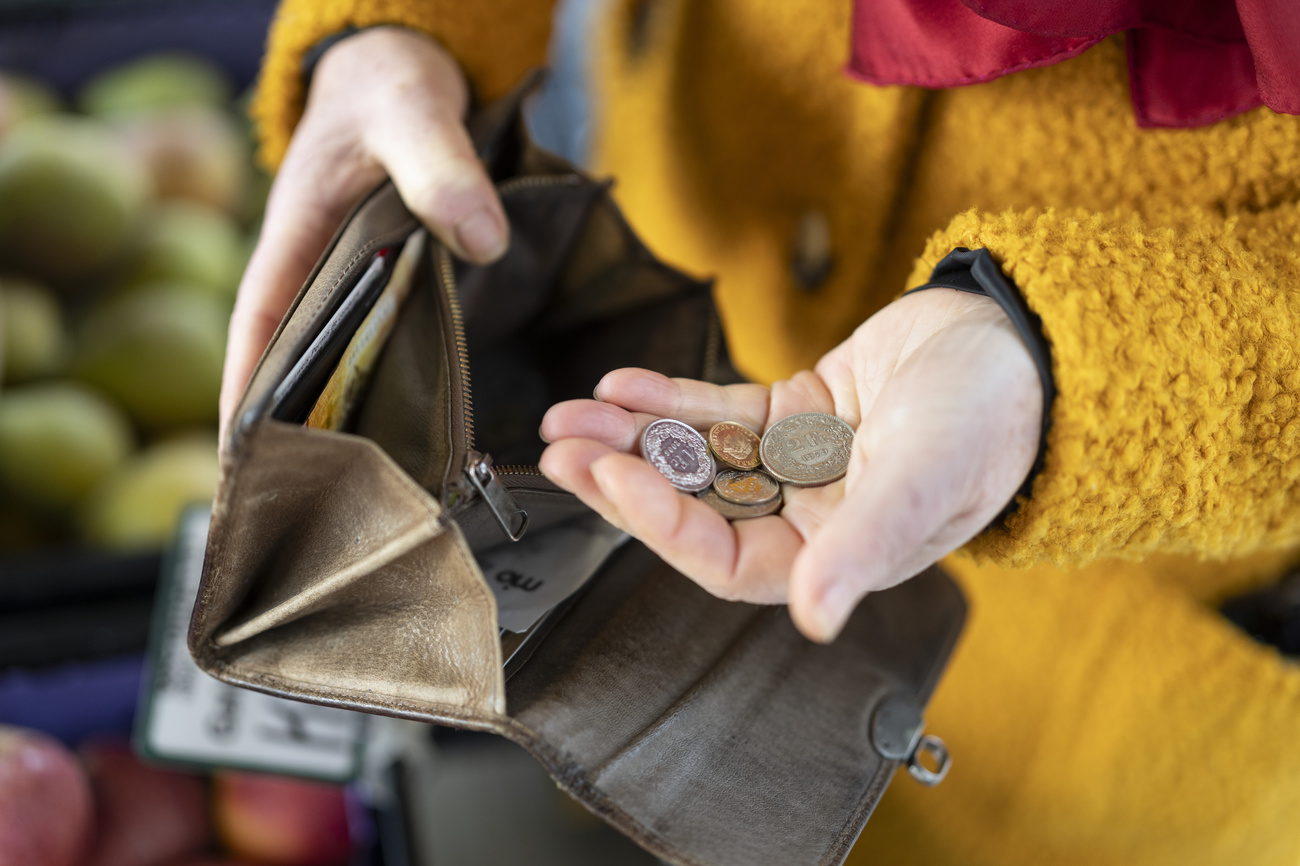
Taking out your small change to pay has become a little less common in Switzerland.
Keystone / Gaetan Bally
Electronic money has overtaken cash for everyday purchases in Switzerland. Nevertheless, the Swiss remain attached to coins and notes, in a way that may come as a surprise, even abroad.
For several years, digital money has been increasingly used instead of cash. This phenomenon became even more pronounced during the Covid pandemic, when digital payments were preferred to the exchange of notes and coins for obvious health reasons.
In Switzerland, several factors had been contributing for some time to cash losing ground to digital methods. The growing success of Twint, a payment app developed by Swiss financial institutions, is a good illustration of this trend.
Last year, Twint recorded a record 773 million transactions, 31% more than the previous year. The growth has been meteoric. When it was launched in 2017, Twint recorded “just” four million transactions.

Only cash or Twint is accepted at this football match in Bern.
Keystone / Peter Klaunzer
Cash dethroned
Until now, various studies have shown that cash is still favoured by the Swiss.
For example, the sixth Swiss Payment MonitorExternal link, conducted by the Zurich University of Applied Sciences (ZHAW) and the University of St Gallen, showed that in 2023 cash was still leading the way against its digital competitor – although its share had fallen sharply since 2019, the date of the first survey.
But the inevitable has happened. For the first time, digital money has overtaken its physical competitor, at least for everyday purchases.
A 2024 report by the Swiss National Bank (SNB) on payment methods of private individuals in SwitzerlandExternal link shows that, for the first time, digital money has overtaken cash for all payments made “on the spot”: in shops, over the counter or at ATMs.
Debit cards are the instrument most frequently used for everyday purchases, according to the survey, which was carried out last autumn among 2,000 people living in Switzerland. Payment apps on mobile phones are used for almost one in five transactions.
These physical vouchers, which have existed for 60 years, will be replaced by digital gift cards. However, vouchers already in circulation will remain valid indefinitely.
Reka vouchers can be obtained at a preferential price from 4,500 companies. They can be used to pay for holidays, leisure activities and public transport at some 6,000 points of acceptance.
The move towards digital technology has been fatal for Reka vouchers. In a press release, the Reka foundation announced that it would stop issuing them at the end of 2025.
“With the definitive digitalisation of Reka money and its products, Reka intends to consolidate its pioneering status as the most popular ancillary income service in Switzerland,” said its director, Roland Ludwig.
Political issue
Could this decline in the use of cash continue until it disappears altogether? This hypothesis is not far-fetched: in Europe the phenomenon is already widespread in the Nordic countries, to the point where it is sometimes difficult to pay with cash in Sweden.
Is such a scenario possible in Switzerland? The SNB doubts it. In a report External linkentitled “Will cash at some point become obsolete?”, it points out: “It can seem that it’s no longer necessary to have banknotes and coins in our wallets. But take another look – the reality is more complex.”
In Sweden the rapid disappearance of cash has prompted the authorities to take action. Since January 1, 2020, a law has stipulated that it must be possible to withdraw cash within a 25km radius of your home. The law was accepted almost unanimously, as members of parliament felt that all-digital technology could discriminate against certain groups of people, such as those who don’t have access to a bank account or a mobile phone because they are very poor.
In Switzerland, where direct democracy is the rule, this kind of decision could come from the people themselves. The Mouvement Liberté Suisse (MLS) has submitted a popular initiativeExternal link entitled “yes to a free and independent Swiss currency in coin or banknote form (cash is freedom)”.
The initiative, which comes from circles hostile to anti-Covid measures, calls for a guarantee that cash will continue to exist in Switzerland and for any replacement of the franc by another currency to be subject to the approval of the people and the cantons.
More

More
The CHF1,000 dance of death and other unforgettable Swiss banknotes
No cash limit
But this initiative is probably superfluous, because the Swiss don’t seem to want cash to disappear. In fact, the latest SNB survey on payment methods shows that 95% of those questioned want cash to remain available as a means of payment.
The Swiss attachment to cash is also reflected in the country’s highly flexible cash legislation – so flexible, in fact, that it might come as a surprise in other, much stricter countries.
Most European countries already limit cash transactionsExternal link: to €1,000 (CHF930) in France and Italy, for example, or €500 in Greece. Only a handful of countries, such as Austria, Cyprus and Luxembourg, have no limits at all. But that’s about to change: the European Parliament has agreed to a €10,000 ceiling, due to come into force in 2027. The idea is to combat money laundering and the financing of terrorism.
In Switzerland, on the other hand, there is no limit. The only requirement is proof of identity for all cash payments over CHF100,000.
More
More
Switzerland tightens its money-laundering rules
There are no limits on transport either. There is only one – small – constraint when crossing the border. You have to provide your identity and the origin and destination of funds over CHF10,000. But only if customs ask you to.
Edited by Samuel Jaberg. Adapted from French by Thomas Stephens


