


Security personnel standing in front of the national flags at the 48th ASEAN Summit in Lapu-Lapu City, Philippines, in early May.
Keystone-SDA
The Association of Southeast Asian Nations, better known as ASEAN, is making headway in its aim to become a major player in a multipolar world. Switzerland, too, has been seeking closer ties. What lies behind the sudden interest?
What is ASEAN’s role in the rivalry between China, the US and Europe?
European countries have been looking more closely at the 11-member Association of Southeast Asian Nations (ASEAN). That’s according to Cristina de Esperanza Picardo, a research assistant for the Indo-Pacific region at Real Instituto Elcano, a think tank based in Madrid. “Global crises and mounting instability are pushing countries to look beyond their traditional economic partners, and Southeast Asia is emerging as an important region for diversification,” she says.
This shift is part of Europe’s broader push to engage with the Indo-Pacific region across several areas, including security. “Due to its strategic location and overlapping territorial claims by several ASEAN states and China in the South China Sea, Southeast Asia is one of the region’s key areas of tension,” says Picardo.
The Association of Southeast Asian Nations, or ASEAN, is an economic and geopolitical bloc in Southeast Asia. Its main goal is to promote economic growth, social progress and stability across the region.
Today, the association has 11 member states: Brunei, Indonesia, Cambodia, Laos, Malaysia, Myanmar, the Philippines, Singapore, Thailand, Vietnam and Timor-Leste. The countries are home to more than 680 million people. With around $4 trillion (CHF3.15 trillion) in annual economic output, it is the world’s fifth-largest economic region.
“Southeast Asia is considered relatively stable compared with West and South Asia,” says Dinna Prapto Raharja, associate professor of international relations at Bina Nusantara University in Indonesia. Even the long-standing tensions between Thailand and Cambodia, for example, have generally been contained because neither side wants to destabilise the region. At an informal level, ASEAN representatives are in regular contact, coordinating efforts to maintain regional stability.
Recently, the war in Iran has caused a shock to energy markets, putting pressure on several Southeast Asian economies. The strain is greatest on countries with open economies and heavy reliance on imports.
RaharjaExternal link says the strategic framework ASEAN Vision 2045 gives the bloc a roadmap for deepening cooperation both within the region and with Europe. The plan could also help guide Switzerland’s approach.

A small boat sailing through the Strait of Malacca off the coast of Malaysia, close to the liquefied natural gas (LNG) tanker ETYFA-Prometheas.
Keystone-SDA
What does a fraying international order mean for Southeast Asia?
Southeast Asia’s future. “ASEAN remains an organisation with deliberately flexible structures designed to protect the sovereignty of its member states. National interests are at the forefront, while the institution itself has only limited autonomy,” she says.
That flexibility comes at a cost. Combined with the bloc’s deep internal diversity, it slows down decision-making and limits ASEAN’s ability to act, Picardo says.
ASEAN is carving out a role at the centre of a global shift to diversify supply chains and is pursuing what is known as “strategic multi-alignment”. It benefits from the “China+1” strategy used by Western companies, which add a second production, sourcing or manufacturing location to reduce risk, all without taking a clear side geopolitically. In 2024, trade with China rose by around 15%, while trade with the US increased by around 12%. Trade with the EU remained stable. ASEAN is the EU’s third-largest trading partner outside Europe.
The Swiss-Asian Chamber of Commerce says that US-China tensions, tariffs, and tighter rules against so-called “trans-shipment” are becoming increasingly important for ASEAN. One example is a 40% US tariff on suspected Chinese rerouting via Vietnam or Malaysia. Such measures strengthen Southeast Asia’s role as an alternative location for production and exports.
Still, Southeast Asia remains closely tied to Chinese supply chains, especially in electronics and critical minerals.
ASEAN is using this moment to drive growth, deepen integration within the region and build new partnerships. Recent GDP growth of 4% to 6% has far outpaced growth in the EU and the US.

Containers at a transhipment terminal in Prague on April 14, 2025, a few days after US President Donald Trump had sparked a global trade war.
Keystone-SDA
How is Switzerland engaging with ASEAN countries?
The EU has been a strategic partner of ASEAN since 2020. Switzerland, which is not part of the EU, has had a more limited role since 2016 as a sectoral dialogue partner, cooperating with ASEAN in selected areas.
“When I was Indonesia’s representative to the ASEAN Intergovernmental Commission on Human Rights from 2016 to 2018, I greatly appreciated Swiss cooperation, particularly in the initiative to combat human trafficking in the region,” says Raharja.
Trade between Switzerland and ASEAN reached around $28.3 billion (CHF22.3 billion) in 2024. Switzerland is actively strengthening ties, including through new EFTA free trade agreements with Malaysia and Thailand, both signed in 2025, and through ongoing negotiations with Vietnam.
“Switzerland still has a relatively low profile in ASEAN,” Raharja says. One reason may be insufficient communication with state and non-state actors in the region.

Containers at the Swissterminal transhipment centre in the Port of Switzerland near Basel.
Keystone / Christian Beutler
Is Southeast Asia becoming a major economic partner for Switzerland?
“Southeast Asia is a dynamic, fast-growing region, both socially and economically. There is real potential for deeper cooperation between Switzerland and Southeast Asian countries,” Raharja says.
Countries in the region have signalled they are open to discussing how Swiss companies could build stronger links with Southeast Asia’s skills base and workforce.
“For Switzerland, which is a small, neutral, export-driven state, ASEAN offers a way to avoid becoming too dependent on China – especially in sectors such as pharmaceuticals, precision engineering, machinery and watches,” writes the Swiss-Asian Chamber of CommerceExternal link.
Which ASEAN countries matter most to Switzerland?
According to data from the Swiss-Asian Chamber of Commerce, Switzerland’s economic ties in ASEAN are concentrated in five countries. Singapore is the region’s main trade and financial hub, with annual Swiss exports of around $7.2 billion (CHF5.7 billion). Thailand is its second-largest trading partner in Southeast Asia, with exports of around $6.2 billion and substantial Swiss investment. Vietnam, where bilateral trade reached $3.11 billion in 2024, hosts more than 100 Swiss companies amid rapid manufacturing growth. Malaysia, which has attracted around $7.7 billion in Swiss direct investment, has recently concluded a free trade agreement. Indonesia, the region’s largest economy, also hosts more than 100 Swiss companies and offers strong potential in renewable energy and infrastructure.
These five countries make up most of Switzerland’s trade with ASEAN. Singapore and Thailand are mainly markets for high-value Swiss exports. In Vietnam and Malaysia, imports and local production play a bigger role, while Indonesia is seen as an important market for the future.
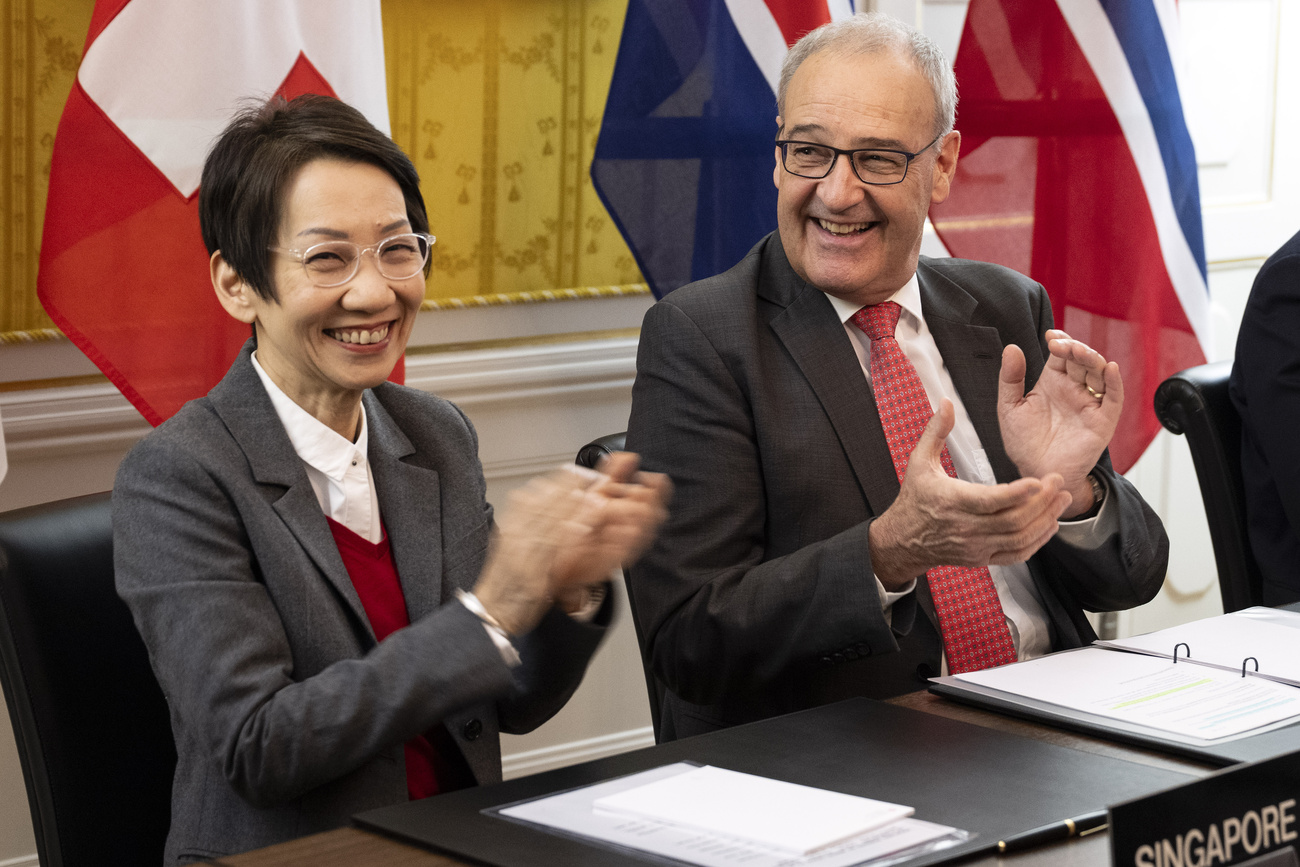
Swiss Economics Minister Guy Parmelin (right) and Grace Fu, Singapore’s Minister for Trade Relations, signed the Digital Economy Agreement between EFTA and Singapore in Bern on September 25, 2025.
Keystone / Peter Schneider
The figures capture only part of ASEAN’s significance. The region as a whole is gaining importance through regional integration and its appeal as a China+1 hub. The bloc’s individual countries are vastly different, from high-tech Singapore to emerging manufacturing centres such as Vietnam.
What risks should Swiss companies expect when doing business in ASEAN countries?
The main risks for Swiss companies come from geopolitics and trade policy. US tariffs on suspected “trans-shipments”, especially through Vietnam, Malaysia or Thailand, create uncertainty. Continued reliance on Chinese inputs adds another risk. Possible tensions in the South China Sea also remain a factor.
“Regulatory and political conditions differ greatly from country to country,” the Swiss-Asian Chamber of Commerce says. Bureaucracy, risks of corruption in some states, and uneven protection of intellectual property pose particular challenges for knowledge-intensive sectors such as pharmaceuticals and watchmaking.
Companies also have to contend with structural gaps in infrastructure and shortages of skilled labour. To reduce risk, companies will need to enter the market gradually and diversify across several ASEAN countries.
According to the Swiss-Asian Chamber of Commerce, the Swiss government should do more to support investment in ASEAN. This should include expanding free trade agreements, doing more to promote export and investment, and increasing its diplomatic presence in the region.
“What matters most are reliable rules, effective networks and close cooperation between government and business,” the chamber says.
Edited by Marc Leutenegger. Adapted from German by David Kelso Kaufher/gw
More

More


