


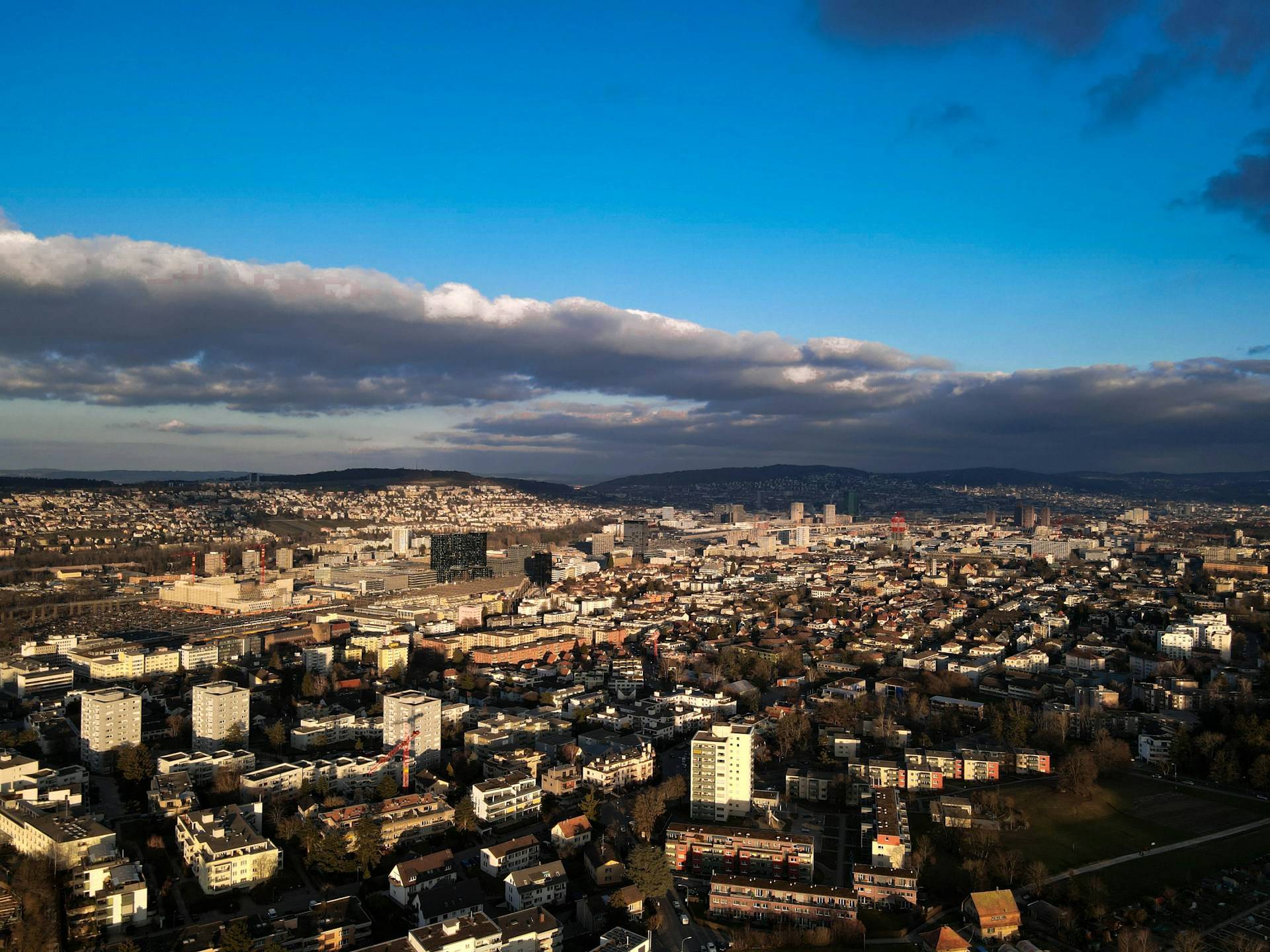
A new study ranks Switzerland in fourth place among European nations most affected by housing shortages. Why has it got so bad and is there any solution in sight?
Almost anyone who has looked for an affordable place to live in, or around, major Swiss cities, knows how dire the situation is on the housing market.
This has been confirmed in a new analysis by Wüest Partner real estate appraisal company, which compared the housing situation across 27 European countries, basing its findings on variables such as population growth, purchasing power, and the number of building permits issued for new construction projects.
What does the study show?
It found that Switzerland ranks among Europe’s worst performers in terms of housing shortages, placing it in fourth place.
Only Luxembourg, Ireland, and Norway fare worse.
A recently updated report by the Federal Housing Office also shows that the housing market is “very tight,” particularly in German-speaking Switzerland, where the supply of housing has become even scarcer over time.
Why does Switzerland fare so badly?
Several factors explain this dismal ranking.
Population growth, among other things, “is worsening the situation,” according to Wüest Partner.
This is not a surprise to anyone who has followed the country’s demographic trends.
“Switzerland has been in a situation of uninterrupted demographic growth for several decades,” according to Philippe Wanner, professor at the Institute of Demography and Social Economics at the University of Geneva.
This increase is mainly driven by the convergence and interdependence of two factors: shortages in the Swiss labour market have driven a demand for more foreign workers who, in turn, fuel a demand for housing.
Advertisement
But there are other factors at play as well
The analysis also shows that not enough new housing is being built in Switzerland.
There are two reasons or that.
Firstly, building permits have fallen by 27 percent over the past five years, “making the demand for new housing increasingly difficult to meet,” according to the analysis.
That’s because getting a construction authorisation is contingent on complying with environmental legislation, which regulates, for instance, the level of noise allowed in housing projects.
So, in order to build more and meet the demand, strict regulations such as those relating to noise protection would have to be relaxed.
Another impediment to construction, which obviously can’t be resolved, is the scarcity of land, as Switzerland is a small country and space to construct new buildings is limited.
Advertisement
What does the future look like?
Not too promising, unfortunately.
While construction rules could possibly be eased, there is no way to solve the underlying problem of the scarcity of land.
At the same time, Switzerland’s population, now at just over 9 million, is projected to reach the 10-million mark several years from now.
When exactly this will happen is not clear, with some experts predicting 2040, while others, like Céline Schmid from the Federal Statistical Office (FSO), saying it could be as early as 2034.
READ ALSO: How soon will Switzerland’s population reach the 10-million mark?
This doesn’t mean, however, that no measures are taken at all to relieve the housing shortage.
Advertisement
Trend of the future: densification
As the name suggests, this means that new apartment buildings are constructed in close proximity to existing ones, rather than on vacant land.
The densification solution is favoured, especially in cities like Zurich and Basel, by The Federal Office for Spatial Development (ARE).
It says that “59 percent of all building permits for residential developments involve for projects on already built-up plots. These projects included, for example, the repurposing of former industrial sites, the extension of existing buildings, or reconstructions. As long as a municipality has few building zone reserves, construction is more likely to take place in existing residential areas.”


