


Spain has been at the forefront of the international pro-Palestine effort, more so than any other European nation. Where does this fervent stance come from? And is support as clear cut among Spaniards as it is the government?
Prime Minister Pedro Sánchez has become one of the world’s leading pro-Palestinian leaders in recent years. Protesters in Spain recently made international headlines by forcing the cancalleation of the final stage of La Vuelta because an Israeli team was competing.
Spain recognised Palestinian statehood back in 2024, well before other countries like France and the UK, and Sánchez was using the language of genocide long before a UN Commission ruled in support of that position last week.
Spain has also said it will boycott Eurovision if Israel takes part and cancelled major arms deals with Israel.
Tit-for-tat diplomatic sparring followed, along with strong words from Israel and the withdrawal and summoning of various ambassadors.
These are far from the first diplomatic flare-ups born from Spain’s pro-Palestinian position, including, among others, Israeli embassy outrage over a Palestinian programme at Madrid’s Reina Sofía museum and Sánchez’s Gaza comments repeatedly angering Israel.
Advertisement
Spain has consistently been one of the most pro-Palestinian voices in Europe, if not the world. But why is this, exactly? What is it about Spain that makes its so pro-Palestinian? Is this a new position or a long-held one?
And is the Sánchez government reflective of the Spanish people more broadly?
The Sánchez government
Recognising the Palestinian state became one of the flagship causes of the Sánchez government last year and calls to stop what he calls ‘genocide’ have continued into 2025. Following Israel’s response to the October 7th terrorist attack by Hamas, many Western countries have faced criticism from the Arab world for being unwaveringly pro-Israel. Sánchez distanced himself and Spain from that position and took on a more humanitarian position.
According to Isaías Barreñada, a Middle East expert at the Complutense University of Madrid, Sánchez hoped that his stance will have “a domino effect” on the rest of the EU nations. In this sense, one way to understand why Spain has been so vocally pro-Palestinian is because it hopes to spark change on the international stage. Looking back a year on, it seems he may have been right strategically speaking.
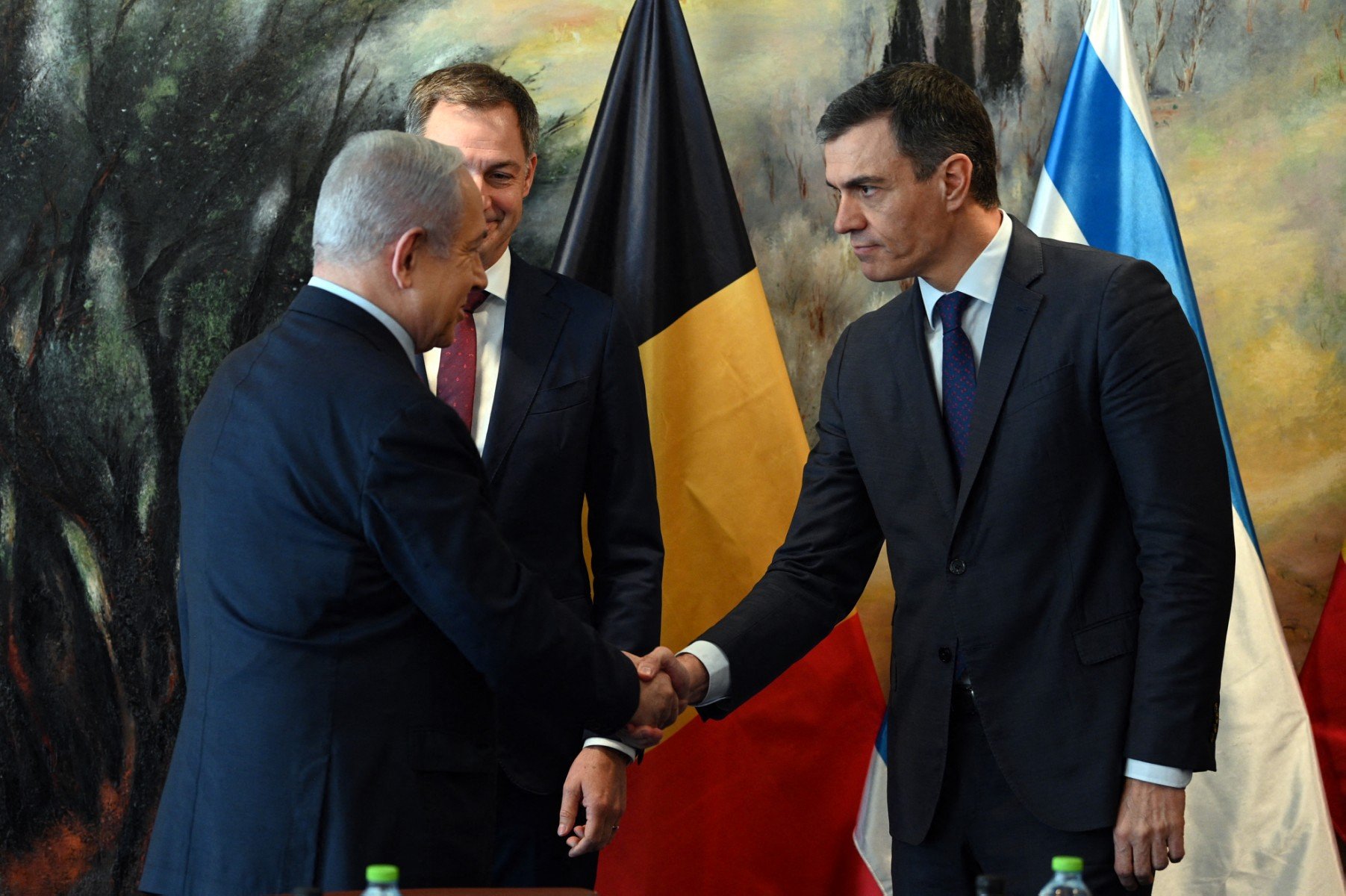
Israeli Prime Minister Benjamin Netanyahu (L) shakes hands with Spain’s Prime Minister Pedro Sánchez next to Belgium’s Prime Minister Alexander De Croo during their meeting in 2023 in Jerusalem. (Photo by Borja Puig de la Bellacasa / LA MONCLOA / AFP) /
Alon Liel, a former Director General of Israel’s Ministry of Foreign Affairs, also viewed Spain’s position as potentially crucial to lasting change: “A Spanish recognition of Palestine at this stage can ignite the momentum that might lead to overall European and UN recognition.”
“Spain would become a meaningful player towards a new diplomatic momentum on the Israeli-Palestinian conflict,” Liel added in an article for the Real Instituto Elcano.
Advertisement
However, as always in politics (and particularly with Sánchez himself) there could also be some political calculations at play here. Firstly, in terms of his political profile on the global stage but also in terms of domestic politics.
Though Sánchez has personally long held a pro-Palestinian position and clearly cares deeply about the issue on a humanitarian level, it is unclear if the government’s position would have been quite so world-leading without internal political pressure from far-left coalition partner Sumar, former partner Podemos, or the clear moral outrage on the part of many Spaniards.
In an editorial for Catalan newspaper Ara last year, the naked politics of Sánchez’s pro-Palestine position are considered more cynically in terms of the Catalonia question and controversial amnesty bill: “For Sánchez, beyond conviction, the manoeuvre serves both to raise his international profile and to put the internal right-wing opposition to the agreement with the pro-independence movement on amnesty on the back burner.”
READ ALSO: Spain finally passes controversial amnesty law for Catalan separatists
Advertisement
“Sánchez knows how to choose his enemies and moments well. He is putting himself at the forefront of Europe as the most critical of the ultra-nationalist Netanyahu and making his own turn of world public opinion, increasingly outraged by the death of innocent Palestinians.”
In 2025, as corruption scandals have threatened to topple his government, a cynic might argue that Sánchez does have a tendency to pivot to Palestine whenever things get particularly difficult at home.
However, to be fair to Sánchez, for all those who accuse him of being a valueless Machiavellian who will say and do anything to cling onto power, on Palestine he has stayed consistent for almost a decade, as evidenced by this 2015 tweet: “We will recognise the Palestinian state when I am Prime Minister.”
Furthermore, Sánchez can justly claim he has the support of the majority of Spanish people. According to polling cited by Onda Cero, 82 percent of Spaniards describe what the Israeli government is doing in Gaza as ‘genocide’ and 78 percent agree with the recognition of the Palestinian state.
Advertisement
History
But Spain’s pro-Palestinian position is nothing new. In fact, a look back into Spanish history and long-held Arabist positioning gives us an idea of why Spain would now be leading the call for statehood recognition in 2024.
Interestingly, it’s not an entirely clear cut political issue either. Whereas in many countries party affiliation pretty much defines position on Israel-Palestine, in Spain it’s not so clearly defined, historically speaking, at least.
The previous right-wing Partido Popular (PP) government of Mariano Rajoy in 2014 supported a parliamentary resolution calling for the recognition of the Palestinian state, though the vote was non-binding.
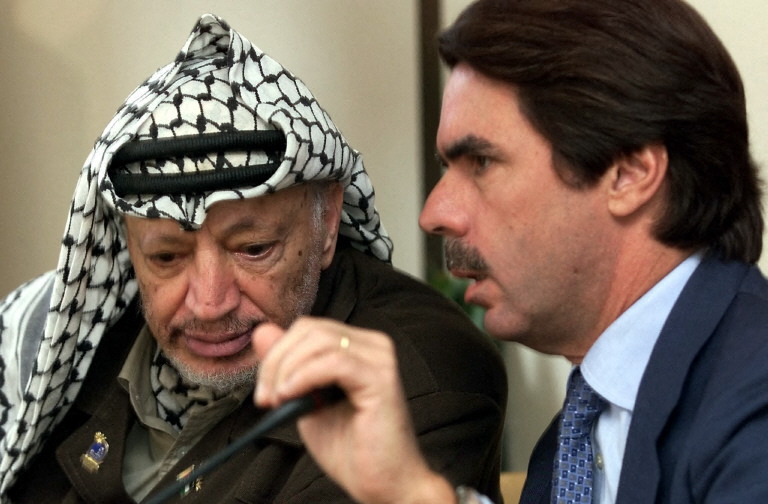
Palestinian leader Yasser Arafat (L) speaks with Spanish Prime Minister José María Aznar (C) in Mallorca in 2000. Photo: CHRISTOPHE SIMON/ AFP.
But Spanish sympathy towards Palestine goes back much further than that and even pre-dates democracy. During the Franco regime, Spain forged closer ties to Palestine and developed a more Arabist position more generally. Alienated from the West, this was due largely to Franco’s desire to get Arab countries to support Spain’s entry into the UN and end its international pariah status.
In September 1979, following the transition to democracy, Prime Minister Adolfo Suárez was the first European leader to receive Yasser Arafat, the then President of the Palestine Liberation Organisation (PLO), at the Moncloa. It was not until 1986 that the nation established official relations with Israel.
Later Spanish leaders including José María Aznar and José Luis Zapatero (from both the right and left) also welcomed Palestinian leaders over the years.
Spain’s position with regards to Israel and Palestine (essentially recognising Israel but still backing the Palestinian cause) was one of the reasons the Madrid Peace Conference was held in the Spanish capital in 1991. According to El País, Palestinian authorities themselves actually proposed Madrid as the location for the meeting.
The Madrid Peace Conference laid the foundations for Oslo Accords in 1993, so Spain can fairly claim a significant role in peace talks as far back as thirty years ago.
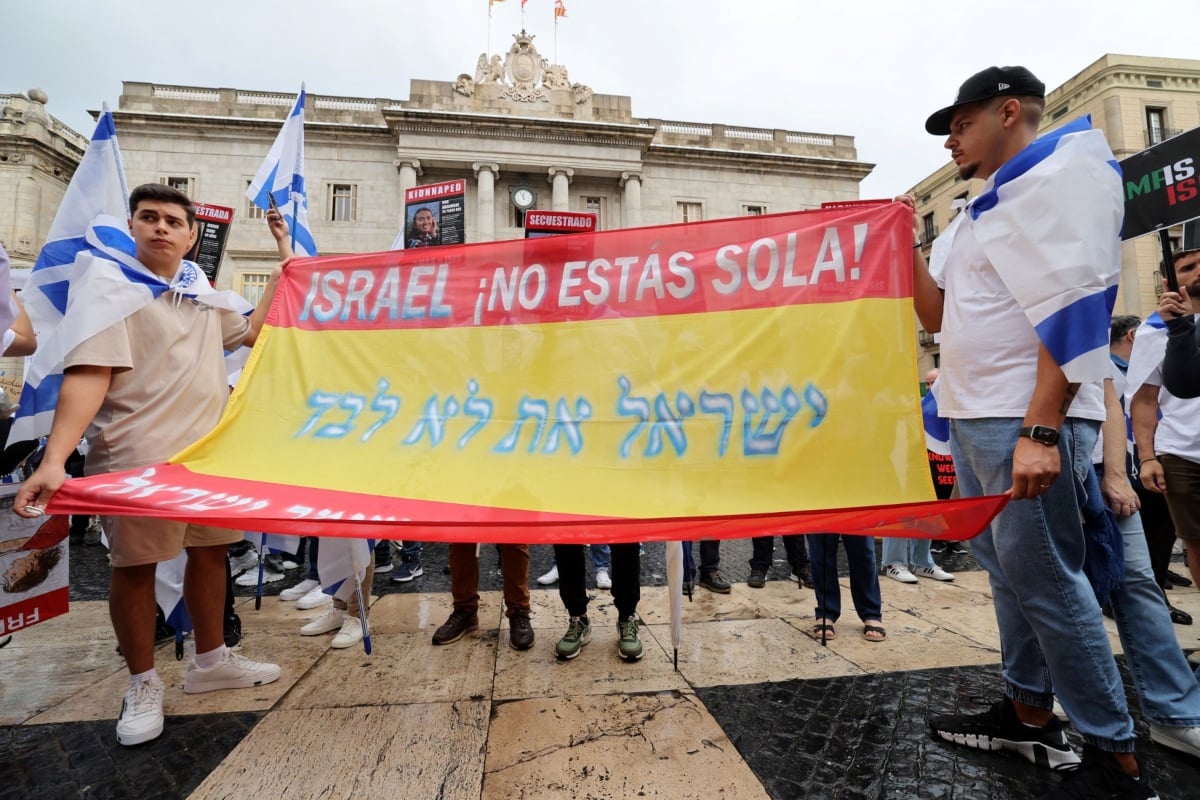
Protesters hold a Spanish flag with the message ‘Israel you are not alone’ a week after Hamas’s October 7th attacks. Protests in support of Palestine rather than Israel have been far more common in Spain ever since. (Photo by LLUIS GENE / AFP)


