


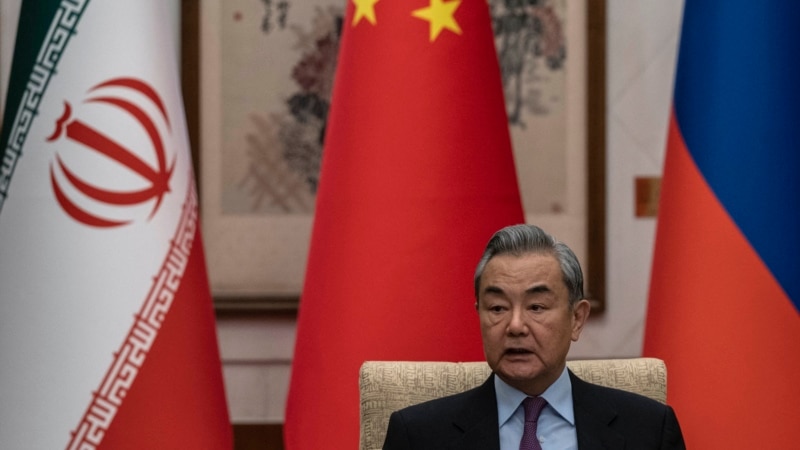
When China’s special envoy to the Middle East recently gave a colorful account of a dangerous overland journey through a war zone, it was a departure from the bland language and boilerplate peace plans often used by the country’s diplomats.
“Airspace closures in some of the countries we visited led to flight cancellations, forcing us to travel by car. Along the way, we heard air raid sirens and witnessed missile interceptions,” Zhai Jun told reporters in Beijing in late March, according to China Daily, the English-language mouthpiece of the Chinese Communist Party.
This account could not be independently confirmed, but Zhai’s trip through Persian Gulf countries highlighted China’s intense interest in a swift end to the US-Israeli war with Iran — and the uncharted territory that it represents for Beijing.
Since then, the US blockade of Iran may have further sharpened the country’s desire to calm tensions, reopen shipping, and resume trade flows. Comments from US President Donald Trump himself suggested a last-minute push from China led to Iran’s decision to accept a two-week cease-fire proposal brokered by Pakistan.
Reports from The New York Times and The Washington Post, citing Iranian officials, also point to Chinese pressure behind the scenes to urge Tehran to pull back from escalation.
But while China is probably Iran’s most important ally, it may lack the full diplomatic and economic leverage to force Tehran to make concessions, according to experts who spoke to RFE/RL. It also may be hesitant to act as a meaningful mediator for a peace deal.
The Levers Don’t Work
On paper, China has an array of levers to pull on Iran as part of an attempt to push it to the negotiating table.
It buys some 90 percent of the country’s oil and sells Iran many products. In 2024, this included vehicle engines and parts, medical equipment, metals, textiles, sunflower seeds, and chemicals, according to Harvard University’s Atlas of Economic Complexity. Given Iran’s heavily sanctioned economy, these ties are a crucial economic lifeline for Iran.
“I imagine that China is exerting pressure behind the scenes, more so than it was maybe a week ago or two weeks ago [before the US blockade]. But there are limits to how much that pressure can accomplish,” Ali Wyne, a senior adviser at the International Crisis Group in Washington, told RFE/RL.
“When you’re in a struggle for survival and an outside party urges you to exercise restraint, urges you to exercise caution, I think that your rebuttal is, ‘Well…our backs are up against the wall,'” he added.
Andrea Ghiselli, a China expert at Exeter University who is currently in Shanghai, took a similar view. He pointed out that any economic steps would take time to take effect.
“If China wanted to pressure Iran, for example, by asking for a greater discount on oil or decreasing the purchase of oil or withholding whatever other product they are selling to Iran, they could,” he told RFE/RL. “At the same time, it takes two to tango, right? It’s also about the Iranians.”
“In this moment, the priority for the Iranians is to solve the problem they have in front of them, not to think about what China might or might not do one or two months later.”
There’s also the diplomatic lever. Beijing, along with Moscow, is Iran’s key advocate at the United Nations and other international organizations.
Chinese Foreign Minister Wang Yi has been had a flurry of calls with his counterparts in recent weeks, according to Foreign Ministry spokeswoman Mao Ning, as Beijing walks a fine line between leveraging diplomatic relationships to strike a deal while avoiding becoming entangled in the conflict.
Ghiselli said withholding such support would be an “extreme scenario.” It would have less impact than economic measures and China would be reluctant to damage its relations with an ally that, Wynne pointed out, shares “grievances” against Washington.
China Has Time, But Not Forever
As the world’s largest exporting nation, China has a clear interest in seeing the Strait of Hormuz reopened. Its closure has caused huge disruption to the global economy and would severely reduce demand for Chinese products if it continues long-term.
Roughly 40 percent of China’s oil and 30 percent of its liquified natural gas (LNG) imports also flow through the strait, including from Persian Gulf countries that have been attacked by Iranian missiles and drones in recent weeks.
While China’s large strategic reserves of oil — built up last year when prices were low — buy it time, it will need to pump up the imports again within two to three months.
This highlights another aspect of China’s dilemma. While Iran is a useful ally, relations with other players in the Middle East are also hugely important.
“China wants to maintain good relations with both Iran and the Gulf States,” Erica Downs, a senior research scholar focusing on Chinese energy markets at Columbia University, told RFE/RL. “I see the Gulf states as being more important to China because of China’s economic ties to them.”
“This includes not just oil and LNG imports but all the renewable energy projects China’s firms have developed, and are developing, in the Gulf countries,” she added.
China has also made massive infrastructure investments in the Gulf States, including ports, industrial complexes, and desalination facilities. Some of those investments have been hit by Iranian attacks.
Zhai Jun’s story of an adventurous journey through the region is a reminder of how China has sought to maintain its ties with these nations even as its own ally bombarded them. This week, the crown prince of Abu Dhabi, Sheikh Khaled bin Mohamed Zayed Al Nahyan, was in Beijing for talks.
“It must have been an awkward meeting,” said Ghiselli. “The UAE is a very close economic partner and yet it is on the opposite side…. [The Chinese] don’t want to choose.”
But not choosing may be getting increasingly difficult.
China’s support for Iran — such as vetoing a motion resolution submitted at the UN Security Council by Bahrain on April 7 — is testing these relationships.
“The longer this conflict drags on, the longer this energy crisis drags on, the more that China runs the risk of straining its partnerships with the Gulf countries,” said Wynne. “It was already a difficult balancing act prior to this war, maintaining relationships with Iran and the Gulf countries, but that balancing act is only going to get harder.”
The Trump Factor
Another key factor no doubt influencing Chinese decision-making is the forthcoming summit with Trump, who is expected in Beijing on May 14-15.
So far, the relationship between Trump and Chinese leader Xi Jinping appears to be in a good place ahead of the summit, at least according to the US president.
“China is very happy that I am permanently opening the Strait of Hormuz. I am doing it for them, also — And the World. This situation will never happen again. They have agreed not to send weapons to Iran. President Xi will give me a big, fat, hug when I get there in a few weeks,” he wrote on social media on April 15.
Originally scheduled for March, the meeting was postponed after the US and Israeli air strikes that started the war with Iran on February 28. The two leaders have much to discuss, in particular their ongoing trade and economic disputes.
“China wants the conflict wrapped up sooner rather than later,” said Downs. “China’s relationship with the US is more important than its relationship with Iran, and Beijing will have an interest in keeping Trump happy ahead of his visit to Beijing.”


