


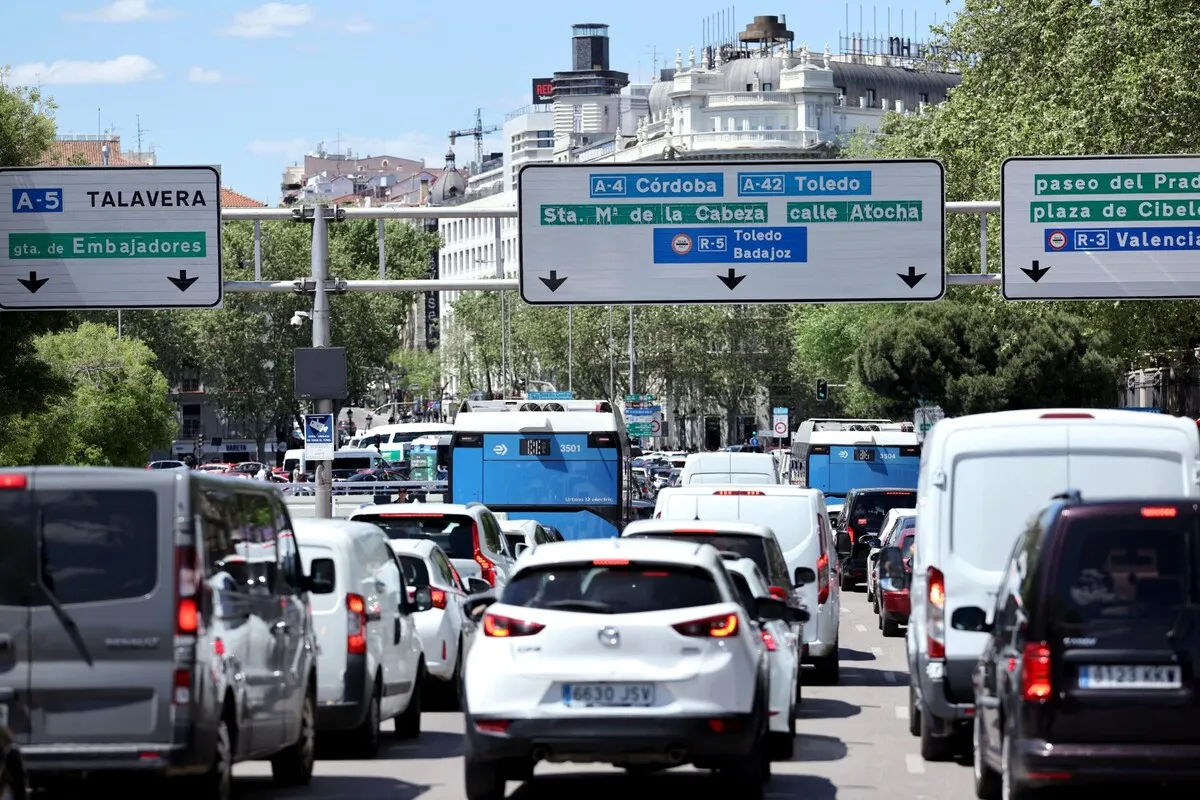
Spain’s Transport Ministry has hiked fees on certain toll roads around Spain to start 2026.
New Year brings with it a number of changes in Spain.
This is particularly true on the roads, with traffic rules meaning that from January 1st 2026 all drivers in Spain should carry a V-16 emergency light in their cars.
However, Spanish traffic authorities have confirmed that no fines will be issued early in the new year and there will be a grace period following the deadline.
Similarly, from January 1st, drivers using certain toll motorways in Spain will have to pay a little more.
This follows news that the Ministry of Transport and Sustainable Mobility has approved a price update that will mean increases of between 3.64 percent and 4.68 percent on most toll roads across the country after several years of partial discounts and frozen fees to mitigate the impact of inflation.
READ ALSO: Why does Spain’s mandatory new V-16 emergency light have geolocation?
Tolls roads that will increase in Spain in 2026
The increase will affect some of the country’s main toll motorways. These include:
AP-6 (Las Rozas de Madrid-Adanero)
AP-66 (Autopista del Huerna connecting Asturias-León)
AP-53 (Santiago de Compostela-Alto de Santo Domingo)
AP-68 (Bilbao-Zaragoza)
AP-71 (León-Astorga)
AP-9 (A Coruña-Tui)
Several sections of the AP-7 (Autopista del Mediterráneo) notably on toll sections Málaga-Guadiaro in Andalusia and Alicante-Cartagena.
According to a press release from the Ministry of Transport, the updated toll rates are also applicable on the AP-51, AP-61, AP-53, and AP-46.
On these roads, the increases will be in line with the review formulas and be between 3.64 percent and 4.68 percent.
One of the increases that has generated the most debate is that of the Huerna toll (AP-66) motorway connecting Asturias with León.
This road will become more expensive again in 2026, with a 3.64 percent increase, which will bring the price of the journey for passenger cars above €16.
Advertisement
In the case of motorways managed by Spain’s State Society for Land Transport Infrastructure (Seitt), such as the main Madrid ring roads, the M-12 and the AP-36, the increase will be more moderate, at around 2 percent.
These include:
R-3/R-5
R-2
R-4
M-12
AP-7 (Cartagena-Vera)
AP-36 (Ocaña-La Roda)
AP-41 (Madrid-Toledo)
On these sections, free night-time travel between midnight and 6 a.m. will also be maintained.
Advertisement
Discounts and subsidies for frequent drivers
Despite the increases, the Spanish government will maintain some discounts for regular drivers on certain motorways.
These measures were introduced to cushion the impact of tolls on those who drive regularly for work or personal reasons, although they do not prevent the final price per journey from continuing to rise overall.
READ ALSO: Do tourists driving in Spain need to carry the new V-16 emergency light?

