


Switzerland’s direct democracy and federalist structure makes it possible for all citizens to have a decisive say in the political process at national, cantonal, and communal levels.
Not only do the Swiss vote more often (three to four times a year) than citizens of other nations, deciding which laws proposed by the parliament should be approved or rejected, but they also have the power to create new legislation.
READ MORE: How ordinary citizens can try to change the law in Switzerland
Where do the people have the most say?
At the national and cantonal level, government and parliament determine policy.
The National Council and the Council of States — the two chambers of the parliament — make decisions, while the Federal Council implements them, after the people approve them in a referendum.
The process is similar in the cantons, with the exception of the Landsgemeinde in Glarus and Appenzell Innerrhoden, where people still vote by the show of hands in an open-air assembly.
READ MORE: ‘Pure democracy’: What is Switzerland’s Landsgemeinde (open-air assembly)?
Advertisement
You may say that this 600-year-old tradition best represents the true, grassroots democracy.
So, generally speaking, ‘citizen power’ is strongest at the national and cantonal level, where laws are created in the parliament but final decisions are made at the ballot box or, as in the case of the two cantons, in the town square.
However, this is not the case everywhere in Switzerland.
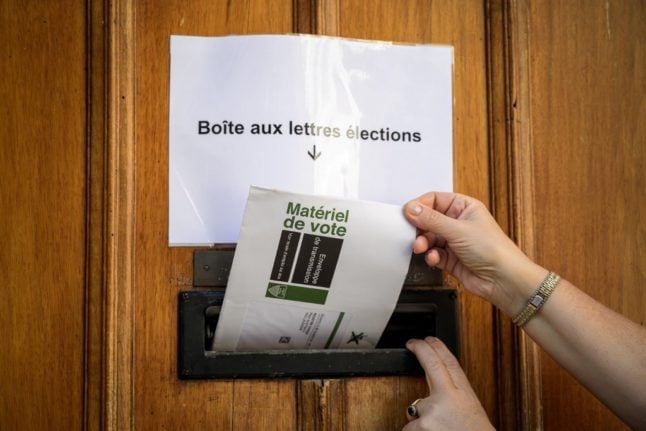
A woman inserts her postal voting envelope into the door of the polling station in the Swiss-French part of the country. Photo by Fabrice COFFRINI / AFP)
Parliament versus municipal assembly
Switzerland has 26 cantons and 2,136 municipalities, but “ironically, in the model country of direct democracy, there are only 500 parliaments,” according to a recent report by SRF public broadcaster.
This means, in effect, that “the electorate only has a say in few cases. In many communes and cantons, elected politicians [and not the voters] decide on important issues.”
Where there are no regional / local parliaments, municipal assemblies make and enact laws.
This is mostly the case of towns in smaller cantons like Uri, Schwyz, Nidwalden, Obwalden and Appenzell.
“Some cantonal constitutions prohibit local parliaments indirectly – for instance, by deeming the municipal assembly the ‘supreme body’,” SRF pointed out.
Why is the council less ‘democratic’ than a parliament?
One reason, according to political scientist Michael Strebel, is that “community meetings lead to random decisions. Frequently only a few voters come, so individual interest groups can mobilise and assert themselves,” — which certainly doesn’t reflect the will of the majority of the population.
Interestingly, on March 12th, citizens of Wohlen near Bern will vote on whether the town should create a parliament. The municipal government, however, opposes this move, arguing that “a direct political discourse is only possible at community meetings, where everyone can bring their concerns,” SRF reported.
“This is how the municipal government argues against a parliament.”
Advertisement
Large cities like Zurich, Geneva, Basel, and Lausanne all have parliaments. There are also no communal councils in Neuchâtel. In Ticino, 90 percent of the municipalities have a parliament. And in Vaud, communes with more than 1,000 inhabitants must have a parliament.
Generally speaking, citizens living in those ‘parliamentary’ municipalites have a more direct say in local politics.
What is an example of a decision that residents of those towns have made via the ballot box?
Perhaps the most publicised was the one in 2012, when Zurich voters approved a city plan to set aside 2 million francs of taxpayer’s money to build several drive-in structures — the so-called ‘sex boxes’ — away from the residential neighbourhoods, so that local prostitutes could ply their trade discretely.
And to ensure their safety and mental health, another $800,000 was earmarked for annual operation costs, which include security and on-site social services.
That’s an example of direct democracy at its best — or worst, depending on where you stand on this issue
READ MORE: Zurich unveils ‘sex boxes’ for prostitutes


