


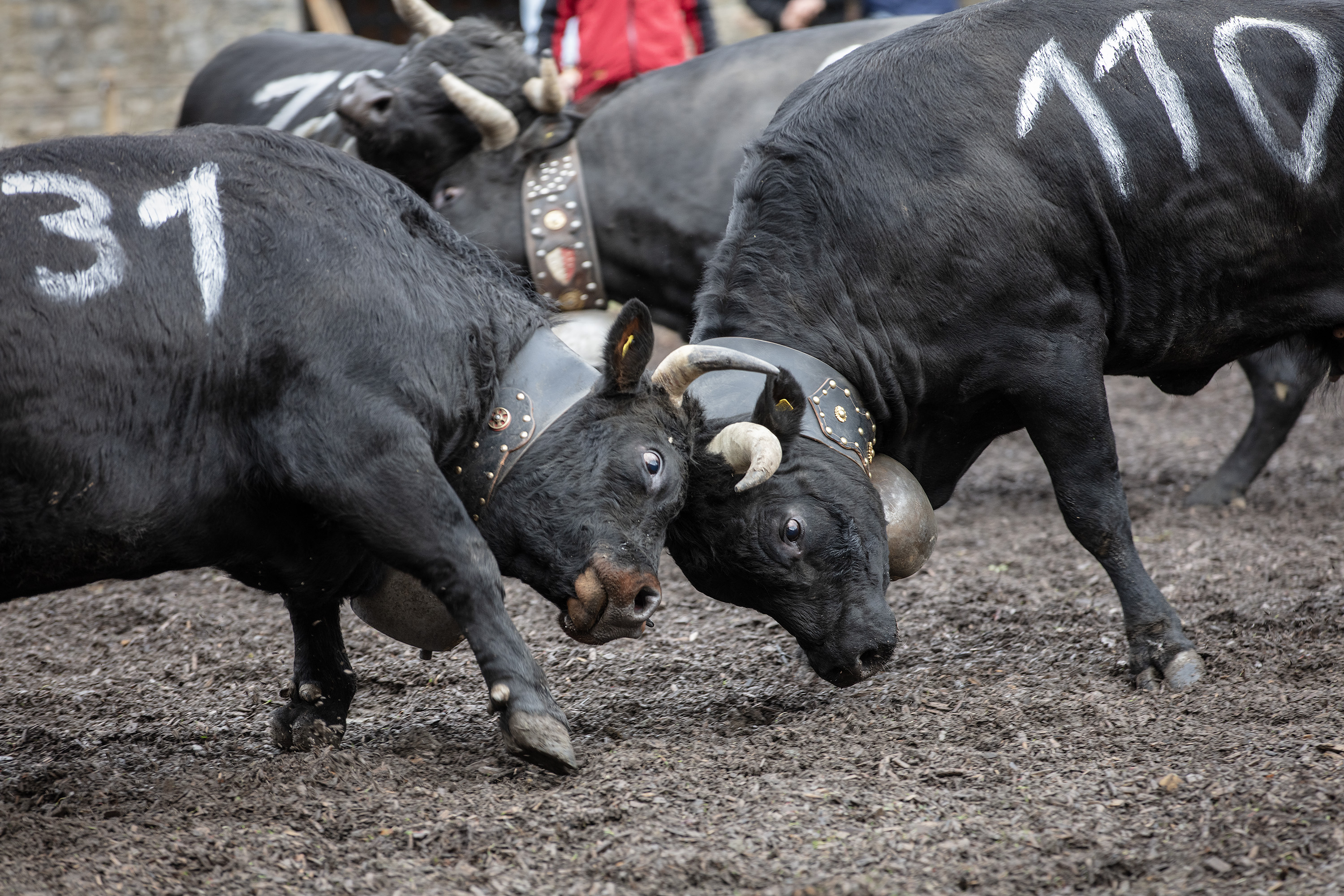
The cow-fighting festivals in Valais are also intended to remind us of the economic and cultural significance of cows in the mountains.
Thomas Kern / SWI swissinfo.ch
Every spring in canton Valais, southwestern Switzerland, thousands of people watch the Hérens cow fights. But what really happens in the arena? And where does this tradition so deeply rooted in the Rhône valley come from? We went to find out in Martigny.
The air is cold and full of tension. In the arena of the Roman amphitheatre in Martigny, on a mid-March morning, 15 cows wait in a circle to be freed from their halters. In the stands, a thousand spectators, their noses reddened and their caps pulled down tightly over their heads, watch the scene. At the judge’s command – “Owners, release the cattle” – the cows shake, as if struck by an electric shock. The fight of the queens begins.
In the middle, with her muzzle to the ground and her horns pointing up, Negra External linkploughs the earth with her hooves. She has yet to choose the opponent against whom she will clash heads. All around her are pairs already in full fight, others studying each other, and cows running in circles with their tails up.
Finally, Negra finds her adversary. Her nostrils flare, her eyes stare ahead, her neck muscles tense. Then comes the impact between two beasts weighing almost 700kg. However, just a few thrusts with the hind legs are enough to make the other cow give up and move away. The clash is too unequal. This will also be the case for three more qualifying fights. Negra will go on to the final.
In the amphitheatre, behind the ropes, Gérard Rouiller nervously follows the fight. He is one of Negra’s four owners; also with him are Nathalie Lugon, Pierre Mugnier and Michèle Lattion. They are passionate about cows of the Hérens breed.
They discovered Negra during a fight in Cogne, in the Aosta Valley, and immediately fell in love with her. “The purchase was a spur-of-the-moment decision driven by the heart,” says Rouiller, revealing in a whisper that the four of them shelled out CHF5,000 ($6,400) each to convince the owner to let her leave for Martigny-Combe.
More
More
Swiss-funded study finds cows are smarter than originally thought
Outing between rows of cows
The spectacle that unfolds around and inside the amphitheatre of Martigny is a concentration of agro-pastoral tradition, personal passion, identity value and social recognition.
At first light, under an ashen sky and with the mountains cut in half by a spring snowfall, the beasts parade like an army in front of the statues of the Roman emperors Caesar, Augustus and Claudius.
They arrive in droves, led by their owners. About 180 head of cattle, including cows and heifers, take part in the “matches”, as the fights are called in the French-speaking part of Valais. Waiting for them are the organisers of the event, those of the breeding syndicate ‘Pied du château’.
The cows are weighed, their health is checked and their horns, which if too sharp are blunted with sandpaper. Finally, armed with a jar of white paint and a paintbrush, those responsible write a number on the flanks. For Negra it is 58.
After being tied to chains, the cows witness a continuous coming and going. The breeders return to their cars to fetch sacks of hay, bags with dry bread, buckets with grain, tables and chairs, cooler bags and containers, gazebos.
Between the rows of cows, huddles of people form: family members, friends and acquaintances. It feels like a kind of picnic. The air begins to smell of manure, coffee and white wine. Country festival music blaring from the loudspeakers covers the bellowing and ringing of cowbells. The waiting begins.
More
More
Hikers told how to avoid scuffles with cows
“I didn’t sleep a wink last night,” Nathalie Lugon says. “But now the worst is over. Now it’s your turn to be honoured,” she says, stroking Negra’s muzzle.
Symbol of an entire canton
The Hérens breed takes its name from the side valley located south of the Rhône valley in Valais. The cows are medium-sized and have a strong, muscular constitution. They are distinguished by their thick horns curved inwards and their uniform coat, which varies in colour from black to reddish-brown.
But what characterises them above all is their fighting temperament. And it is from this natural behaviour that the tradition of queen fighting originated. Initially, they only took place on the jointly managed mountain pastures.
When the herds of different breeders met, the head of the herd had to be defined. “The strongest cow, the queen, could graze the grass of the best pastures, and with her the cows in her stable,” writes Valais historian Thomas Antonietti in his bookExternal link Kein Volk von Hirten – Alpwirtschaft im Wallis (Not a nation of shepherds – Alpine farming in Valais).
“Cow fights were therefore not only symbolic and of social prestige but also responded to practical considerations. […] Like the prize cows at livestock shows, the crowning of a queen on the Alp increased the economic value of the animal,” he says.
More

More
The difficult search for real Swiss cows
On the Alp, herd fights were attended only by breeders. The popularity of cow fights increased when, from the 1920s onwards, fights were organised on the plains.
The first fights were held in Montana and Martigny in autumn, after the summer pasturing. The real success came when the meetings were held in spring. From the 1960s onwards, the fights thus became a very popular spectacle, often attended by several thousand people, not all of them from the rural world. According to Antonietti, the regionalisation of the events has led to a semantic shift. “The fighting cow gradually became a symbol of the entire canton.”
As the years went by, the Hérens cow thus became one of the identity animals of the Valais: its stamina and tenacity transformed it into a metaphor for the rugged and wild Alpine territory and the people who inhabit it.
The most representative moment of this cantonal dimension is the national final held in May in Aproz, where the whole of Valais symbolically comes together. And it is there that we will find Negra.
In the middle of the arena, her muzzle on the ground, her hooves digging the earth, Negra will wait for her adversary for the encounter that could consecrate her queen of queens.
The fighting of cows of the Hérens breed follows precise rulesExternal link. The animals are divided into three categories according to weight, plus primiparae (first lactation) and heifers. The day includes qualifying rounds in the morning and finals in the afternoon, at the end of which the queen of each category is crowned.
A five-member jury, including a president, directs the fights and is in charge of enforcing the rules, eliminating cows that lose or refuse the fight and establishing the final ranking. A cow is generally eliminated when it loses or withdraws three times.
Also operating in the arena are the rabatteurs (beaters), often young, who act on the instructions of the judges. Their task is to approach the cows to facilitate the fight, prevent other animals from disturbing two contenders and remove eliminated or reluctant beasts from the fight.
The fights are conducted using the progressive elimination system: during the qualifying round, groups of 12 to 16 cows compete against each other and the five to six best from each group advance to the category final. In the final, the competitors fight until one dominates all the others and is proclaimed queen of the category.
Translated from Italian by AI/ts
More
How we translate with AI
We use automatic translation tools, such as DeepL and Google Translate, for some content.
Each translated article is carefully reviewed by a journalist for accuracy. Using translation tools gives us the time for more in-depth articles.
Learn more here about how we work with AI.


