

Because of Switzerland’s topography certain parts of the country are more likely than others to get higher temperatures during heatwaves that will become more common due to the human-caused climate crisis.
This year, Switzerland broke the record for its hottest-ever June day, with the mercury rising to 39C in parts of the country.
Extreme heat was recorded elsewhere in the country too, and forecasts for July call for more of the same.
You already know that getting a permission to install air conditioning in private dwellings is not an easy task, so all you can do is follow government recommendations on how to stay cool indoors.
READ MORE: How to keep your cool during Switzerland’s heatwaves
But that is only half the battle.
Certain parts of the country worse than others
The June heatwave was particularly fierce in the city of Basel, which stands on the border with France and Germany. Temperatures there hit a punishing 39C.
And there was a a reason for this. Chalk it down to location, location, location – in the worst sense of the word.
Concretely, Basel is situated at about 270 metres lower than the Plateau.
According to meteorologist Olivier Duding from MeteoSwiss, this means that the region lies in “a sort of basin where hot air stagnates when there is little wind.”
Basel’s proximity to France plays a role as well.
The Rhine corridor exposes the city and canton to hot air from Alsace and Burgundy, said another meteorologist, Vincent Devantay from MeteoNews.
“Air from these regions, also exposed to temperatures approaching 40C, rushes into this corridor to reach Basel,” he pointed out. “It then stagnates in this famous ‘basin’ and accumulates there for days.”
As well as the Basel region Météo France highlights the lower Valais area and Geneva plus the canton of Ticino as having the highest summer temperatures.
The map below from Météo Swiss gives an idea for the parts of Switzerland with the highest average temperatures.
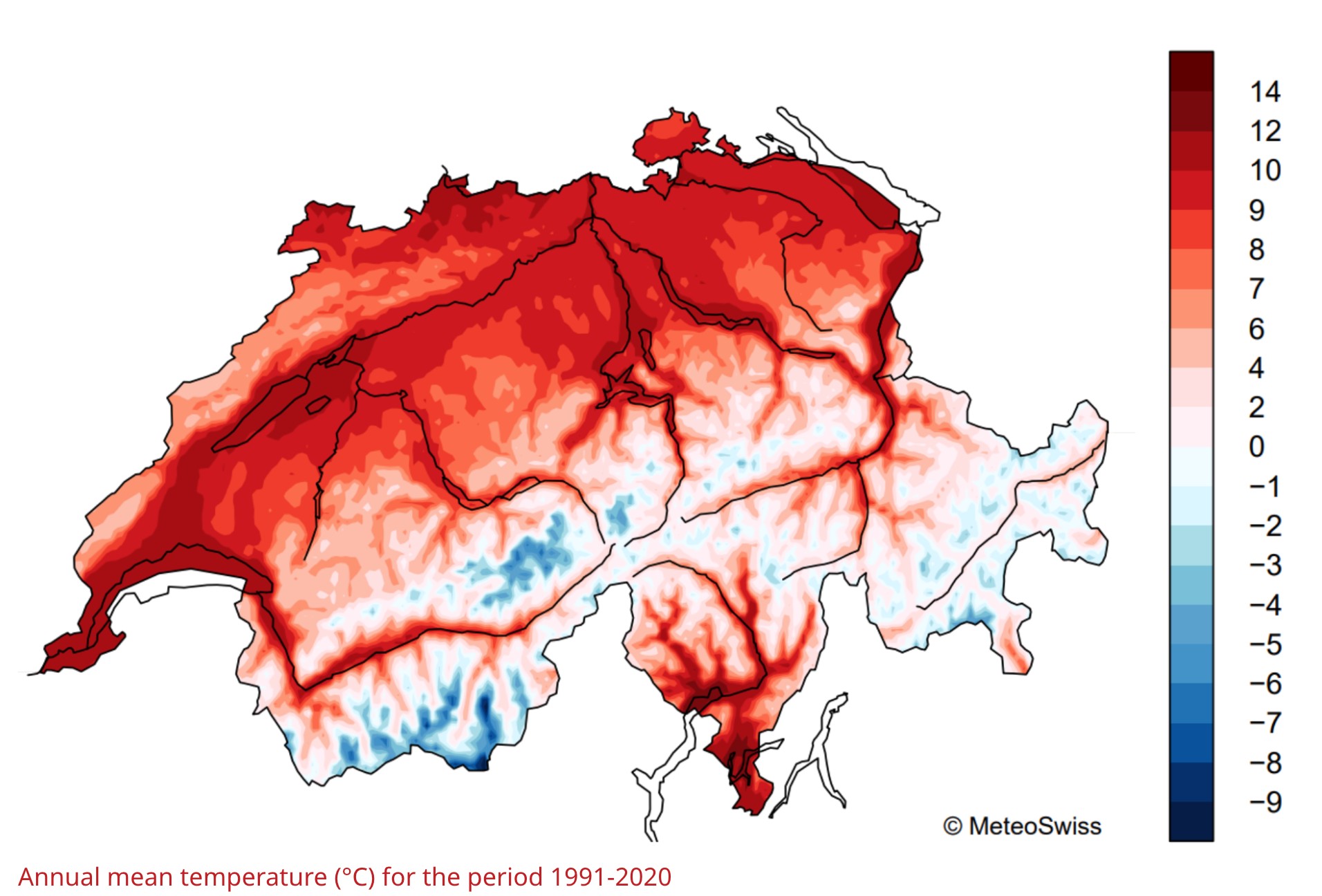
Annual mean temperature (°C) for the period 1991-2020. Image: Météo Swiss.
Météo France also states: “The highest temperatures north of the Alps are reached in Western Switzerland along Lake Geneva and at the southern Jura foothills, in the Basel region and in the Foehn valleys along the Rhine and Reuss rivers. The annual averages in the lower-lying areas around the large Ticino lakes and Lower Valais are somewhat higher.
“The highest temperatures are recorded in July and August in the lower-lying regions of the country.
READ MORE: Which parts of Switzerland have the best and worst weather?
City centres
Heatwaves are significantly worse in large urban areas.
According to the Federal Institute of Meteorology and Climatology (MeteoSchweiz), cities are more densely built up and have a larger percentage of impermeable surfaces like pavements, for instance, which retain and radiate heat.
Therefore, “the air temperature in urban areas is often higher compared to their more natural surroundings. This difference in temperature is known as the ‘urban heat island’ effect,” MeteoSchweiz points out.
And the more densely populated a city is, the more pronounced this effect.
Research has shown that Basel, Geneva, and Zurich are worst Swiss cities in terms of heat, with Basel top among them.
What about outdoors?
When you are out and about in a heatwave, it is not easy to find a place where you are not going to sweat – at times, profusely.
In fact, though it may seem like a mission impossible, it is not.
Let’s look at places it it best to avoid in very high temperatures, and those you should flock to.
It is a logical conclusion then, that during extremely hot weather, it is best to avoid these notorious heat traps.
But can you be in a city like those three and still stay (relatively) cool?
Yes, it is possible.
All major cities (and smaller towns as well) have green and shaded spaces like parks where temperatures are typically a few degrees lower than in heat islands.
Geneva, for instance, has expanded its green areas specifically so residents and visitors have somewhere to go to avoid summer heat – Bois de la Bâtie and Parc Trembley, to mention just two.
Zurich also has a number of parks, but among the best cooling-off spots are green and shaded gardens surrounding the Federal Institute of Technology (ETH).
They include Albert-Steiner-Garten and Flora-Ruchat-Roncati-Garten.
These are just some examples of cool green spots that abound across the country, in towns big and small.
And the same ‘cooling-off’ effect, by the way, pertains to forests and heavily wooded areas as well.
Now let’s talk about hiking
Swiss people are really into hiking and you probably think that nature walks are excellent ways to stay out of the heat.
Yes and no.
You can write that idea off if you want to hike at altitudes lower than 800 m in sunny weather.
This could be a recipe for disaster because you could end up with heat stroke or heat exhaustion, as sun is strong at this altitude and hiking requires a certain effort.
However, this activity is a lot safer at higher elevations.
Therefore, the higher up in the Swiss Alps you climb, and the more shaded your trail is, the safer (from the heat) you will be.
What about Switzerland’s lake- and river-side beaches?
They may seem like safe places, with water to cool off just there, but much depends on where on the beach you are – and when.
If you lie or sit in direct sunlight at noon, then your risk of heat-related complications is high.
If, on the other hand, you lie in a shade and splash, or swim, in the water frequently, you should be fine – but only if you avoid the so-called ‘water shock’.
This can happen if you plunge your overheated body into cold water without ‘prepping’ it first.
This shock can be avoided by submerging yourself slowly, rather than diving or running in, to give your body time to adapt. You can also splash water onto your face as you enter.
READ MORE: How to stay safe when swimming in Switzerland’s lakes and rivers this summer


