


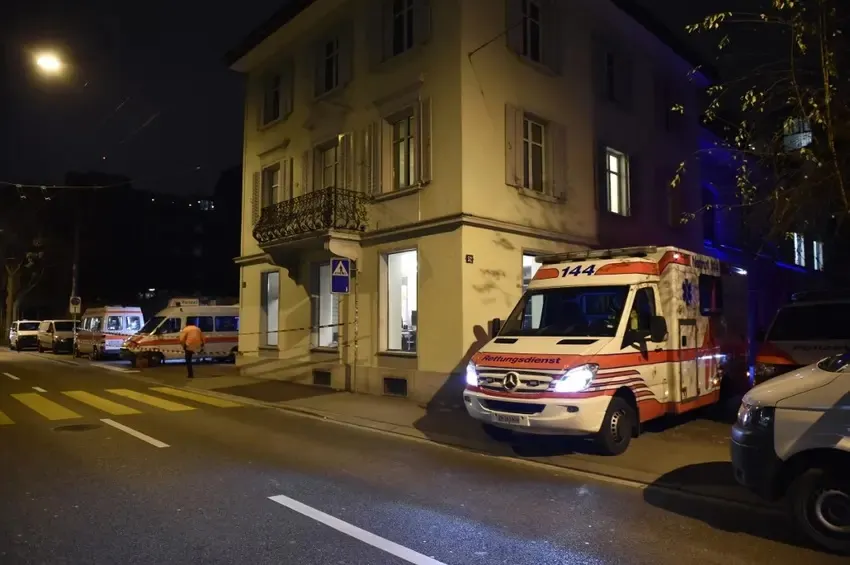
Extremely hot weather can cause many people, and not just the elderly, to feel unwell. But Switzerland has strict rules about the use of hospital ERs. How do you know whether the use of emergency services is justified during a heatwave?
In some countries it is common for people to go to an emergency room (ER) with all kinds of health complaints.
In some cases, they even routinely call an ambulance to take them there.
But in Switzerland the rules are stricter: since minor cases are putting a strain on emergency services, ERs and ambulances are to be used sparingly, in life-threatening situations only.
Do heatwave-related health problems qualify as a serious health emergency?
When we suddenly start feeling ill in very hot weather, we may automatically misjudge the severity of a symptom and ask to be driven to a hospital.
But should you?
Thomas Sauter, head of the University Clinic for Emergency Medicine at Inselspital in Bern, explained in Swiss media that people – with the exception of babies and young children, as well as the elderly and those with chronic medical conditions – should not act in the heat of the moment and automatically think of visiting hospital.
Instead, when it comes to assessing the severity of their symptoms, they should remain coolheaded even in the midst of a scorching heatwave.
Here’s his advice on how to judge whether your symptoms are a medical emergency or not:
Overheating: Not an Emergency
You may be sweaty and uncomfortable, but ‘overheating’ is “not a medical term, more of a temporary condition,” Sauter said.
You should just go to a cooler place and drink plenty of water.
READ MORE: How to keep your cool during Switzerland’s heatwaves
Heat exhaustion: Not necessarily a life-threatening emergency
This happens when a person suffers a significant loss of fluids and salts – a condition which strains the circulatory system. The person sweats much more and their body temperature becomes elevated.
“Once again, the motto is: cool down, cool down, cool down,” Sauter said.
However, if you remain in the heat with symptoms of heat exhaustion, “this can develop into a life-threatening condition,” Sauter said. “If someone suffers a true heatstroke, this can lead to organ failure and consequently death.”
Sunstroke: A possible emergency
This happens when sun shines directly and for too long on the head and neck.
But while you may have a headache and feel the burn in affected areas, “a mild case of sunstroke isn’t a reason to go to the emergency room,” according to Sauter.
However, if severe headaches occur, accompanied by vomiting, loss of consciousness, confusion and other personality changes, “this is clearly a case for the emergency room.”
In particularly severe cases, transport to the hospital by ambulance or helicopter is necessary.
How can you, or a person taking care of you, know whether your symptoms are serious or not?
Generally speaking, heart attacks and strokes, head trauma, severe respiratory distress, heavy bleeding, serious injuries, and other conditions where any delay in treatment can put your life or health at risk is considered a life-threatening emergency.
If you don’t feel well (even in the absence of the above-mentioned symptoms), you may overestimate your ailment and think it requires an urgent visit to the ER.
But before you go there, get your condition evaluated by medical professionals.
Your first point of contact should be your primary physician (GP), who can decide whether you need to go to the hospital or can be treated another way.
In the event you don’t have a GP (or are a tourist), there are other options available in Switzerland, such as medical centres and walk-in clinics in virtually all cities.
If you are not sure how serious your condition is and need professional evaluation, you can call a “duty doctor” service (Notarzt in German, médecin de garde in French). Their numbers vary by cantons; it is 0800 33 66 55 in Zurich, 022 748 49 50in Geneva, 061 261 15 15 in Basel, and 0848 133 133 in Vaud.
People who answer the phone will ask questions about your symptoms and can decide whether you need to go to the ER, require a visit from the duty doctor, or can just wait and see how your condition evolves.
A duty doctor is also an alternative to the emergency room if you start feeling ill at night, on weekend or public holiday, as this service responds 24/7.


