


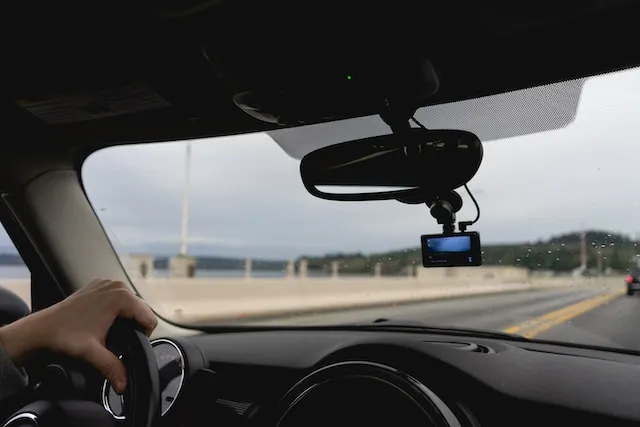
Many drivers in Spain wonder if having a camera in your vehicle is legal. These are some rules you need to follow if you want to do it legally and avoid fines, as well as the grey areas.
Having a camera in your car, whether on the windshield, dashboard (hence the name ‘dash cam’) or attached to your rear-view mirror, is popular in many parts of the world. It can be a good way of proving liability if you have an accident, or if your car is damaged while parked on the street.
Dash cams are increasingly popular in countries like the US and UK, and in places like Russia seen as a necessity. In fact, nowadays there are many car models that have inbuilt dash cams installed at the factory, as is the case with Teslas.
So what about in Spain? Are dash cams legal in Spain, and what are the rules?
Dash cams in Spain
Put very simply (more on the actual rules below) dash cams are legal in Spain. However, there are some regulations you should know about because they might be the same as in your home country.
READ ALSO: What are the rules on being double parked in Spain?
In Spain, restrictions on dash cam use focus mostly on what you do with images captured by the camera, and using the devices while driving.
Any vehicle, for private or public use, whether intended for the transport of people or goods, can have a dash cam in Spain. Anyone in a car, motorcycle or other vehicle, as well as professional drivers, are legally entitled to one.
Advertisement
The rules
Firstly, Spain’s General Directorate of Traffic (DGT) allows the use of dash cams (or any type of camera) inside the car, so long as you comply with DGT regulations and the camera does not cover the windshield and impair the driver’s visibility in any way. If the dash cam does affect visibility and you are caught, you could be fined €80.
Secondly, you cannot touch the dash cam while you are driving. This is considered a more serious offence that could earn you a €200 fine and the removal of 3 points on your license if caught. Think of this as similar to using your phone while driving, though as many dash cams are fixed to the rear-view mirror or dashboard, there shouldn’t be much reason to touch it while driving.
READ ALSO: Driving in Spain: Which towns and cities have low-emission zones?
If you want a dash cam, you must keep in mind Spain’s data protection laws, which establish that recorded images and video content can only be recorded and reproduced for private use, that is, it cannot be published on social media or in any public place because it would violate the privacy of third parties.
So, if the images you record on your dash cam are for personal use, say recording a scenic drive or route, data protection regulations do not apply. However, if you record other people and post it online, it could plausibly contravene data protection legislation.
Advertisement
In addition, according to Spain’s Royal Automobile Club, you cannot make continuous recordings with a dash cam because that could be considered surveillance activity of a public space, something that only certain groups and bodies have permission to, such as the police and security services. For this reason, dash cams must be configured to only record specific moments when a motion sensor or an accelerometer is activated.
Similarly, because there is no specific legislation dealing with dash cam footage, it is grouped under the broader rules on data protection. Spain’s Data Protection Agency (AEPD) explained in a report that, as such, when it comes to dash cam footage each case must be studied on an individual basis.
It also gives some precautions on using dash cams legally in Spain while avoiding possible legal complications. The AEPD report suggests that the recording should be activated only at the time of the event, such as a car crash. That is to say, dash cams should be used to record specific incidents, not generally record the roads. It so advises that that images should be limited to recording what is in front of the vehicle, and that, when reviewing or editing footage, people or information such as license plates that are not linked to the incident should be blurred or removed.


