


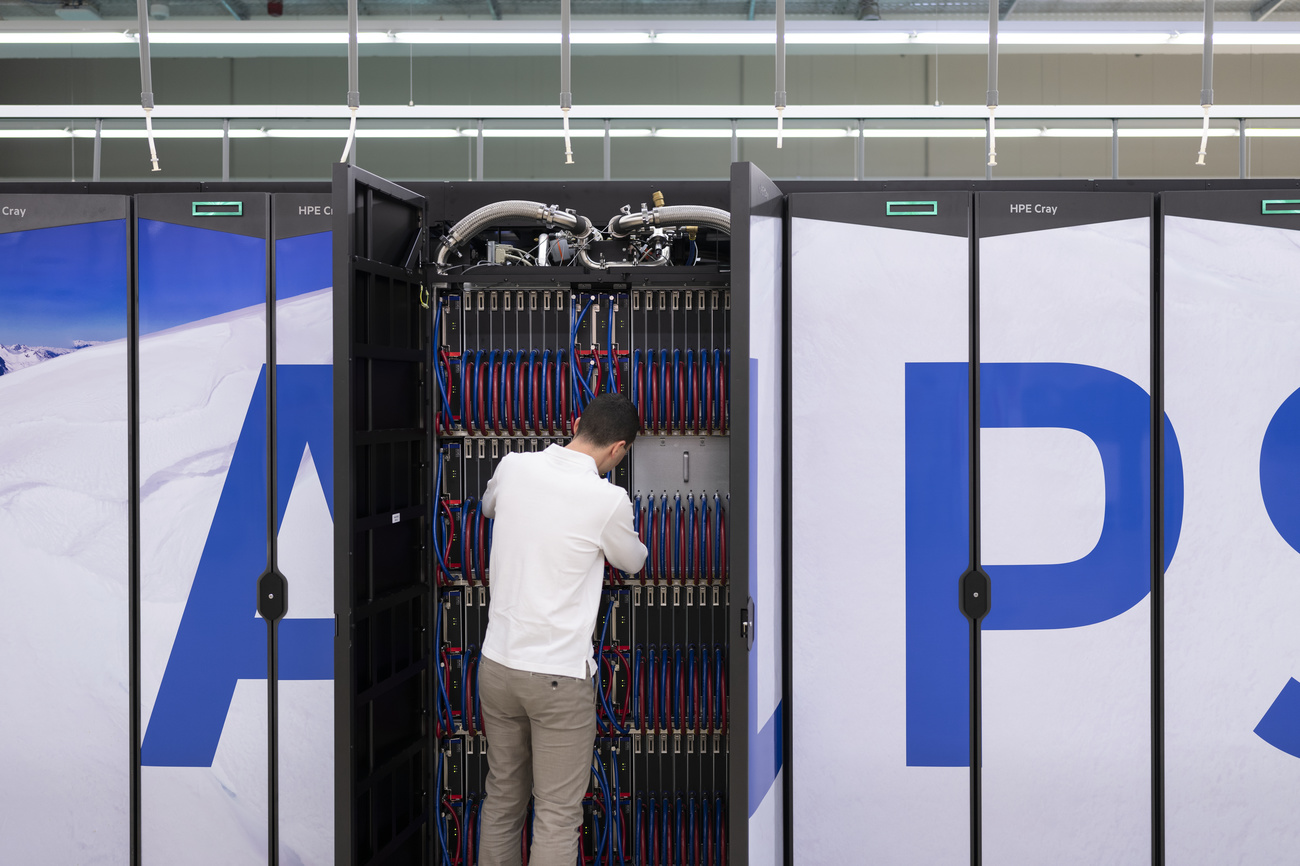
“Alps” – currently the seventh most powerful supercomputer in the world.
Keystone / Gaetan Bally
Switzerland recently unveiled a supercomputer built to support the increasing data demands of scientific research and complex artificial intelligence (AI) systems. But such machines, while they have the potential to mitigate climate change, are themselves big energy guzzlers. How sustainable is Switzerland’s latest technological leap?
Several studies have shown that AI could provide a boost for climate protection – for example, by analysing complex climate patterns or helping to predict heatwaves. The technology can also find ways to distribute electricity more efficiently to homes and industries, a crucial step in any transition to renewable energy. But there’s a catch: developing and operating AI systems requires vast resources, notably electricity and water, meaning they have a big environmental footprint that could counteract their benefits.
The International Energy Agency estimatesExternal link that AI technologies could increase their energy needs tenfold by 2026, reaching levels comparable to what countries such as Austria or FinlandExternal link use in a year. And the electricity often comes from fossil fuels.
Even Sam Altman, CEO of OpenAI – the company behind ChatGPT – said at last year’s World Economic Forum in Davos that an “energy breakthrough” will be needed to sustain the expansion of generative AI tools (which create text, images or audio). With nearly four billion monthly visits, ChatGPT already uses as much energy as 33,000 households; 6% of the waterExternal link in the US-based district where its data centre is located is needed to cool its servers.
Meanwhile, Switzerland’s two federal technology institutes have developed Alps, one of the most powerful supercomputers in the world, to support large language models (LLMs) such as those behind chatbots like ChatGPT. The goal is to create open-source and public AI systems for scientific research, particularly in the climate and medicine fields. But at what environmental cost?

Kai Reusser / SWI swissinfo.ch
Water-powered supercomputer
Alps’ performance currently ranks seventh on the Top500 listExternal link of the world’s most powerful supercomputers. But its environmental impact remains relatively limited compared to counterparts in the US, according to Vlad Coroama, an independent researcher and founder of the Roegen Centre for Sustainability in Zurich.
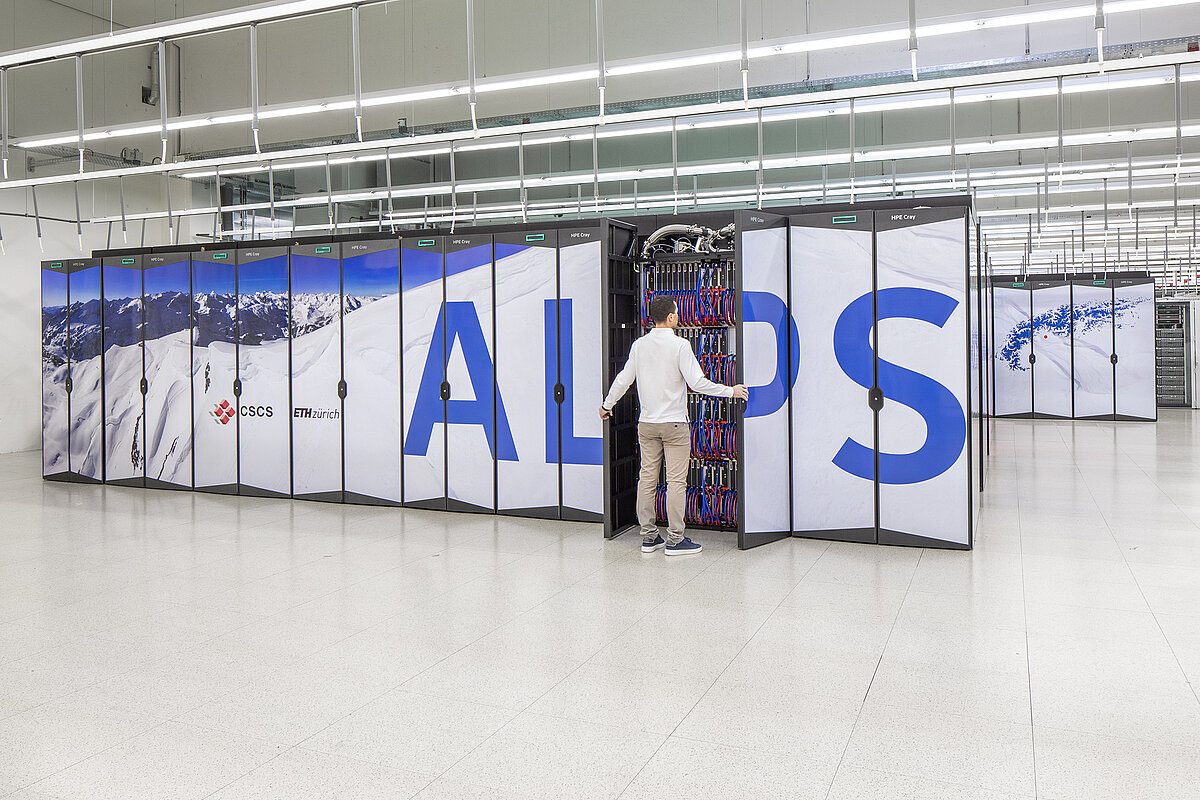
Equipped with 10,000 graphics processing units (GPUs), Alps consumes an average of seven megawatts of electricity – equivalent to 10,000 Swiss households or 0.09% of the country’s total consumption, according to Coroama’s calculations.
More
More
Swiss Alps supercomputer to leverage AI for science
“Two wind turbines could cover the needs. “It’s not insignificant, but it’s justified if the goal is to advance fundamental scientific research,” he says. By comparison, the El Capitan supercomputer, the world’s most powerful, uses over four times more power at 29 megawatts – electricity which also comes from non-renewable sources.
Meanwhile, to meet their growing energy needs, major private tech companies like Amazon, Google and Microsoft are investing heavily in nuclear power.
But Maria Grazia Giuffreda, deputy director of the Swiss Center for Scientific Computing (CSCS), says it’s “unthinkable to continue building computing centers everywhere powered by nuclear energy”. Her organisation houses Alps and other major computing systems. “We must focus on clean and alternative energy sources,” she says, noting that the publicly-funded CSCS has taken such an approach.
Alps relies exclusively on hydropower, meaning direct CO2 emissions are minimal. Whereas US-based data centers often have diesel generators in case of emergencies, the CSCS has backup batteries and a water reserve. This allows critical services like MeteoSwiss, the national weather forecaster, to run autonomously for about 20 minutes while the supercomputers are down. The CSCS also repurposes the water used to cool its servers as a hot water supply for the city of Swiss city of Lugano.
Overall, Coroama estimates that the Alps supercomputer is responsible for 0.013% of Switzerland’s annual CO2 emissions – a negligible amount, he says.
Not just energy
Tech giants like Microsoft are meanwhile investing billionsExternal link – $80 billion (CHF73.35 billion) in 2025External link alone – in AI supercomputers, such as Microsoft’s planned “Stargate”External link. Estimates show that the machine will require up to 5 gigawatts to operate, equivalent to the energy output of five nuclear reactorsExternal link.

Kai Reusser / SWI swissinfo.ch
Coroama envisions and encourages a future focused on smaller, more specialised AI models, like those which Swiss scientists intend to develop using Alps. Such models require less power.
But the environmental impact of AI extends beyond just the energy used by data centres. “AI data centers already have significant public health consequences,” says Shaolei Ren, an associate professor of engineering at the University of California, Riverside.
In a recent studyExternal link, which hasn’t yet been peer-reviewed, Ren and his colleagues estimate that US healthcare costs linked to air pollution caused by AI technologies could reach $20 billion by 2030, equivalent to the public health burden of all vehicles in California. Air pollution contributes to diseases like asthma, lung cancer, and heart attacks.
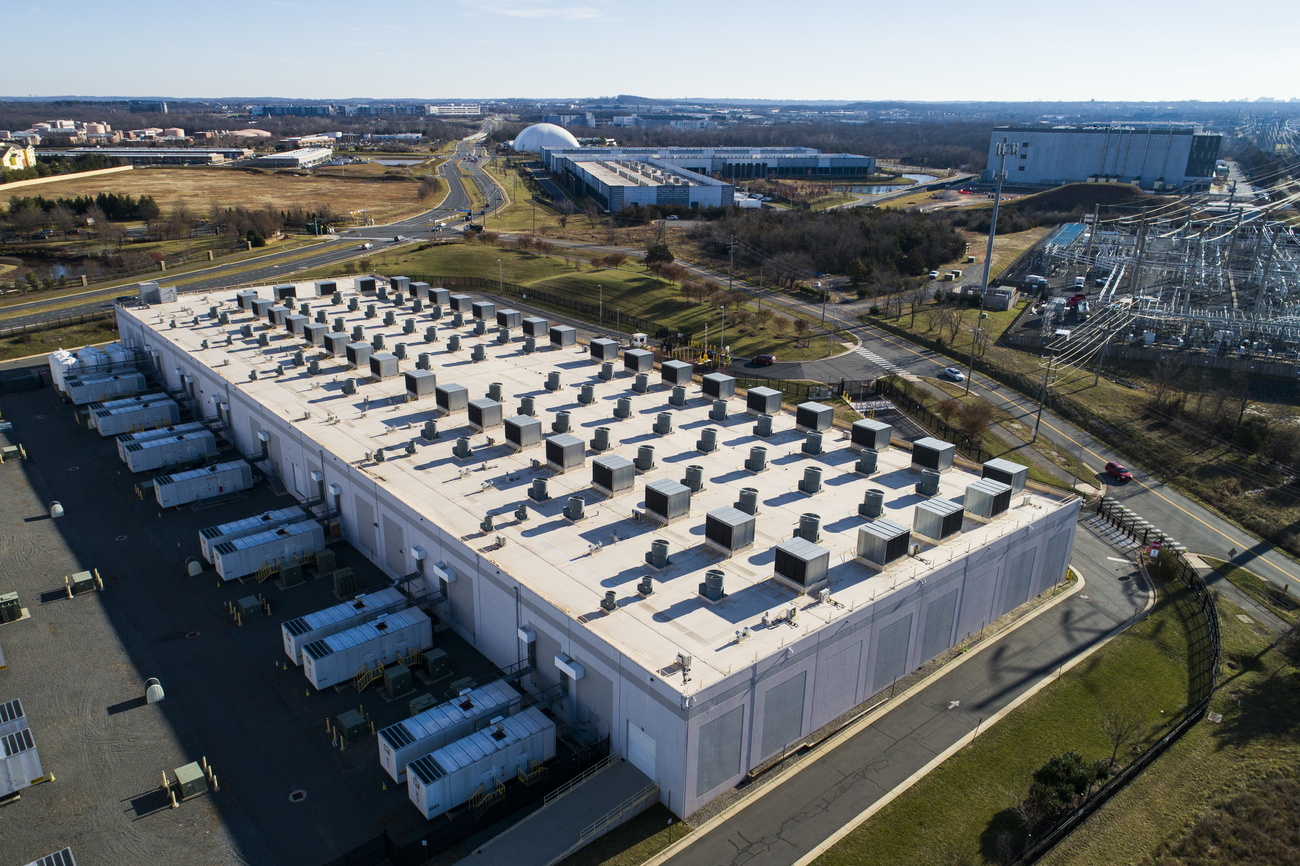
Ashburn, Virginia (USA) is home to the largest data centre cluster in the world – including this one belonging to Amazon Web Services (AWS).
Keystone
Sustainable solutions, societal benefits
Switzerland’s CSCS mitigated these risks by avoiding diesel generators, one of the main sources of air pollution. But Ren still sees room for improvement. The environmental impact of supercomputing is huge even with the use of green energy and recycled cooling water, he explains. Supercomputers’ vast energy demands can strain local grids, while their extensive cooling systems lead to water loss through evaporation. He compares the current situation for AI to the automotive industry, which was initially very polluting but later became more efficient.
“We can do better,” he says, suggesting practical steps like situating data centers in regions with abundant and cheap renewable energy and natural cooling resources, such as cold lakes and rivers, snow reserves and underground areas for geothermal cooling. According to Ren, the Nordic countries would be ideal for outsourcing local computing capacities, an option that CSCS director Thomas Schulthess has already publicly backed.
Giuffreda, however, says this possibility should be considered with caution. “We have to think about whether it is really conceivable to move strategic infrastructure to places where we do not have total control,” she says.
More
Meanwhile for Vlad Coroama, the success of the Swiss initiative will be measured above all by its societal benefits.
“For large scientific and climate simulations, a supercomputer is essential,” he says. He points out that enerative AI models such as ChatGPT or Google Gemini consume much larger amounts of resources than Alps, and with fewer tangible benefits. “It’s a waste of energy to use these huge, very powerful models for small tasks like writing emails,” he adds.
The Alps supercomputer could offer more, Coroama says. “Good science costs money; but it’s worthwhile when it brings real value to society as a whole.”
Edited by Sabrina Weiss and Veronica De Vore/dos


