


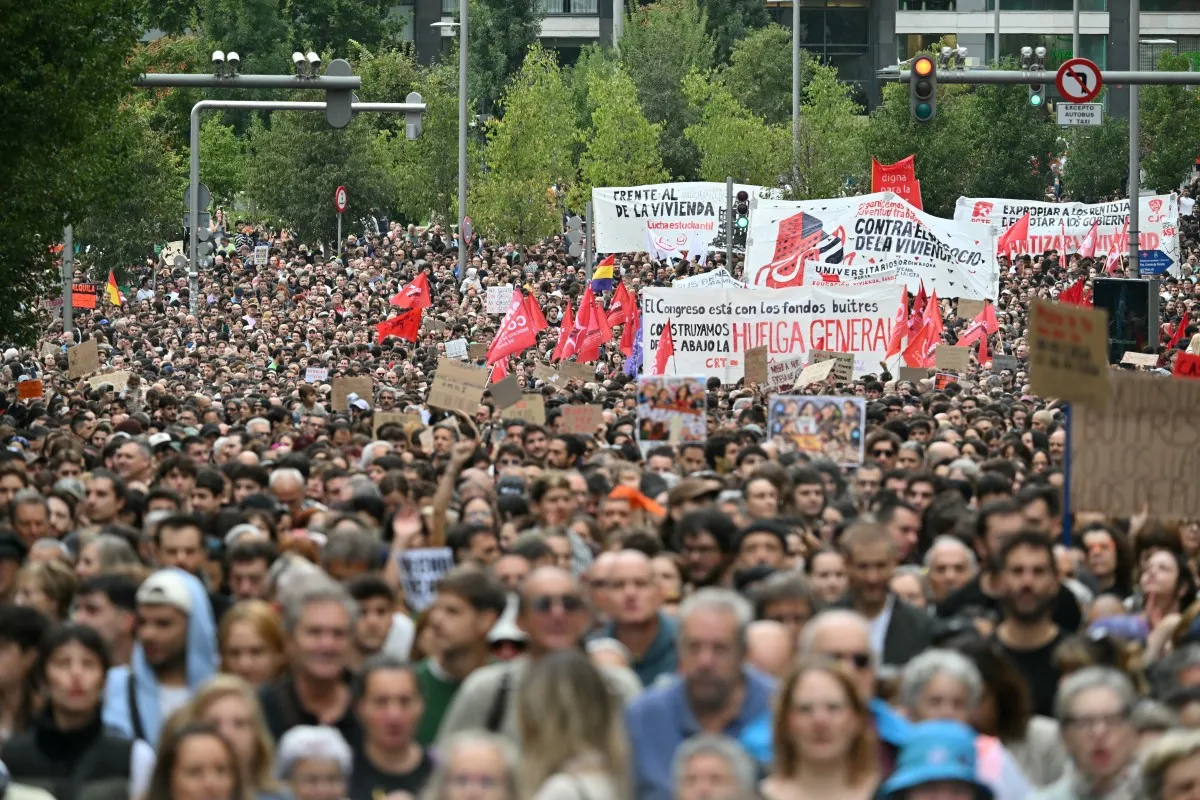
Spurred by calls for housing reform and the high-profile eviction case of Maricarmen Abascal, Spanish unions have joined forces with tenants groups for the first general strike in Spain since 2012.
Spain is preparing not only for a general election but now a general strike too.
Prime Minister Pedro Sánchez’s surprise snap election announcement came days after right-wing parties voted down two key decrees in parliament which included measures such a moratorium on evictions, a ban on vulture funds, automatic rental contract extensions and restrictions on temporary and room rentals.
Protestors took to the streets across Spain, but it wasn’t a snap election that they were calling for, rather a general strike that could bring the country to a standstill.
READ MORE: Housing protests flare in Spain after relief measures rejected
From Bilbao to Badajoz and Oviedo to Ourense, one of the recurring slogans was “¡Huelga general ya!” (General strike now!).
Organisers from the Tenants’ Union (Sindicato de Inquilinas) declared these demonstrations as the launch pad for an upcoming “general strike against rent-seeking and in defence of the right to housing”.
Don’t miss our journalists’ daily news roundup from Spain
When is the strike?
The walkout will take place on Wednesday 11th November — just two days before the official start of the election campaign.
This is reportedly because, as the electoral process formally begins on November 13th, union bosses don’t want to risk a political party challenging the strike notice before the electoral authorities.
Are general strikes common in Spain?
No, the last general strike in Spain was in 2012 when a 24-hour stoppage was called against the austerity policies of the PP government of Mariano Rajoy.
What are they striking over?
According to the joint CCOO and UGT press release, unions are striking “to demand decent wages to enable access to decent housing”.
“Last weekend’s demonstrations have shown the strength of this demand, and the response must be built jointly by all the organisations supporting it,” the trade union confederations added, emphasising the significance of the fact that thousands of demonstrators had called for the strike.
Union bosses have described the eviction of Maricarmen as the “spark” for action that connects housing with wages and labour rights.
Can everyone take part in the strike?
No, in Spain there are several groups that are excluded by law from taking part in general strikes.
These include members of the military, state security forces and law enforcement, serving judges, magistrates and prosecutors, self-employed workers, as well as several essential service sectors including healthcare, social care, transport, security, and telecommunications.
The government sets minimum service levels for sectors, and employers inform those included in these that they may not miss work on strike days.
Is it legal?
Some might argue it is.
Article 11 of Spain’s royal decree 17/1977, which outlines labour relations rules, states that a strike is unlawful:
- Where it is initiated or maintained for political reasons or for any other purpose unrelated to the professional interests of the workers concerned.
- Where it is a strike of solidarity or support, unless it directly affects the professional interests of those who organise or maintain it.
Spain’s major employers’ organisation CEOE has also hinted at a possible legal challenge to the strike: “The demands that have led to this announcement are not, in essence, of a labour-related nature,” reads a statement issued on Tuesday.
The employers’ organisation also criticised the unions and housing movement for seeking to influence the election.
“It is difficult to justify using the activities of companies and their workers as a means to influence the outcome of a process that should be approached with calm and in accordance with democratic norms,” the employers argue.
READ ALSO: Why has Spain’s PM called a snap election?


