


Wildfires typically occur after long periods of dry weather and during summer heatwaves, which often go hand-in-hand, as is the case currently in Switzerland.
Temperatures exceeding 30C combined with prolonged drought are, quite literally, recipes for disaster.
At the start of July with Switzerland braced for another heatwave, the risk of wildfires was considered very high.
The map below from the Swiss government shows the areas that were most at risk in early July. The regions marked in dark red were considered ‘very high danger’, whilst those in bright red were “high danger”. An orange level warning means “considerable danger” whilst for those areas marked yellow the danger is considered “moderate”.
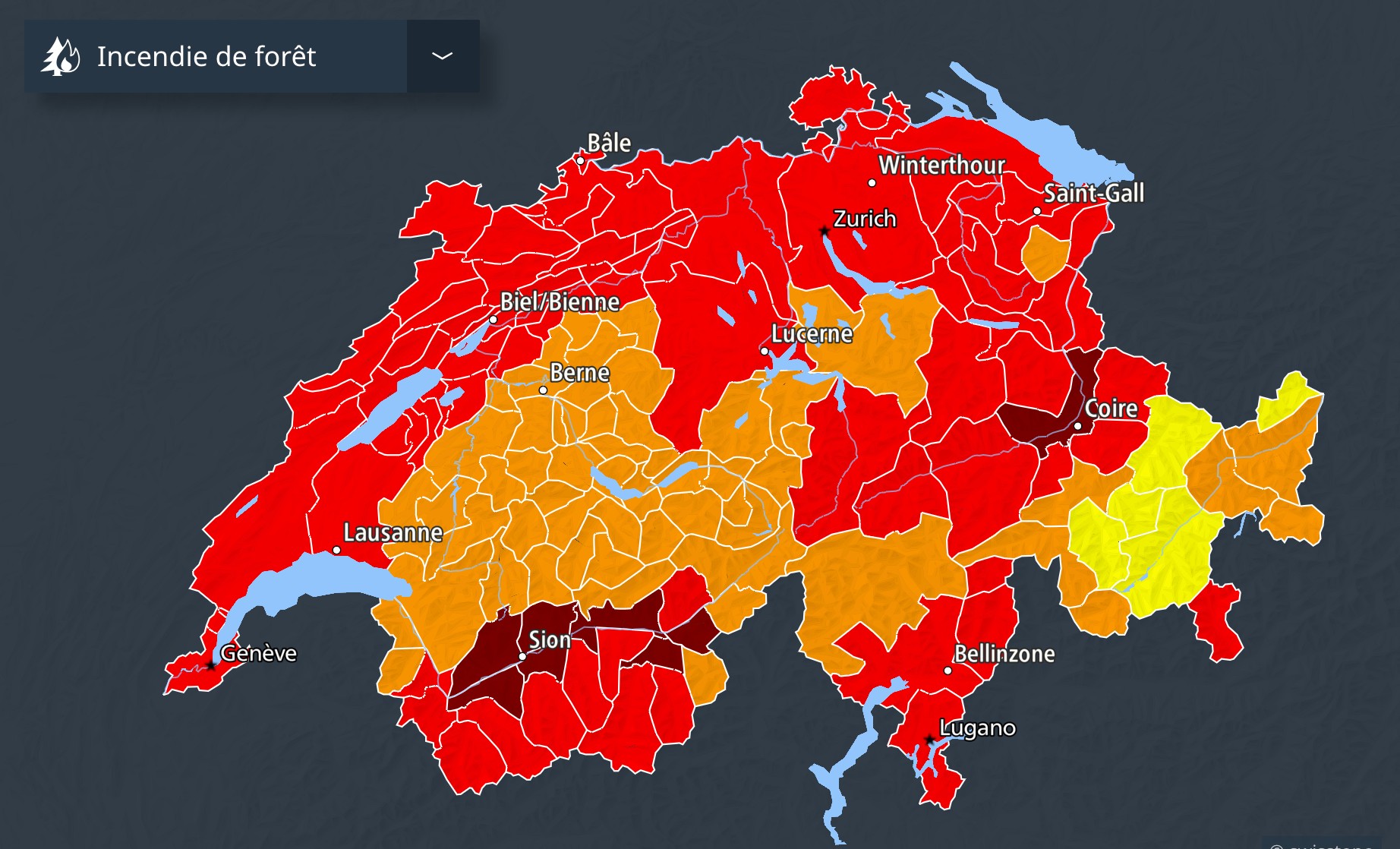
Image source: https://www.dangers-naturels.ch/#hazards-tab=forestfire
You can follow the Swiss government’s alerts on wildfires at its “natural hazards” site by checking the most recent messages.
For example on Wednesday July 8th the latest message warned of the “very high danger” from forest fires in certain areas in particular Valais (VS): Südrampe (VS), Riddes (VS), Sion-Sierre (VS), Simplon north (VS), Vispertal (VS), Montana (VS), Fully (VS), Rheintal (GR).
More information is available for each canton on The Federal Office for the Environment (FOEN).
In July many cantons in Switzerland had implemented measures to prevent the ignition and spread of wildfires, with several imposing an absolute ban on open fires. The FOEN has made an interactive map available so residents can check on the measures that are in place in their canton.
The grey and black striped areas show where the outright ban on fires in the open was in place in early July.

Image: The Federal Office for the Environment (FOEN
Be aware of danger levels
In Switzerland (as in many other countries), the risk of natural disasters – including earthquakes, avalanches, flooding and, yes, wildfires – is rated by the government numerically from 1 (‘low)’ to 5 (high).
Here’s what they mean:
1 – No or low danger (green)
Ground and surface fires are unlikely to occur. Tree crowns are not affected. A lightning strike is unlikely to cause a fire.
What you should and should not do:
- Do not throw away burning/smouldering cigarettes, matches, etc. in or near the forest.
- Always watch a fire and extinguish any sparks immediately. Always extinguish embers completely when leaving, ideally with water and sand/earth.
Speed of spread: Usually slow.
Level 2 – Moderate danger (yellow)
Ground and surface fires may occur. Tree crowns are unlikely to be affected. A lightning strike may cause a fire.
Recommendations for action:
- Do not throw away burning/smouldering cigarettes, matches, etc. in or near the forest.
- Always watch a fire and extinguish any sparks immediately. Always extinguish embers completely when leaving, ideally with water and sand/earth.
Speed of spread: Slow to medium.
Level 3 – Considerable danger (orange)
Ground and surface fires may occur. Individual tree crowns may also be affected. Lightning strikes are likely to cause a fire.
Recommendations for action:
- Always watch a fire and extinguish any sparks immediately. Always extinguish embers completely when leaving, ideally with water and sand/earth.
- Do not light fires outdoors
- Follow the orders of the local authorities (e.g. fire bans).
Speed of spread: Rapid in open terrain, medium in forest.
Level 4 – High Danger (red)
Hot surface fires spreading to individual tree crowns may occur. Burning embers may be thrown and spark new fires. Lightning strikes are highly likely to cause a fire.
Recommendations for action:
- Do not light fires in strong winds.
- Follow the orders of the local authorities (e.g. fire bans).
Speed of spread: Rapid in open terrain and in forest.
Level 5 – Very High Danger – dark red
Very hot ground fires and widespread crown fires may occur. Burning embers may be thrown over large distances and spark new fires. Lightning strikes are highly likely to cause a fire.
Recommendations for action:
- Do not light fires outdoors.
- Follow the orders of the local authorities (e.g. fire bans).
Speed of spread: Very rapid over long periods in open terrain and in forest.
What should you do if you see a wildfire in Switzerland?
The government’s advice in such situations is that “while a forest fire is burning, avoid any kind of panic, act calmly and exercise good judgment. Follow the sequence: raise alarm – rescue – extinguish.”
This is the recommended sequence of action:
Raise alarm
- Report forest fires immediately by calling national fire service number, 118
- Warn people who could be endangered by the fire.
Rescue
- Rescue people and animals.
- Use blankets or coats to wrap around people whose clothes are burning (roll them on the ground and cool with water).
- Vacate the scene of the fire.
Extinguish
- Do not take any risks.
- Follow the instructions of the local fire and forestry service.
Where in Switzerland are wildfires most likely to occur?
According to the Federal Meteorological Institute MeteoSchweiz, these fires “most often affect small areas. Besides the valleys that are regularly exposed to the foehn, the primarily endangered regions are Valais, Graubünden and Ticino.”
However, no area is totally safe from such a fire, especially in hot and dry conditions.
The largest forest fire ever recorded in Switzerland broke out in 1973 near Bogno in Ticino, destroying 1,600 hectares of forest.
Thirty years later, in 2003, a fire above Leuk in Valais destroyed 300 hectares of forest. It is the largest fire recorded to date in that canton.


