


Every year at Christmas, Spaniards go lottery mad, queuing for hours to buy tickets for the famous “El Gordo” – The Fat One – and this year is no exception.
Spain’s Christmas Lottery, known as El Gordo (The Fat One) has taken place every year on December 22nd since 1812 without fail, even during the Spanish Civil War years and the coronavirus pandemic.
This year, a total of €2.772 billion will be at stake in the draw, €60 million more than last year.
The 2025 top prize money is €4 million per full ticket, which works out as €400,000 per décimo for people who buy one-tenth of a ticket.
The second prize per décimo is €125,000 and the third is €50,000.
Then there are two fourth prizes (€20,000 per décimo), eight fifth prizes (€6,000 per décimo) and 1,794 prizes of €100 per décimo.
With the odds of winning at least something put at one in six, no wonder the Christmas lottery has a whole nation gripped.
According to the latest stats, 85 percent of residents aged between 18 and 75 play the Spanish Christmas lottery – that’s 27 million people in total.
Data from the State Lottery and Betting Society (SELAE) shows Spaniards will invest €76.08 on average in buying lottery tickets for the Christmas draw on Monday December 22nd.
READ ALSO: Is there a science to winning Spain’s Christmas lottery?
Advertisement
History
El Gordo is a Spanish institution and the second oldest lottery in the world.
The first Christmas lottery took place on 22nd December 1812 in Cádiz and the event has been taking place on the same day every year since.
 Some of the winners from 2021’s El Gordo. Photo: OSCAR DEL POZO / AFP
Not even the Spanish Civil War could stop the Christmas lottery, which moved to Valencia when the Republican government had to relocate their capital from Madrid.
After the war, the lottery moved back to Madrid and continued under the regime of the dictator Francisco Franco.
READ ALSO: Where to find traditional British Christmas food in Spain
Advertisement
How it works
Because so many people in Spain take part in El Gordo, the ticketing system is complicated.
Unlike in the UK, for example, you don’t go into a newsagent and shade in the numbers you want on your lottery card. Instead, lottery shops have certain numbers available.
This is why the big winners of the Christmas Lottery are usually from the same area: many people have bought tickets from the same shop which holds all the winning tickets.
This assigning of numbers to certain shops means if you want to ‘play’ a particular number, you might have to travel quite a way — or buy your tickets online.
It’s also possible to track down where to buy your preferred number using online search tools like this one from El Mundo.
In terms of prizes, because so many people take part, numbers are repeated up to 172 times. That means if you do win ‘the fat one’, you will be sharing your prize with at least 171 others.
This explains why the top individual prize in the biggest lottery in the world comes in at a ‘mere’ €4 million for the winning serie (a set made up of one ticket of each number that participates in the draw).
One ticket (billete) costs a whopping €200, but many people choose to buy a tenth of a ticket (un décimo) for €20.
Even smaller portions of tickets are sold: it is common for businesses to buy a ticket then sell small portions, or participaciones, of that ticket to their patrons for €1.
Advertisement
Where to buy them
You can purchase a ticket in a lottery shop but they are also available at local bars, restaurants and through syndicates at workplaces, social clubs etc. You can also purchase them online.
Sometimes it means shelling out for several just so you are not left out of the group in case of a win!
Tickets are on sale in the lottery shops until 10pm on December 21st or online until 11.45pm.
Anyone can play the Christmas lottery in Spain, regardless of whether you’re a Spanish national or have residency here. If you win, smaller prizes can be collected in person, but for the larger wins you’ll need a Spanish bank account to receive the transfer and pay tax on it.
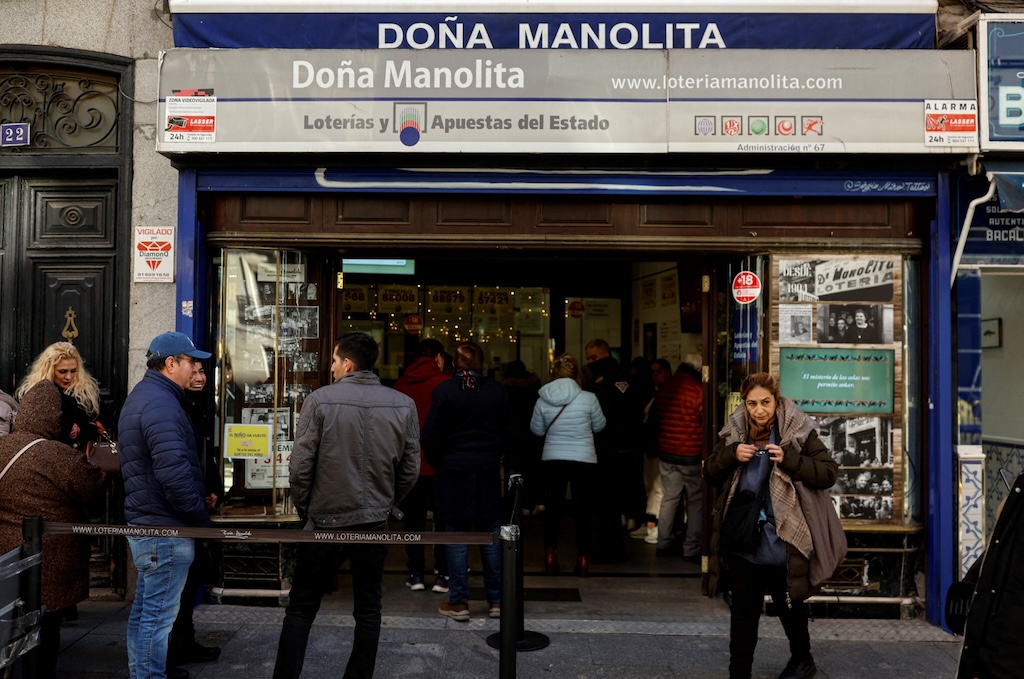
People queue to buy tickets of the Spain’s Christmas lottery “El Gordo” (the Fat One) at the popular “Dona Manolita” lottery outlet in Madrid. Photo: OSCAR DEL POZO / AFP
The advert
Every year the Christmas lottery releases a suitably schmaltzy advert, and the campaign for 2025 is no exception. This year, it centres on the story of a couple who find a 30-year old lottery ticket at a flea market. The woman discovers that the ticket actually won and goes on an adventure to try and find the owner. You can watch it here.
Most sought-after numbers
The most requested numbers tend to be connected to an important date over the year that’s about to end. This year the most popular is 00093, the number Marc Márquez wore when he was crowned MotoGP World Champion. Another popular one is 28425, which refers to the day the nationwide blackout happened on April 28th. Many are also searching for 21425 – the death of Pope Francis and 08525 – the election of the new Pope Leo XIV on May 8th.
Last year, as well as this year, popular ones were 29104 and 30104 – the dates of the devastating storms and flooding in Valencia and Albacete.
In 2022, it was 24222, the day the war in Ukraine started. In 2021 it was 80121, the date on which Storm Filomena brought Madrid to a snow-covered standstill. In 2020, tickets numbered 140320, the number that symbolised the start of the Covid State of Emergency, sold out.
Spaniards also check numbers that have won previously. Tickets with numbers ending in ‘5’ are also popular as numbers that end in a ‘5’ have won a total of 32 times. Those ending in ‘4’ and ‘6’ are also popular as they have been awarded 27 times each.
The day itself
Every 22nd December the streets of Spain are silent as everyone huddles around their televisions to watch the El Gordo lottery draw, an affair which begins at 9am and can take over three hours.
The balls are drawn in a unique way befitting the unique lottery tradition, while the numbers are sung by the pupils of Madrid’s San Ildefonso school.
The school was originally a home for orphans and the tradition of the winners of El Gordo donating a portion of their winnings to San Ildefonso dates from this time.
The balls were originally only drawn by boys, with the first girl taking part in the big draw singalong in 1984. Audience members at the live draw, as well as viewers watching from home, are known to dress up in lottery-themed clothing and hats.
On the stage itself are two spherical vessels, one containing balls embossed with the numbers found on the lottery tickets and the other featuring the associated prizes in euros.
“Ball number 20.456 gets €20,000!” they might sing. This goes on, the tension rising until, at some point in the live broadcast, the €4-million ball is drawn making the numbered ball drawn alongside it El Gordo.
The coverage of the draw has famously lambasted as “the most boring Christmas show on TV”.
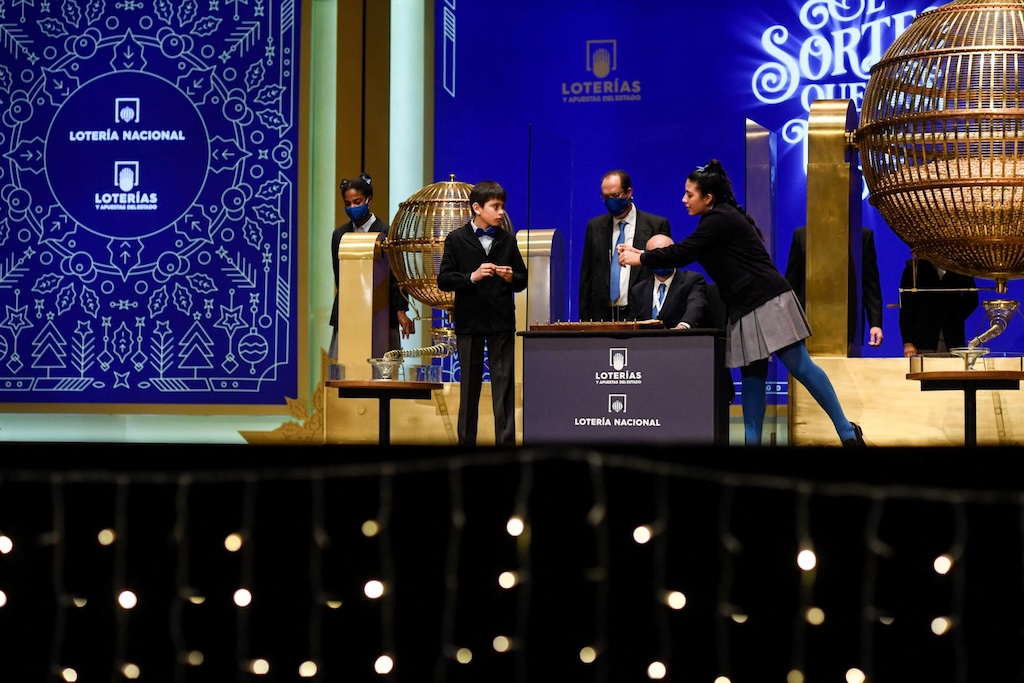
Children sing during Spain’s Christmas lottery “El Gordo” (the Fat One) at the Royal Theatre in Madrid. Photo: OSCAR DEL POZO / AFP
The winners
In 2011 the tiny Spanish village of Sodeto famously won El Gordo, with all but one of its 250 inhabitants having bought a lottery ticket. The unlucky loser was a Greek resident who lived on the edge of town and failed to buy a ticket because he did not realize just how big the Christmas lottery was.
The winners each claimed a share of €120 million, with people collecting sums ranging from €100,000 to €1 million each.
This was the first time in El Gordo’s 200 year history that one entire village had won the prize, but it is not uncommon for many people in the same location to all win at the same time, given lottery shops are often assigned the full complement of a given number.
This should be a lesson to us all. No-one wants to be the only within a community who missed out on the win!
Are the winnings tax free?
Crisis-hit Spain taxed the lottery for the first time in 2013, with the Spanish government hitting the headlines for the 20 percent tax imposed on prizes over €2,500 in the much-loved lottery.
In 2022, that limit was raised to €40,000 tax free on each winning ticket, meaning the winner of a top prize décimo will get the first €40,000 of the €400,000 tax free and pay 20 percent tax on the rest. Therefore €72,000 would go to Spain’s Hacienda taxman and the winner would keep €328,000.
Warnings
The Christmas lottery is also not immune to scams. Madrid’s city council warns people to buy their tickets only from authorised vendors, and not to believe emails telling them they had won prizes.
Last but not least, the council warns people to keep their ticket safe as losing them makes claiming prizes very difficult indeed.
And there is lots of advice on how to ensure that there’s is no argument between friends sharing a winning ticket.
The best idea is to take a photo of the number, share it on WhatsApp with each other and the terms written underneath, that way there can be no argument later.


