


An accident is not on anyone’s ‘to-do’ list, but sometimes bad things unfortunately happen to good people. These are the steps to take if you are involved in a road accident in Switzerland.
Of course, nobody plans on a car accident, with many of us thinking it’ll never happen to us. Even if you are a safe driver, you could still be a victim of an accident caused by another person.
Nearly 18,000 traffic accidents involving injuries were reported in Switzerland in 2020. Fortunately, the vast majority were relatively minor; over 3,700 people were seriously injured and 227 were killed.
The only bright spot among these grim statistics is that the number of car accidents has dropped considerably — by 62 percent — in the past two decades.
EXPLAINED: How does roadside assistance work in Switzerland?
What should you do if you are involved in an accident?
If this happens, it is normal that you might get nervous, stressed out and feel in a state of shock, possibly forgetting how to act and what to do.
The steps to take are the same whether you or the other driver(s) are at fault. According to motoring organisation Touring Club Suisse, this is what you must do immediately after a traffic accident.
Advertisement
Stop and keep calm
This is easier said than done but it is essential that you keep a cool head.
- First, turn on your distress signals
- Determine the number of vehicles involved, their positions and the nature of the accident
- Secure the scene of the accident by installing the warning triangle at least 50 metres (approximately 60 paces) from the scene of the accident. Note to self: make sure you have these triangles in the trunk of your car.
Make an accident report in writing
Describe the course of the accident with the help of the European accident report. If you don’t already have this document, you can download it here.
Always keep this document in the glove compartment of your vehicle: hopefully, you will never need it, but it is better to be prepared.
In the best-case scenario, everyone involved in the accident can stay polite or, in the very least, civil. All parties can then fill out the accident report together, with each person signing it.
Taking photos of the damage is always helpful.
Declare the accident to the insurance company
Don’t repair your vehicle until after your insurance company has examined it.
If you are at fault, your insurance will settle with the other driver(s)’ insurance; if the other party is responsible, then your carrier with seek compensation from the other policyholders.
READ MORE: Which Swiss canton has the worst drivers?
When should you call emergency services?
Traffic accidents are common and most are minor, not requiring an intervention from emergency services or law enforcement.
However, one or the other (or both) should be called if:
- You or other people involved are injured (ambulance number: 144)
- There is a risk of fire or explosion: call the fire department (118)
- When an argument or a fight erupts among the parties involved in the accident, call police (117).
Advertisement
What equipment should you always have in your car?
In Switzerland, you are only required to have the triangle, according to TCS. Safety vests are not obligatory but it is good to have one nevertheless, as they are compulsory in many other European countries, including Switzerland’s neighbours.
This map shows where the vests are required:
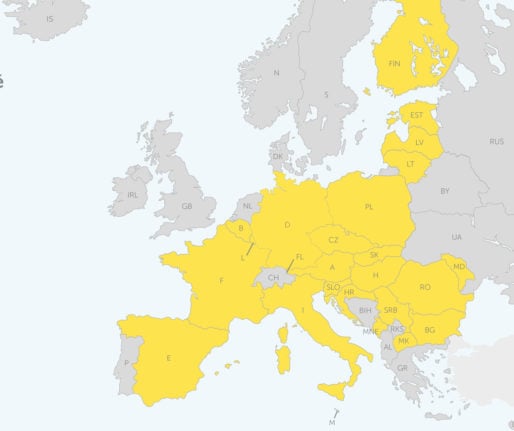
Countries marked in yellow require safety vests. Image: TCS
Another very important thing to know before you even hit the road (though hopefully not literally): car insurance is mandatory in Switzerland, even if it is only the basic one that doesn’t cover your own vehicle, but covers others.
READ MORE: Everything you need to know about car insurance in Switzerland


