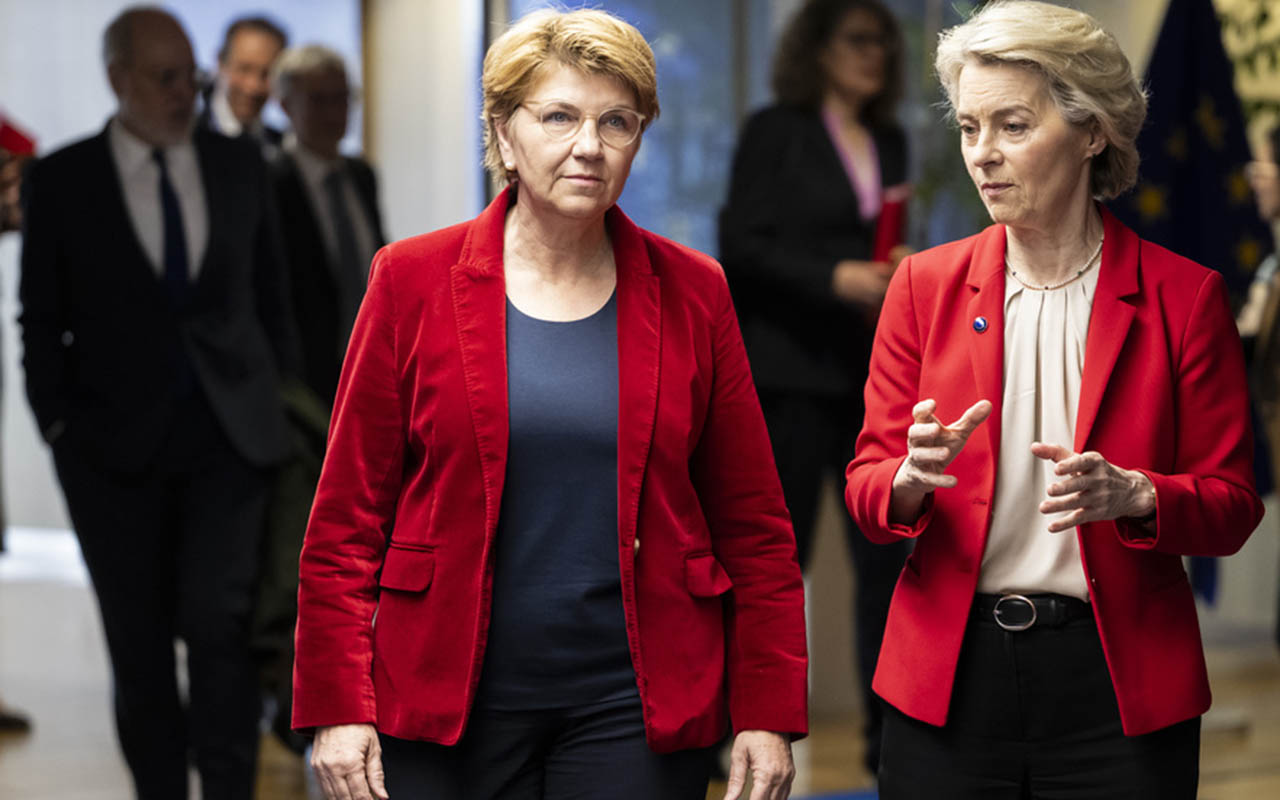
Swiss Federal President Viola Amherd, right, shakes hands with European Commission President Ursula von der Leyen, left before a bilateral meeting on Friday, December 20, 2024 in Bern, Switzerland. Van der Leyen pays an official visit to Switzerland to formally mark the conclusion of the negotiations between the EU and Switzerland.
Keystone / Alessandro Della Valle
Relations with the European Union (EU) will be the main political nut to crack in the coming year. The Swiss government will have to defend the agreement reached with Brussels. The debate, which promises to be heated, is of particular importance to the Swiss Abroad.
At the heart of Switzerland’s political agenda for 2025 are relations with the European Union. After months of tough negotiations, the Swiss government has finally reached an agreement with the 27-member bloc, the broad outlines of which it unveiled before Christmas.
The president of the European Commission, Ursula von der Leyen, travelled to Bern for the occasion, where she called the accord between Switzerland and the EU “historic”. “We’re giving common responses to a global reality,” she said. Next to her, Swiss President Viola Amherd spoke of a “milestone for the stability and development” of bilateral relations.
The government wants to bring together the agreements aimed at stabilising the bilateral relationship in a federal “stabilisation” decree. This would include the updating of existing agreements, which include rules on state aid, participation in EU programmes and Switzerland’s cohesion contribution. The three new agreements – on electricity, health and food safety – will be presented separately in “development” federal decrees.
Heated debates on the horizon
The successful conclusion of the negotiations between Bern and Brussels is a first step – but the hard work is not over. A consultation period is to be scheduled before the summer. The year 2026 will be even tougher: that’s when parliament will debate the package of agreements.
The government will need to convince the two chambers – not an easy task, given opposition to the agreements among some parliamentarians and interest groups. The right-wing Swiss People’s Party opposes closer ties with the EU. Trade unions will too if they find that wage protection is under threat.
Even if lawmakers approve the package of agreements, voters will still need to have their say. According to several media reports, the government may end up separating the package into parts, which means that several votes and referendums would have to be held. All signs are already pointing to lively voting campaigns.
More
More
The Swiss are deeply divided over relations with the EU
The debate could be further stoked by three people’s initiatives in the pipeline that touch on Swiss-EU relations – even though they are still at the stage of signature-collection and no votes will take place in 2025.
Two of these initiatives could jeopardise the outcome of the new deals with the EU. They are the “No to 10 million Swiss” initiative of the People’s Party, which clearly calls for an end to the free movement of people, and the “Compass Initiative” driven by three billionaire entrepreneurs, which seeks to prevent the automatic incorporation of European law into Swiss law.
The pro-Europeans also have their own initiative, put forward by the Operation Libero movement, which wants closer ties with the EU. However, the collection of signatures for this text is struggling, and the undertaking may even fall through.
The whole issue is also of central importance for the Swiss Abroad. As Ariane Rustichelli, the outgoing director of the Organisation of the Swiss Abroad (OSA), points out, “the bilateral agreements and their future have a direct impact on the rights and mobility of Swiss nationals living in Europe”.
Slimming regime for federal finances
On the domestic front, the government will have to carry through its comprehensive savings programme, announced last September. It wants to save CHF3.6 billion ($4 billion) from 2027, particularly in the fields of social welfare and international cooperation. The aim is to bring federal finances back on a sound footing, despite increased expenditure, primarily for the army and old-age pension provision.
Finance Minister Karin Keller-Sutter, who holds the rotating Swiss presidency in 2025, has her work cut out for her, as the planned economic measures are causing discontent on many fronts: the left, the cantonal governments and even the right. The consultation process is due to begin in late January, and then it will be up to the parliament to examine the planned cuts. The left might be tempted to ride on the wave of its referendum successes by attacking the austerity package. In this case, the people could be called on to vote on it very soon.
Some of the planned measures in the federal government’s economy drive also have a direct impact on the Swiss Abroad. “The 10% cut in subsidies to the OSA and educationsuisse [the umbrella organisation of the 17 Swiss schools abroad] and the threatened closing down of SWI swissinfo.ch could weaken the political representation of the diaspora, as well as communication with the Swiss Abroad, even as the community of Swiss living abroad continues to grow,” says Rustichelli.
A light agenda for votes
The upcoming year looks likely to be a rather quiet one with regard to popular votes. The first Sunday of federal voting sets the tone, with just one issue being put to the ballot on February 9. This is the Young Greens’ “environmental responsibility” initiative, which seeks to oblige the Swiss economy to develop in a way that respects the planet’s limits. Its opponents accuse it of jeopardising Switzerland’s prosperity, and the text is struggling to win over anyone other than left-wing voters.
More

More
Swiss ‘environmental responsibility’ initiative: essential for the left, unacceptable for the right
As for any other issues that might be on the cards, uncertainty still reigns. Several popular initiatives have been successfully launched, but parliament has not yet finished examining them. It is not yet possible to know which ones will be ready for submission to the citizens for approval. “It all depends on how quickly parliament progresses in its work,” says Beat Furrer, the Federal Chancellery’s information officer.
It is likely, however, that the so-called cash initiative will be put to a popular vote this year. The text, launched by the Swiss Freedom Movement – whose members include opponents of the measures to fight Covid-19 – seeks to ensure that a sufficient quantity of coins and banknotes is always kept in circulation in order to avoid the complete digitisation of money.
Would you like to receive all the information you need during federal voting periods? Subscribe to our newsletter.
The people could also be called to cast their vote on a question that has been debated for years, and which has been taken up in an initiative – “For fair taxes” – by the women of the centre-right Radical-Liberal Party. The text calls for married couples to be taxed individually rather than jointly, so that they do not pay more tax than single people.
Two more issues may also be ready to go to a nationwide vote: foie gras and fireworks. A popular initiative wants to ban the import of foie gras and products based on it. With this text, the Swiss Animal Alliance is seeking to ban a foodstuff that requires the “force-feeding” of thousands of animals.
Another initiative wants to prohibit the sale and use of fireworks. Former journalist Roman Huber, the driving force behind the campaign, argues that firecrackers are stressful for noise-sensitive people and for animals.
An even bigger question mark hangs over any referendums that might lie ahead. No signatures are currently being collected on any issue. According to the Federal Chancellery, it is therefore possible that no referendums will be put to nationwide vote in 2025.
To make it easier for the Swiss Abroad to take part in the various ballots, the OSA intends to continue supporting the introduction of electronic voting in the cantons. E-voting is currently being tested in three cantons – Basel City, St Gallen and Thurgau – and in several municipalities. In this context, Rustichelli of the OSA believes that parliament’s endorsement of electronic identity is a step in the right direction.
Edited by Samuel Jaberg. Adapted from French by Julia Bassam/Geraldine Wong Sak Hoi