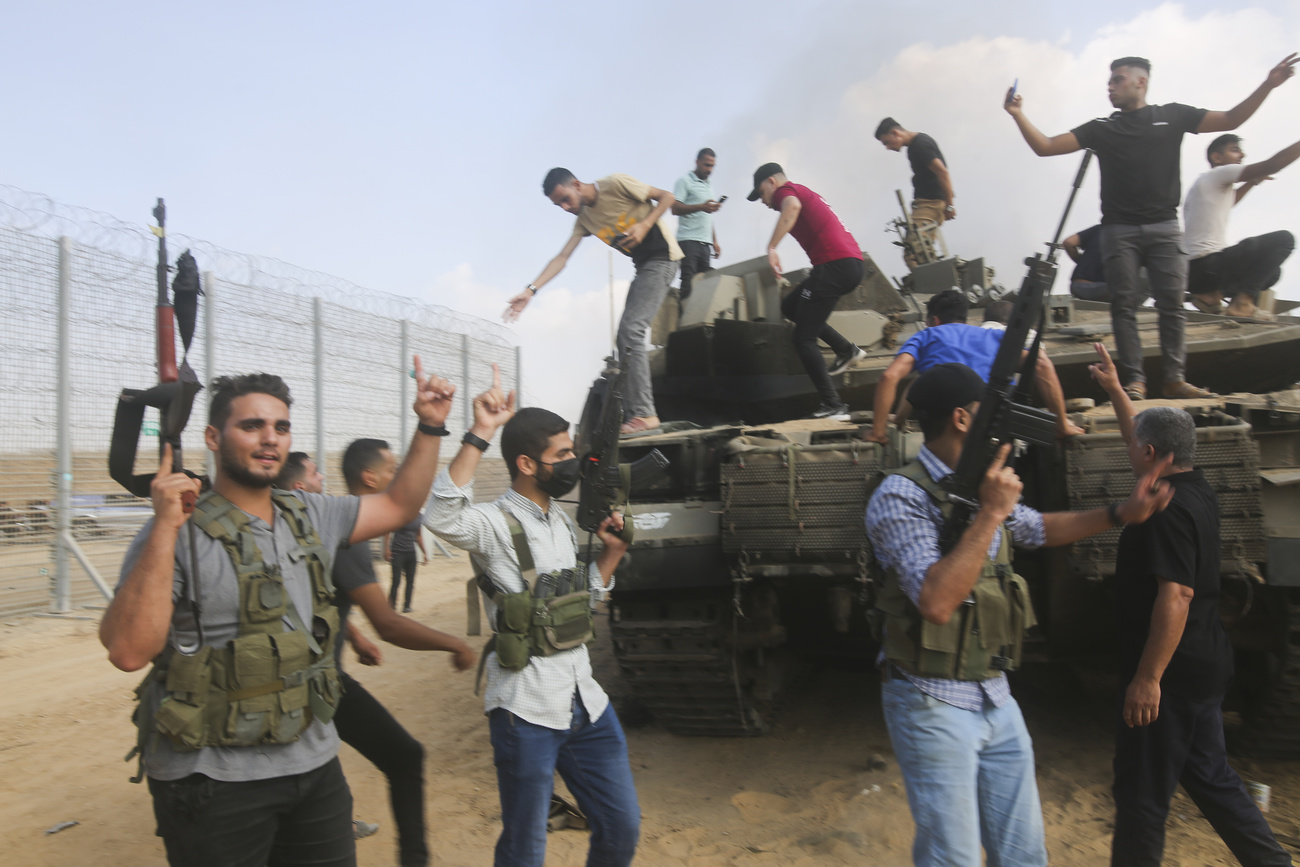
Hamas fighters celebrate the massacre of Israelis on October 7, 2023.
Copyright 2023 The Associated Press. All Rights Reserved.
Does it harm Switzerland’s good offices if it bans Palestinian militant group Hamas? Parliament has been debating this for years. Now the arguments in favour of a ban have won.
Until now, Switzerland has deliberately exercised restraint in banning terrorist organisations, preferring to keep its doors open. “We talk to everyone” is the slogan of Swiss diplomacy.
This also applied to Hamas. Switzerland maintained a discreet but at times intensive dialogue with Hamas for decades, until just a few years ago. “Switzerland uses its contacts with Hamas in Gaza to urge them to comply with international humanitarian law” – this was how the government explained its policy in 2017, when the call to ban Hamas first emerged in the Swiss parliament.
More
More
Swiss parliament approves a five-year ban on Hamas
Even then, the government emphasised the importance of good offices in its foreign policy. It also justified its so-called contact policy with Hamas by saying Switzerland’s engagement “is aimed at preventing violent extremism”.
This didn’t work. In 2023 Hamas committed the massacre of October 7 in Israel, the worst pogrom against Jews since the Holocaust. Hamas members killed 1,200 people and abducted 250. It said such attacks would be repeated until Israel was destroyed.
After that, dialogue was over – also for Switzerland. Under pressure from parliament, the government imposed a ban on Hamas. Parliament has now sealed this law.
Diplomats are concerned
For Switzerland this is a departure from its previous doctrine. It banned al-Qaeda and the Islamic State, and that was that. Until then, the neutral country had merely adopted the existing UN bans when it came to sanctioning terrorist organisations. That is what its law requires. Hamas, however, is not on the UN terror list. This is why Switzerland first had to create a special law to be able to overturn its own self-imposed prohibition policy.
This should now remain an exception. “We don’t want to create an automatic ban,” says one politician involved in security.
More

More
How easy is it for Switzerland to declare Hamas a terrorist organisation?
Swiss diplomats are nevertheless concerned. Until now, they have positioned their small state as a neutral broker around the world. Now some of them fear that in future, partner countries – such as the United States or Turkey – could put pressure on Switzerland to ban their disagreeable organisations, either to send a signal or to track down their financial flows.
Other countries, that are not neutral, were quicker to ban Hamas. The EU placed Hamas on its terror list as early as 2003, following the attacks of 9/11. At the beginning of 2024, after the massacre of October 7, it extended this ban and imposed sanctions. The US (1997) and the UK (2001) also explicitly banned Hamas. Israel was the first to do so, banning the organisation as soon as it was founded.
Switzerland maintains numerous parliamentary groups. These bring together members of parliament from different parties who are committed to a common cause. One of these is the pro-Israel Parliamentary Group Switzerland-Israel. For its members, Switzerland’s ban comes soberingly late.
“We should have banned Hezbollah and Hamas a long time ago. You can see who they are working with,” says its president Alfred Heer, who points to the toppled Syrian dictator Assad and Iran, which is causing unrest throughout the region. Heer is bitter that it was the mass murder of October 7 that made the Swiss ban possible.
For him, there is no difference between the Shiite Hezbollah and the Sunni Hamas. That’s why he has always argued in favour of a ban on Hezbollah. “Hamas was created to torpedo peace in the Middle East, and Hezbollah sends the missiles to do so,” he says. “It destabilised Lebanon and kept a butcher in power in Syria.”
Will it remain an exception?
Will Hezbollah be banned as well? The Swiss government didn’t want that, even though a motion from the security policy committees of both chambers of parliament called for exactly that.
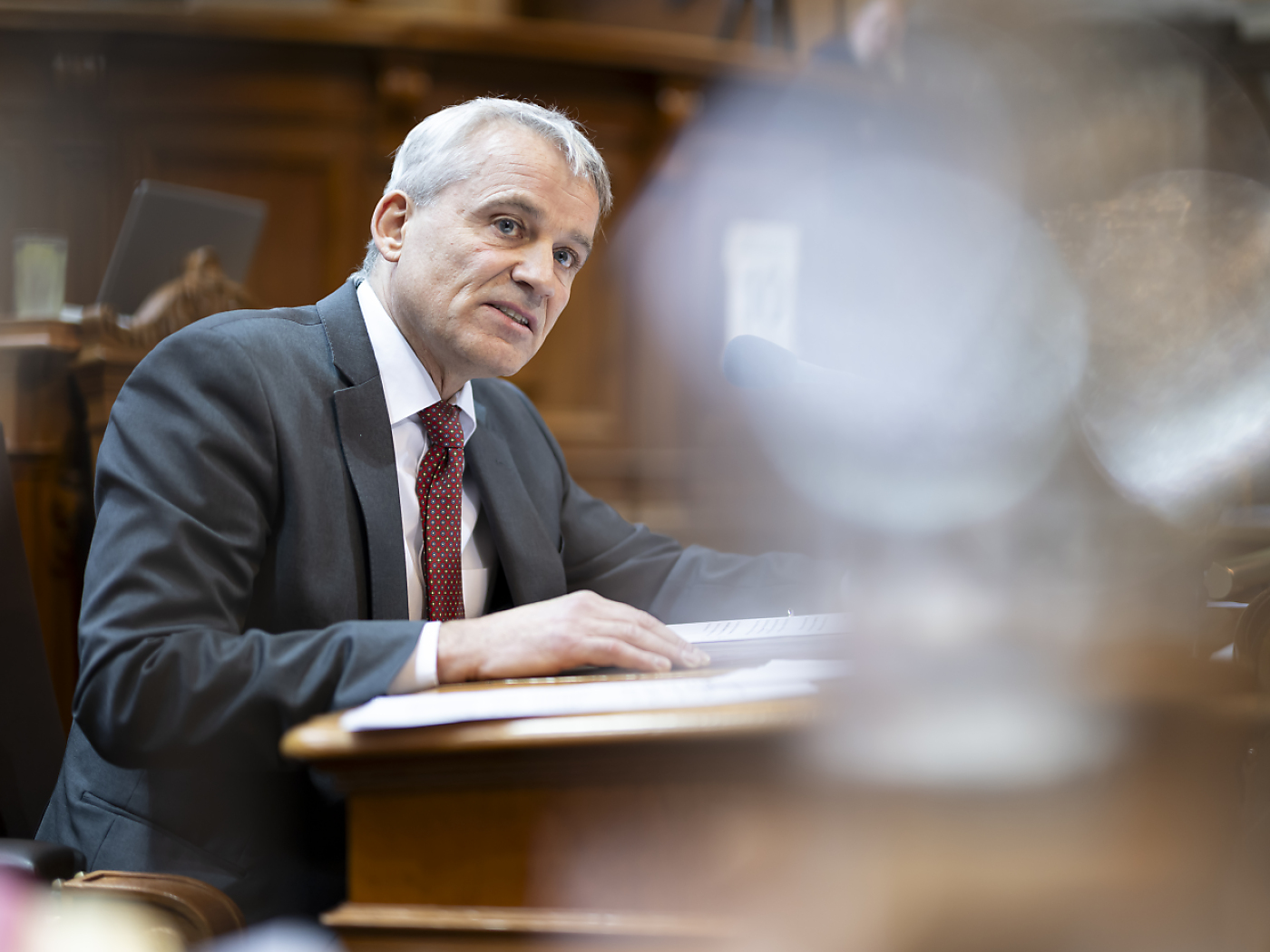
“Switzerland doesn’t have a culture of prohibition in its foreign policy,” argued Justice Minister Beat Jans in parliament. “If Switzerland now moves to ban such organisations with special laws, the question will inevitably arise as to where and how to draw the line.”

“It’s not out of the question that Switzerland will talk to Hamas despite this ban,” Justice Minister Beat Jans told parliament.
Keystone / Anthony Anex
This is also emphasised by parliamentarian Carlo Sommaruga. As a long-time supporter of the Palestinian cause, he was the only member of the Senate to vote against the Hamas ban. He pointed out that Switzerland had deliberately refrained from sanctioning the Taliban in Afghanistan, the IRA in Ireland, ETA in Spain, the RSF in Sudan or the FARC in Colombia as terrorist organisations. “There is therefore a contradiction.”
Beat Jans also argued against a ban on Hezbollah – following the government’s strategic line – pointing to its good offices. “We must not underestimate what such bans mean for the perception of Switzerland in the region and with regard to possible future mediation services by Switzerland as a neutral country,” he said.

A Hezbollah demonstration in Beirut, March 2024.
Copyright 2024 The Associated Press. All Rights Reserved
Alfred Heer doesn’t accept this. “If Israel wants Switzerland’s good offices, we can still fulfil them,” he said. Even Jans agrees indirectly. “It’s not out of the question that Switzerland will talk to Hamas despite this ban,” he said in parliament.

“Switzerland must ensure that it doesn’t become a refuge for such organisations in this situation,” said Marianne Binder-Keller.
Keystone / Peter Schneider
Parliamentarian Marianne Binder-Keller considers not taking a position out of consideration for the good offices to be misguided. Their benefits should be put into perspective, she believes. “Won’t such organisations cause much more damage if we don’t dry them out?” she said.
Binder-Keller is one of the authors of the motion that also wanted to ban Hezbollah. As resolutely as the Senate supported this, so has the House of Representatives postponed a decision on it.
The EU also imposed sanctions on Hezbollah ten years ago. It classified its military arm as a terrorist organisation as early as 2013. The US led the way in 1997. The UK and the Netherlands soon also banned the civilian arm of the organisation. From 2020, other countries, including Germany and Estonia, followed a policy driven by the US to abandon the distinction between military and civilian units. The list of countries that have banned Hezbollah now spans the globe: from the 21 states of the Arab League to Argentina, Japan, Australia and New Zealand.
More than just symbolic politics
An important motive for Binder-Keller is the international environment, in particular the EU’s clear stance following the massacre on October 7. Europe is closing ranks, she said. “Switzerland must ensure that it doesn’t become a refuge for such organisations in this situation.”
Security politicians such as Binder-Keller in particular therefore see the ban on Hamas that has now been passed as far more than just symbolic politics. “It facilitates prevention and prosecution. It makes it possible to stop the financial flows,” she said.
David Zuberbühler, who campaigned for a Swiss ban on Hezbollah in the House of Representatives, even sees parliament’s decision as strengthening Switzerland’s position on the international stage. “Our country can only be a genuine and credible peace mediator if it doesn’t look the other way when it comes to anti-Semitism, terrorism, glorification of violence and racism,” he said.
Nik Gugger, an experienced foreign policy politician, takes a similar view. In view of the recent events in the Middle East, he says it’s perhaps a good thing for a country such as Switzerland to take a clear stance now. “It’s a signal that can also give people like the new strongman in Syria a sense of direction,” he said.
Edited by Mark Livingston. Translated from German by DeepL/ts