


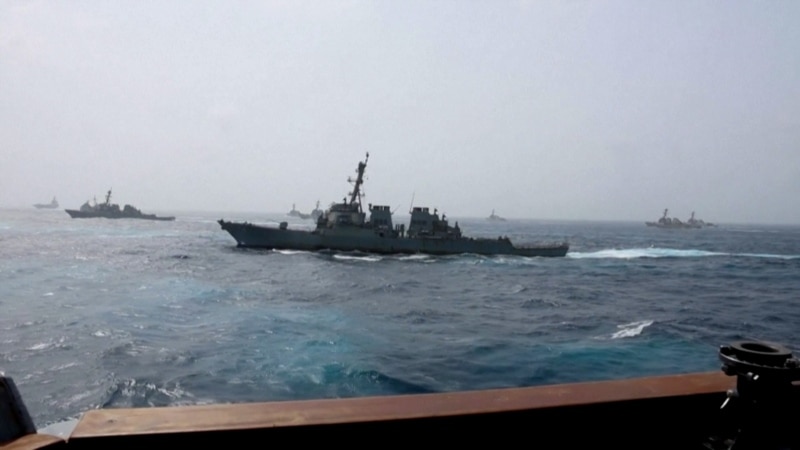
WASHINGTON — As tensions between Washington and Tehran escalate following renewed US military action , questions are mounting over the risks of regional escalation and the future of finding a diplomatic solution to bring peace.
In an interview with RFE/RL, former US Ambassador to Qatar Timmy Davis argues that, despite the military confrontation, negotiations remain the only viable way out of the crisis.
RFE/RL: President Trump has announced a renewed US naval blockade targeting Iranian shipping, while fighting between the US and Iran has intensified. Looking at the broader picture, where do US-Iran relations stand today? Is there still a realistic path back to diplomacy?
Timmy Davis: Well, I think the only realistic path is back to diplomacy. The current state of negotiations and this conflict suggests that both sides are actually interested in reaching some sort of agreement that they can live with.
I think it becomes clearer every day that the outcome of this conflict is going to require compromise from both sides. I understand that the US is obviously disappointed at this point with the state of negotiations, but I also think it’s important to remember that dialogue continues, whatever the activities are in the Strait.
Those activities are a step toward some resolution of this conflict, so I don’t think this is a moment to lose heart. I do think it’s a moment to be very careful and to make sure that both sides have some respect for one another. But ultimately, diplomacy is really the only way out of the current conflict.
RFE/RL: President Trump says the US will act as the “Guardian of the Hormuz Strait.” What would that actually mean in practice for regional security and for future negotiations with Iran?
Davis: That’s a great question: what does it mean in practice? I think that is still yet to be seen. Any situation in the Strait of Hormuz that requires military action or sustained conflict is not something that can endure. Certainly, for the countries in this neighborhood, we cannot have a long-term, ongoing conflict, even if it allows some commercial activity in the Strait.
Ultimately, the resolution has to be the free flow of commerce through the Strait of Hormuz. As an international waterway, it should not require guardians. If temporary military action is necessary, I think that is understandable. But, in the end, what everyone wants — certainly the countries in the Gulf — is to be able to conduct commerce without unnecessary checks or constraints.
RFE/RL: President Trump has also proposed a 20 percent US toll on cargo passing through the Strait. Do you expect exemptions for key allies, or do you see this as a blanket policy?
Davis: I think it’s important to remember that this is an extraordinary moment. What you don’t want to do is set a precedent whereby there are long-term taxes or tolls to be paid for using the Strait of Hormuz. That begins to impact the global economy.
So wherever we are on the idea of tolls, and however the question of exemptions is addressed, I think those are questions of the moment. Ultimately, countries in this region and around the world should have an interest in the free flow of commerce. Whether there are exemptions or not, I don’t think there should ever be a system of haves and have-nots when it comes to international trade.
RFE/RL: Iran has also stepped up attacks on US positions in the Gulf. How concerned are you that this could expand into a broader regional conflict?
Davis: It always has to be a concern. But I also think this is a very defined conflict, with Iran ultimately serving as the catalyst for efforts to bring about greater peace in the region.
I think the countries of the region have shown great restraint. There is also a level of confidence in the US’ ability to conduct its current military operations. I would be shocked if regional leaders wanted to become directly or asymmetrically involved in this war.
So I think the risk of a broader regional conflict is relatively low at the moment. Communication and the relationships between the Gulf partners and the US are relatively strong, so I don’t believe there should be major concern about missteps right now. But it is something we absolutely have to monitor.
I would also say that communication between the Gulf partners and the US is hugely important, but communication within the Gulf itself is equally important, so there is no misunderstanding about where neighboring countries stand. What you don’t want — and what could become a cause for concern — is any sort of conflict among Gulf neighbors over how to respond to this crisis.
RFE/RL: What role can Gulf countries — particularly Qatar — and other regional partners play in reducing tensions and keeping diplomacy alive?
Davis: That’s a great question. First, I would note that they are already assisting the US by hosting US military personnel, sharing information when it is available, demonstrating patience, and not responding erratically to attacks by Iran.
Ultimately, whatever plan emerges from this moment and from future negotiations, the Gulf partners are going to be essential in carrying out what comes next.
Qatar, in particular, is working extremely hard to help manage this conflict. People have to understand that Qatar has a very close relationship with Iran. They share an energy field, they share geographic proximity, and every day Qatar is working to move us toward some resolution.
But all of the Gulf partners will be hugely important in implementing whatever agreement eventually emerges after this conflict.
RFE/RL: Do you believe the current US strategy is creating new leverage for negotiations, or do you expect tensions to remain high for the foreseeable future?
Davis: I think tensions are going to remain high until we get closer to a negotiated resolution. Everything has to be viewed in context. We’ve seen before in this conflict periods of escalating military activity followed by de-escalation during periods of more intensive dialogue.
Both sides are trying to gain as much leverage as possible — that’s what is happening in the Strait. But I think everyone needs to remain calm, especially when people talk about one side or the other gaining leverage through military activity.
I would urge people to pay attention to the dialogue and to what is actually coming out of those discussions, rather than focusing on the rhetoric surrounding them. Serious people are having serious conversations. Because we’ve seen repeated breakdowns of ceasefires, I think we’ve all become a little numb to that reality.
So, leverage or no leverage, it is ultimately going to be the serious work of negotiation that brings this conflict to a resolution.
RFE/RL: Finally, what will you be watching in the coming days to judge whether this crisis is moving toward diplomacy — or toward further escalation?
Davis: What I’ll be watching — and what I would urge others to watch — is the willingness of both parties to continue talking.
I would also pay close attention to signals coming out of Doha, Islamabad, and other Gulf capitals. The Gulf partners will provide important indications of whether we are moving in the right direction.
I don’t think we are only a few days away from a resolution, but I do think we could begin to see signs over the next several days that dialogue and negotiation are once again moving to the forefront.
As people watch the bombings inside Iran or Iran targeting vessels, it’s worth remembering that we’ve seen all of that before. I would urge observers — and anyone who wants to see this conflict resolved — to pay more attention to the diplomatic dialogue than to the military back-and-forth. Ultimately, that’s where the real answers will come from.


