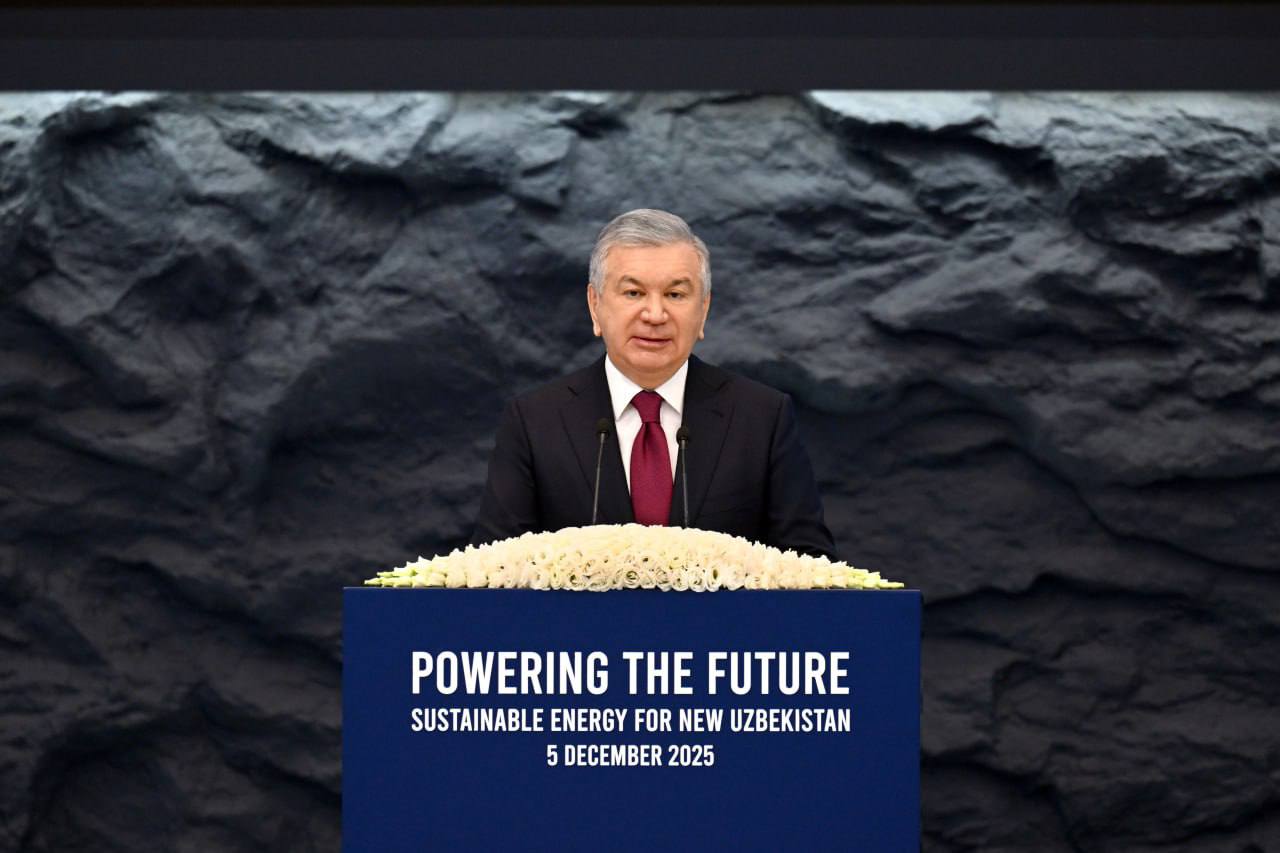
TASHKENT, Uzbekistan, December 5. President
Shavkat Mirziyoyev attended the ceremony titled ‘Powering the
Future: Sustainable Energy for a New Uzbekistan,’ which marked the
inauguration of 42 new energy facilities and the commencement of
construction for an additional 21 projects, collectively valued at
$11 billion, Trend
reports via the press service of the Uzbek President.
The projects include 16 solar, wind, thermal, and hydropower
plants with a combined capacity of 3,500 MW in Karakalpakstan,
Bukhara, Kashkadarya, and Tashkent regions and are expected to
generate 15 billion kWh of electricity per year, contributing to
Uzbekistan’s green energy output, reducing natural gas consumption
by nearly 7 billion cubic meters, and preventing 11 million tons of
harmful emissions.
The projects encompass 10 energy storage systems with a total
capacity of 1,245 MW, 11 major substations, and 420 kilometers of
high-voltage transmission lines, all designed to ensure a stable
electricity supply. Local enterprises Angren Energo and
Uzhydropower are set to produce 15,000 transformers and 155 hydro
units annually, respectively. Additionally, small and micro
hydropower plants with a combined capacity of 65 MW, along with
household and social solar installations, will further augment the
country’s renewable energy capacity.
President Mirziyoyev emphasized that in recent years, over $35
billion in foreign investment has been attracted to the sector,
leading to the addition of 9,000 MW in new capacity. As a result,
total electricity production has increased from 60 billion kWh in
2017 to an estimated 85 billion kWh by 2025. Currently, solar and
wind energy capacity stand at approximately 5,000 MW, while
hydropower contributes 400 MW. Small-scale solar systems installed
in households and social facilities have collectively generated an
additional 2 billion kWh of renewable energy this year.
The event also brought together key ministers from the UAE,
Türkiye, Azerbaijan, and Kyrgyzstan, as well as representatives
from major international institutions, including the World Bank,
the European Bank for Reconstruction and Development, the Asian
Development Bank, the Asian Infrastructure Investment Bank, the
Islamic Development Bank, and leading companies such as ACWA Power,
Aksa Enerji, Cengiz Enerji, Masdar, China Energy, Datang, Sinoma,
Poly, EDF, Voltalia, TotalEnergies, Siemens Energy, and Nebras
Power.
Simultaneously, Uzbekistan is strategically positioning itself
to augment its green energy capacity by an impressive 19 gigawatts
by the year 2030, thereby elevating the proportion of renewable
sources within the national energy portfolio to a substantial
54%.