


Switzerland is analysing the implications of US tariffs
Keystone / Salvatore Di Nolfi
Swiss exporters have been hit with a dramatic and unexpected tariff hike of up to 32% on the goods they sell in the United States. Companies, politicians and economists are scrambling to work out the exact cost for Switzerland.


+ Get the most important news from Switzerland in your inbox
The consequences of sudden trade dislocations can trickle down to the person on the street in the shape of uncertain job security and the prices they pay for goods.
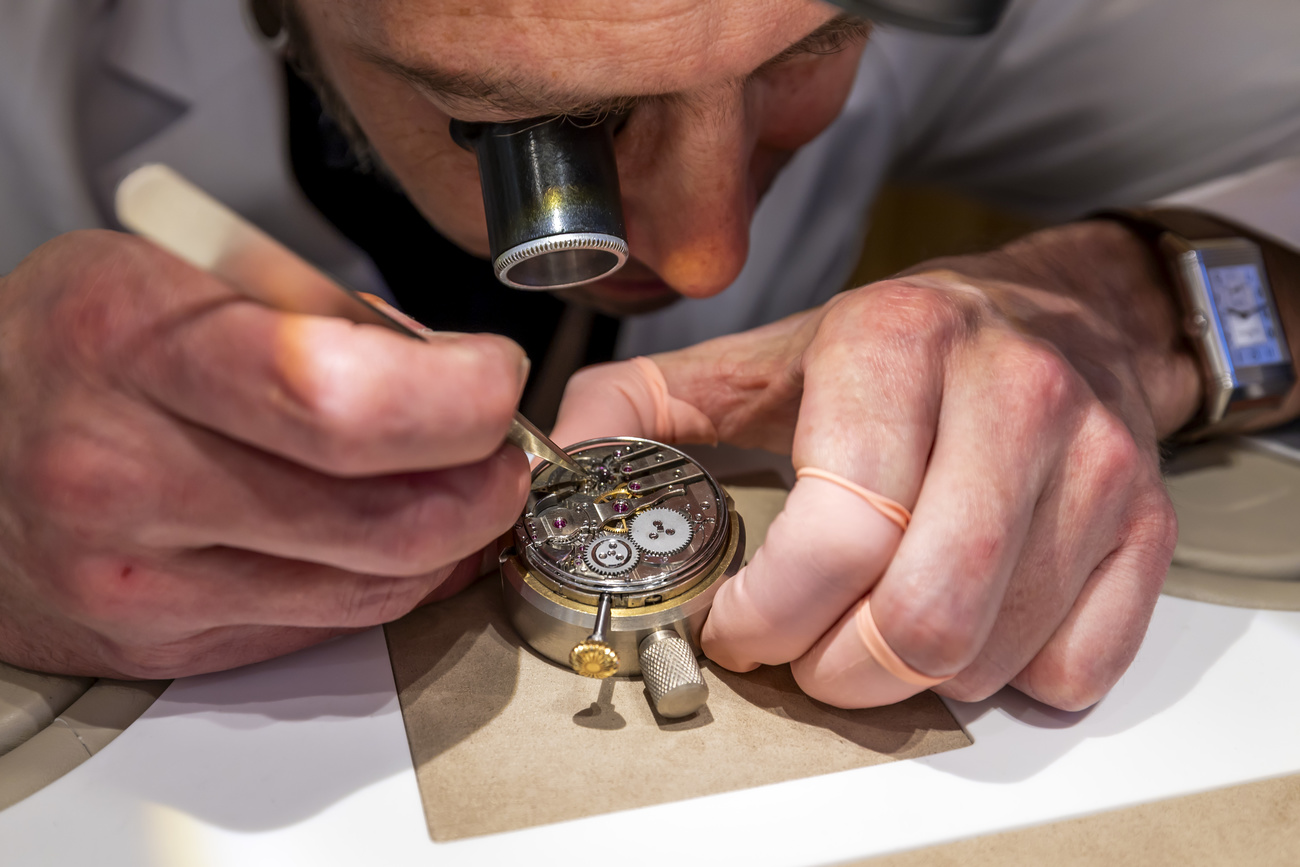
The imposition of such heavy trade taxes by the US have led to some sections of the Swiss economy to cry foul, particularly the watch making, precision machines and medical devices sectors.
But the ultimate cost of President Trump’s tariffs will not come to light until the reaction of countries around the world is known.
The looming threat
The US has imposed much higher tariffs on Switzerland than on other countries in Europe. European Union exports face a 20% charge, Britain just 10% and Norway 16%.
The US calculations that underpin these rates (a response to perceived trade barriers against US goods) are hotly disputed by Switzerland and other countries. Nonetheless, Swiss exporters face the double whammy of increased tariffs and a competitive disadvantage with neighbouring countries.
This means that smaller Swiss companies “face losing this market [the US] altogether”, warned the tech engineering and precision tools lobby group Swissmem. Manufacturers will also be hit by a separate 25% US tariff on car parts.
Nearly 17% of Swiss watch exports went to the US last year, making it the largest market by far. The US also absorbed 23% of exported Swiss medical devices.
“Export barriers not only jeopardise companies, but also jobs, innovation and security of supply,” said Adrian Hunn, director of Swiss Medtech.
Medicines have been spared US tariffs so far, but Trump has indicated that new export charges could be levied in the near future. The Swiss pharmaceutical industry provided nearly half of the value of Swiss exports to the US last year (CHF31.2 billion).
What damage could this cause?
For smaller companies that rely on the US market, but don’t have production facilities there, the US tariffs pose a major threat.
This could potentially have a negative impact on jobs in the coming months. Swissmem has called on the government to allow more workers to be put on state-subsidised shortened working hours.
Around a third of the 1,300 companies represented by the mechanical engineering lobby group Swissmechanic had already reduced the working hours of staff before the tariffs were announced.
The rate of unemployment in Switzerland at 2.9% is currently less of a problem than in neighbouring countries, such as Germany. The KOF Swiss Economic Institute last month predicted the jobless rate to peak at 3% this year, but this figure has yet to be updated since tariffs were announced.
More
More
What is a tariff? A quick guide
Trade unions do not sound alarmed just yet. “The US tariffs are indeed a nuisance for the Swiss export industry. But over-dramatising them is inappropriate,” wrote Swiss Trade Union Federation chief economist Daniel Lampert in a blog post.
In October, KOF released calculations of how anticipated US tariffs could impact Switzerland. Assuming a 60% tariff against Chinese goods and 20% for the rest of the world, KOF predicted Switzerland’s economic growth to slow by between 0.2% and 0.3%.
Such losses would equate to an annual economic loss of CHF200 per head of population. Speaking to Swiss public broadcaster SRF, KOF economist Hans Gersbach said the 32% tariff had the potential to result in greater losses.
What will Switzerland do next?
The Swiss response to the alarmingly high tariffs has been typically understated, unlike other countries.
China has filed a lawsuit with the World Trade Organisation (WTO) and imposed 34% charges on US exports. Canada has also threatened retaliatory tariffs.
Taiwan and Spain have announced state-funded support to protect industries hit by US tariffs.
Swiss President Karin Keller-Sutter told a media conference that the US version of “unfair” trading conditions with Switzerland was akin to making “one-plus-one equal three”. But she warned that a knee-jerk retaliation could cause greater damage to the economy.
The government has instead opted to analyse the impact of the tariffs in “greater detail” before making a decision. The economics ministry has also been tasked to “begin preparatory work on a possible solution with the US”.
Switzerland stated that it is “committed to open markets, stable framework conditions and legal certainty”.
A silver lining?
Provided the world does not descend into an all-out tit-for-tat trade war, Switzerland is reasonably positioned to absorb the worst impact of the new US tariffs, Stefan Gerlach, chief economist of EFG bank, told SWI swissinfo.ch.
The strong franc gives Swiss exports some advantage over competitors in the euro zone. And global customers should retain an appetite for high-end Swiss goods even if prices are forced upwards.
“Swiss exports in general, and particularly luxury goods, are not very price sensitive. Manufacturers can work around the problems by redirecting their trade to other countries, especially within Europe,” he said.
He also expects US consumers to bear the brunt of increased prices of goods, which will be passed on in part by manufacturers.
“A more likely outcome is the deflationary effect of disrupted trade, which could contract economic growth worldwide,” said Gerlach
“In the worst-case scenario, global recession, driven by international retaliatory tariffs and an escalation by the US, could bring severe consequences for an export-dependent country like Switzerland. But we are a long way off such a situation right now,” he added.
The WTO expects the Trump tariffs to reduce global trade by around 1% this year.
Edited by Marc Leutenegger/ts


