


Addressing ambassadors in the Security Council, Jean-Pierre Lacroix, head of UN peace operations, highlighted the need for change.
“Ceasefire monitoring can no longer be just about being present, it is about rapidly understanding and acting on what is happening on the ground,” he said.
Advances in technology, he explained, are helping ‘blue helmets’ increase their impact by allowing them to monitor vast and complex landscapes in near-real time – overcoming the need to be physically on the ground.
At the same time, a political process backed by the unified support of Member States, particularly the Security Council, remains vital to secure and sustain peace.
Ceasefires depend on combatants
“While peacekeeping can be an integral part of a ceasefire monitoring regime, the success of any ceasefire remains the sole responsibility of the parties [to the agreement],” he said.
Lieutenant General Aroldo Lázaro Sáenz, Head of the UN Interim Force in Lebanon (UNIFIL), also underscored the critical importance of political process.
Originally established in 1978, the mandate of UNIFIL was most recently defined in resolution 1701 of 2006, which called for a full cessation of hostilities between Hezbollah and Israel following the 34-day war in Lebanon.
It reinforced UNIFIL’s mandate to monitor the ceasefire, support the Lebanese Armed Forces deployment in southern Lebanon and facilitate humanitarian access.
However, the conflict between Israeli security forces and Hezbollah following the 7 October 2023 attacks by Hamas and other Palestinian armed groups in southern Israel, complicated UNIFIL’s operating environment, until the cessation of hostilities agreed in November 2024.
“Since this cessation of hostilities and in the absence of a permanent ceasefire, one of the main obstacles has always been that the parties interpret differently their obligations under resolution 1701 and now with respect to the cessation of hostilities understanding,” Lt. Gen. Lázaro said.
Combating disinformation
Another challenge is the rise of misinformation and disinformation, which undermines the credibility of UN peacekeepers and fuels local distrust. It compelled UNIFIL to adapt its approach to safeguard credibility, project impartiality and strengthen trust.
Effective outreach, fact-checking and timely responses are critical to safeguarding the mission’s impartiality, Lt. Gen. Lázaro said, noting that UNIFIL has implemented a structured communication strategy to counter misinformation, ensuring that messages are fact-based, clear and consistent across all peacekeeping units.
“It is essential that government actors also make public statements to sensitize the population to UNIFIL’s role and mandate, to avoid misperception,” he added.
Like UNIFIL, the UN peacekeeping mission in the Democratic Republic of the Congo (MONUSCO) is also combating the growing influence of disinformation, which armed groups exploit to destabilize communities and undermine peacekeeping efforts.
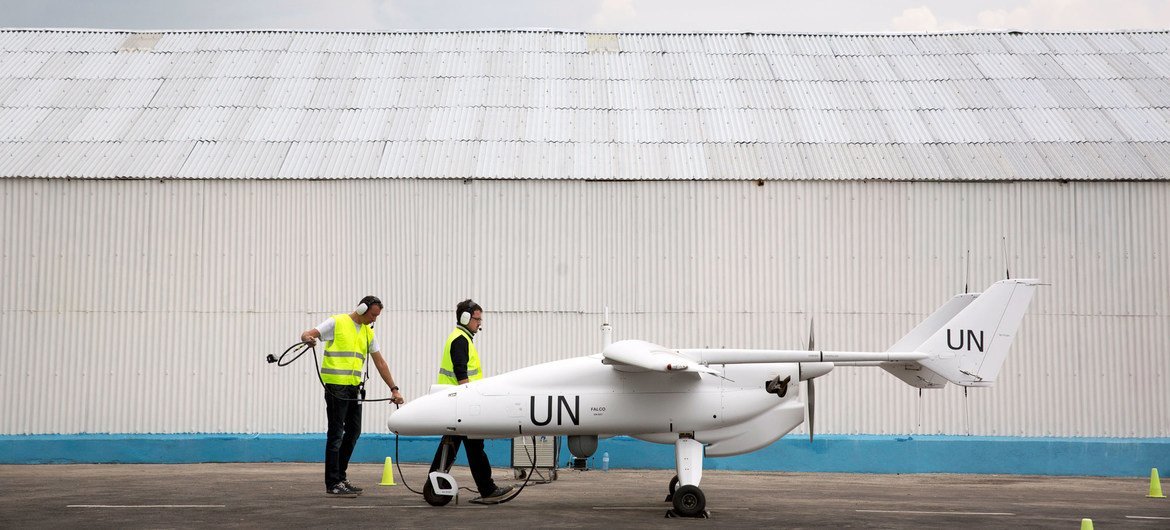
An unmanned aerial vehicle or drone is prepared for flight in Goma, in the Democratic Republic of the Congo.
Misuse of technology by armed groups
Lt. Gen. Ulisses De Mesquita Gomes, MONUSCO Force Commander, highlighted the evolving threats peacekeepers face, particularly from armed groups leveraging modern technologies to evade detection and spread propaganda.
“While important to peacekeeping, surveillance technologies have also been used by armed groups, militia and criminal networks,” Lt. Gen. Gomes said.
“In recent months, we have observed the use of readily available drones for reconnaissance by armed groups and the exploitation of encrypted messaging apps for coordination and propaganda dissemination, circumventing traditional monitoring methods.”
He warned that these tactics, combined with the willingness of armed groups to operate beyond traditional State control, make them unpredictable and difficult to counter.
To address these evolving threats, MONUSCO has adapted its strategies to swiftly integrate new capabilities – both from the private industry and contributing nations – within weeks or months, rather than years.


