

Two Russian drone strikes hit near the Polish border early on September 13, Ukrainian authorities have reported, attacks that Kyiv said was Moscow “knocking on the doors of the EU and NATO” and urged further sanctions.
A Russian drone strike hit a petrol station near the Yahodyn border crossing between Poland and Ukraine early on September 13, with no casualties reported. The border crossing, in Ukraine’s Volyn region, was temporarily closed but has since reopened.
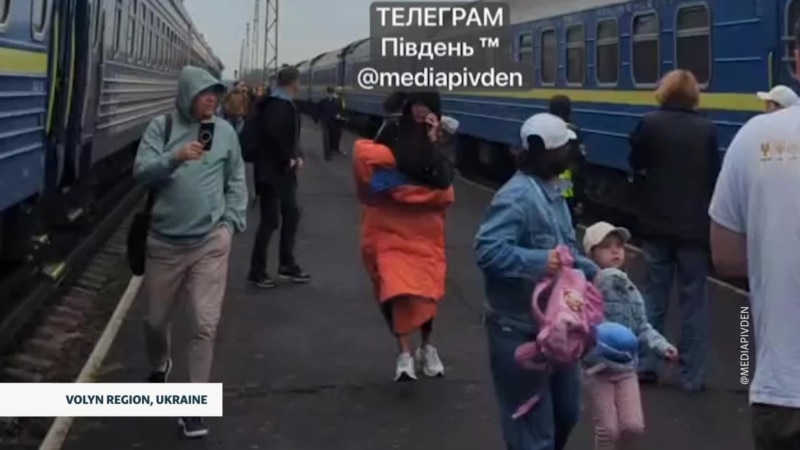
Also in Volyn, a Russian drone struck the locomotive of a passenger train two kilometers from the Polish border, reported Ukrainian Railways, which said a monitoring group was able to warn the train’s crew of the threat in advance.
Video footage showed people running from the blast at the railway station. According to Oleksandr Shevchenko, a local transportation official, a Russian UAV drone hit the locomotive of a train traveling from Kyiv to Warsaw on the morning of September 13, and that no casualties were reported.
Air raid alerts were issued in several eastern districts of Poland around the time of the strikes, although there were no reports of violations of Polish airspace.
In separate incidents, Romanian authorities reported a drone entering the country, and Lithuania called on residents in the capital and neighboring regions to preventively seek shelter after issuing an alert of possible drone sighting.
The country’s main airport was shut down and NATO jets were scrambled. The alert was called off within an hour.
The strikes in Ukraine come as Russia has stepped up its attacks on civilian infrastructure across the country and EU officials have warned of an escalation in Russian violations of European airspace that represents “the new normal.”
“Russia’s barbaric strikes at the Ukraine-Poland border in Yahodyn are not just a continuation of its attacks on our state borders,” Ukrainian Foreign Minister Andriy Sybiha wrote on X on September 13. “This is Putin’s terror ‘knocking’ directly on the doors of the EU and NATO. Russian barbarians are at your gate, dear partners.”
He urged European leaders to “throw the full weight” of sanctions against Russia.
“Make Moscow feel the consequences of its terror. Not just half-decisions, but uncompromising, powerful steps. Full trade embargo. Full entry bans. Full sanctions on the military-industrial complex,” he wrote.
Earlier this month, Germany officially blamed an incident on Moscow in which explosive-laden drones interrupted flights at Leipzig Airport. At the time, European Commission President Ursula von der Leyen said that “Europeans are faced with a hard truth that this is the new normal.”
Meanwhile, Ukrainian President Volodymyr Zelenskyy said on September 13 that Russia had launched a total of 2,100 drones, 1,700 gliding bombs, and 73 missiles of various types at targets across Ukraine in the past week.
“It is precisely to prevent these strikes from spreading further into Europe that Ukrainian men and women fight every single day, laying down their lives to keep this aggression from expanding,” he said in a post on Telegram. “Russian terrorism is a shared threat to many, but it can and must be defeated right here in Ukraine.”
Overnight on September 12-13, Russian troops launched massive strikes against the western regions of Ukraine, including Odesa and the Odesa region.
According to the Ukrainian Air Force, Russian forces launched more than 450 drones across the country overnight and into the morning.
A drone attack in the Khmelnytskiy region caused a fire at an unspecified industrial facility, local authorities reported. No injuries were reported.
According to Ukrainian media, the Ivano-Frankivsk, Ternopil, and Lviv regions were also hit.
Regional authorities in the Odesa region said that nine people had been injured after a drone struck several residential buildings. A warehouse in the regional was also reportedly targeted.
Rescuers previously completed work at the site of the drone strike on a 25-story residential building in Odesa on the night of September 12. Two people were killed and more than 20 injured.
Russia’s Defense Ministry claimed that overnight strikes targeted “logistics centers through which military cargo is delivered and distributed, as well as energy facilities that support their operation.”
The ministry also reported strikes on railway infrastructure in western Ukraine.
Russia denies targeting civilian areas despite widespread evidence of such attacks that have killed thousands of people since the start of Russia’s full-scale invasion.
