


Ukrainian drones hit a Russian oil facility some 1,500 kilometers from the Ukrainian border, officials said, the latest in the series of long-range strikes targeting Russian energy facilities.
The attack came hours after US President Donald Trump and his Russian counterpart, Vladimir Putin, spoke by phone to discuss a potential cease-fire aimed at pausing Russia’s 4-year-old, all-out war on Ukraine.
Regional Governor Dmitry Makhonin reported on April 30 that a Ukrainian strike drone hit an oil facility and industrial site in Russia’s Perm region and that there were no casualties or significant damage.
Ukraine’s Security Service (SBU) had confirmed a similar drone strike on a Russian oil pumping station near the city of Perm a day earlier.
The SBU said on Telegram on April 29 that a large fire broke out at the facility, adding that preliminary reports indicated nearly all oil storage tanks were engulfed in flames.
After the drone strike in Perm, Ukrainian President Volodymyr Zelenskyy said Kyiv’s forces would continue expanding the range of its strikes inside Russia.
“We will continue to extend these ranges, and these are entirely justified Ukrainian responses to Russian terror,” he wrote in a post on X.
On April 28, a Ukrainian drone attack caused a major fire at a Russian oil refinery in the Black Sea port of Tuapse, the third attack on the oil facilities in less than two weeks, sparking another billowing fire and prompting evacuations.
Putin described the attack as evidence of increased Ukrainian attacks on civilian targets.
Ukraine has stepped up drone attacks on Russian oil facilities in recent months, curtailing exports and hampering Moscow’s capacity to take advantage of a spike in global energy prices prompted by the Iran war and Tehran’s effective closure of the Strait of Hormuz.
Meanwhile, Ukrainian officials reported that at least 20 people were injured in a Russian drone attack on Ukraine’s major port city of Odesa overnight on April 30.
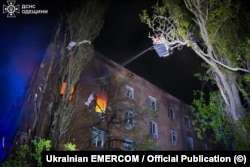
According to Serhiy Lysak, head of the Odesa military administration, three of them are in critical condition.
He added that the attack caused widespread damage across Odesa, including residential buildings, a kindergarten, a hotel, a shopping center, and infrastructure facilities.
According to the Ukrainian military, Russian forces launched one Iskander-M ballistic missile and 206 drones overnight on April 30.
Trump, Putin Discuss Temporary Cease-Fire
Trump and Putin held a phone call in which the two discussed a possible temporary cease-fire to halt fighting in the war in Ukraine.
Trump told reporters at the White House on April 29 that during the 90-minute conversation with Putin, a cease-fire next month to mark the anniversary of the end of World War II in Europe was broached.
Trump said he suggested “a little bit” of a cease-fire “and I think he [Putin] might do that.”
Putin’s foreign policy adviser, Yury Ushakov, told Russian media further details of the phone call, saying Putin said he was prepared to have a cease-fire through or around May 9, when Russia marks the defeat of Nazi Germany.
Ushakov noted that the phone call was initiated by the Russian side.
The comments come after Russia’s Defense Ministry said the annual Victory Day parade on Red Square — a Kremlin spectacle celebrating the Soviet role in World War II and Moscow’s military today — would be drastically scaled back this year, with no military vehicles or heavy weaponry on display for the first time in almost two decades.
Zelenskyy, in reaction to the Trump-Putin call, said that he had instructed his team to contact US administration to clarify Russia’s proposed temporary cease-fire.
“We will clarify what exactly this is about — a few hours of security for a parade in Moscow, or something more,” Zelenskyy wrote on X.
He stressed that Ukraine’s goal is a long-term cease-fire and reliable and guaranteed security for people.


