


The Darvaza gas crater photographed in 2012
Photo: Amos Chapple (Courtesy Image)
Recent visitors to Turkmenistan’s Darvaza gas crater have been left cold by the landmark’s feeble flames amid government efforts to suppress the blaze. Now Turkmenistan has announced a technical plan to extinguish its famous gas fire completely.
Dylan Harris, the managing director of British tour company Lupine Travel, told RFE/RL he has seen a gradual decline in the intensity of the flames in recent years, but “in particular last year, the flames were at a significantly lower level.”
Photos made in 2025 confirm that only a few tongues of flame are now burning where countless gas fires once hissed.
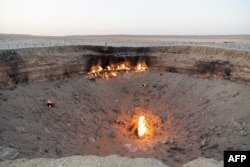
On December 28, a statement from Turkmenistan’s national gas company, Turkmengaz, on “solving the Darvaza phenomenon,” described drilling a new well that will divert gas away from the Darvaza crater’s source to “completely eliminate uncontrolled gas emissions into the atmosphere.”
Ashgabat’s plan to snuff out the fiery crater comes after months of disappointment from tourists over the fading of Darvaza’s flames, a phenomenon which was explained at an energy conference held in Turkmenistan in June.
Irina Luryeva, the head researcher for the country’s state-owned energy company Turkmengaz, revealed to conference attendees that several mothballed gas wells were recently reopened in the desert near the Darvaza site to divert gas flows away from the crater. “The reduction [in fires] is nearly threefold,” Luryeva said. The conference was aimed at showcasing the gas-rich country’s green energy credentials.
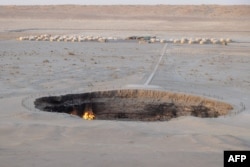
Sukru Merey, an expert in natural gas engineering at Turkey’s Batman University, told RFE/RL that, despite reduced gas flow into the crater, putting out the blaze completely will remain a difficult engineering puzzle. “Even after drilling [a new well], it may not be possible to completely eliminate gas leakage to the crater,” he says. Merey estimates such a secondary well would cost millions of dollars to establish.
Calls to extinguish the Darvaza blaze were first made in 2010 by then President Gurbanguly Berdymukhammedov. But the authoritarian country later appeared to waver between embracing what it called the “Shining of Karakum” as a tourist draw and seeking its erasure as an unsightly remnant of a Soviet-era mishap.
The crater is believed to have been formed in the 1960s or 1970s when a Soviet gas-drilling rig collapsed into the desert and methane began leaking from the geological rupture. With villagers nearby at risk of asphyxiation, the decision was made to ignite the gas, which has been burning ever since.
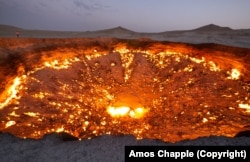
Efforts to put out the blaze may have been kickstarted by recent reports that Turkmenistan was seeping more greenhouse gases from two of its gas fields than the entire annual emissions of the UK. While the Darvaza crater releases only carbon dioxide from its fires –unlike the more harmful methane leaking from other, unlit gas fissures — it still stands as a vivid symbol of waste amid controversy over Turkmenistan’s greenhouse gas emissions.
Analysts have estimated the total amount of greenhouse gases released from the site to be approximately equivalent to the annual emissions of 7 million vehicles. The market value of those decades of gas leakage is believed to be around $300 million.
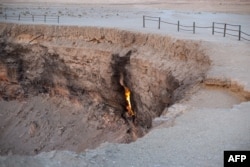
Tourism into Turkmenistan is set to be significantly affected by moves to extinguish the blaze.
Harris says the crater is “the most popular tourist site in Turkmenistan,” adding that, “it’s often the main reason why people visit” the reclusive country.
Another experienced tour operator who operates in Turkmenistan but asked not to be identified for this story says, “we’ve been watching the flames going down for 15 years, I would say, so there must have been works in the nearby gas fields for a while. But [there have been] no official accounts as this sort of thing is always secret.”


