


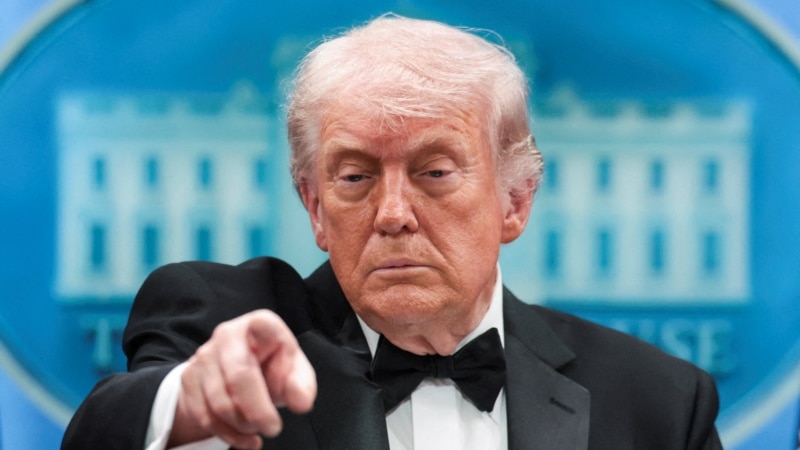
US President Donald Trump said that Tehran “can call us” if it wants to talk, but he added that it must give up any plans to build a nuclear weapon or “there’s no reason to meet.”
Meanwhile, Abbas Araqchi, Iran’s foreign minister and key negotiator, arrived in St. Petersburg, where he is expected to meet with Russian President Vladimir Putin, a key ally, on April 27 as the future of Pakistani-mediated peace talks between the US and Iran remains clouded.
“If they want to talk, they can come to us, or they can call us. You know, there is a telephone. We have nice, secure lines,” Trump told Fox News on April 26.
“They know what has to be in the agreement. It’s very simple: They cannot have a nuclear weapon; otherwise, there’s no reason to meet,” Trump said.
Tehran has always insisted that its nuclear program is strictly for civilian purposes, although the US and Israel accuse Iran of secretly attempting to build a nuclear weapon.
Trump has demanded that Tehran cease its program of enriching uranium that could be used to build a bomb and that it had over its supply of the mineral — something Iran has said will not happen.
Axios on April 26 reported that Tehran, working through Pakistani mediators, has given the US a new proposal in which the Strait of Hormuz would be reopened and a US blockade of Iranian ports lifted, but with negotiations on Iran’s nuclear program to be held later. The story cited an unnamed US official and two sources with knowledge of the matter.
Second Round Called Off
A second round of talks was tentatively set to kick off in Pakistan over the weekend, but after Tehran said its team was not planning to meet with American negotiators, Trump announced he had canceled the trip of White House envoys Steve Witkoff and Trump’s son-in-law, Jared Kushner, to Islamabad.
In a social media post, Trump suggested Iran’s negotiators were at odds with authorities at home. “Too much time wasted on traveling, too much work! Besides which, there is tremendous infighting and confusion within their ‘leadership,’” he said.
Araqchi, who along with powerful parliament speaker Mohammad Baqer Qalibaf led a first round of talks in Pakistan on April 11-12, is making the diplomatic rounds in an effort to beef up support for Iran.
After traveling to Pakistan, Araqchi went to Oman, where he looked to sell leaders there on the idea of a joint shipping toll on the crucial Strait of Hormuz waterway — a move vehemently opposed by most of the rest of the world.
“Important discussions on bilateral matters and regional developments. As only Hormuz littoral states, our focus included ways to ensure safe transit that is to benefit of all dear neighbors,” he wrote on X.
Araqchi then returned to Pakistan briefly before heading on to Russia, arriving early on April 27 in St. Petersburg for talks with Putin. Iran and Russia are both subject to crippling Western sanctions and have built a strong political and military alliance.
Tehran’s ambassador to Moscow, Kazem Jalali, wrote on X that Araqchi will meet with Putin during his visit. Russian officials confirmed that Putin plans to meet with Iran’s top diplomat..
Jalali added that Araqchi would “consult Russian officials regarding the latest status of the negotiations, cease-fire, and surrounding developments.”
“Coordinating interactions and advancing joint programs at the regional and international levels is the most important agenda of this trip,” he wrote, adding that Iran and Russia are in a “united front” against Western nations.
Fighting In Lebanon
While the US-Israeli cease-fire appears to be holding in Iran, the Israel-Lebanon truce — although still officially in effect, appears to be fraying.
Lebanese officials said Israeli strikes killed at least 14 people and wounded 37 on April 26 after the Israeli military warned residents to leave seven towns beyond the “buffer zone” it is occupying.
The Israeli military accused the Iran-allied Hezbollah militant group of violating the cease-fire and vowed to respond.
A militant group and political party that controls much of southern Lebanon, Hezbollah is considered a terrorist organization by the US, while the European Union has blacklisted its armed wing but not its political branch.


