


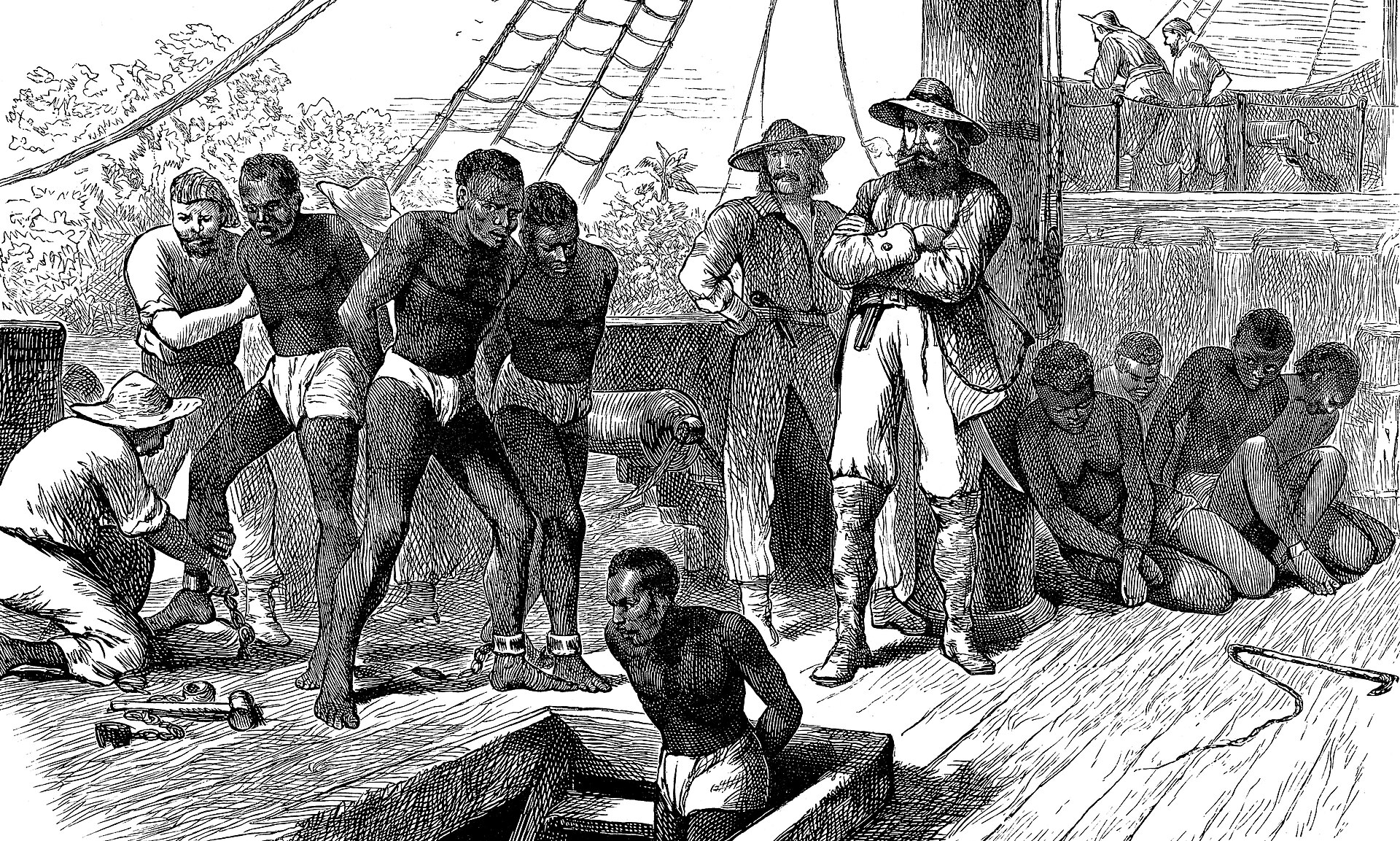
Contemporary depiction of a slave ship being loaded, c. 1880.
Hulton Archive
Can past injustices be brought before the courts? The Swiss Office of the Attorney General must now investigate whether the historical predecessors of the cantons of Zurich, Bern and Solothurn were guilty of aiding and abetting slavery.
A criminal complaint filed against cantons Zurich, Bern and Solothurn has brought the question of Switzerland’s role in the slave trade before the courts. At its heart is the allegation that the historical predecessors of the three cantons helped to finance a system founded on the slave trade in the 18th century.

Shelley Moorhead.
The complaint was filed in early September by Swiss lawyer Catherine Reiter on behalf of activist Shelley Moorhead. It draws on an expert report by historian, writer and political activist Hans Fässler. Both Reiter and Fässler are based in St Gallen, in northeastern Switzerland.
Fässler has been delving into Switzerland’s links to colonialism and slavery for years. In his study, he examines the role played by members of the Old Swiss Confederacy – a loose alliance of independent small states that served as the precursor to modern-day Switzerland – within the colonial economic system.
A main argument of the study is that the three city-states were not merely observers of a distant system. Rather, they benefited economically from colonial structures linked to the transatlantic slave trade and plantation economies.
Bern, Zurich and Solothurn made a mint
Fässler cites several examples relating to Zurich. In the 18th century, the city invested in the British South Sea Company, which was involved in the transatlantic slave trade.
Later, the state-owned Bank Leu conducted business with the Danish Crown and granted loans to companies and banks with ties to plantation agriculture and the slave trade. According to Fässler, Zurich thus participated economically in colonial structures and reaped profits from them.
Bern also features prominently in the historian’s report. As early as 1719, the city-state invested substantial sums in the South Sea Company, and it held Danish government bonds for decades. These investments, Fässler argues, helped to fund a state whose Caribbean colonies relied on slave labour. At the same time, the investments proved profitable, generating considerable returns for the Bernese state.

Historian Hans Fässler.
zvg
As for Solothurn, the report refers primarily to holdings in the French Mississippi Company, which drove France’s colonial expansion in North America and relied on slave labour.
Another chapter in the study is devoted to the Karrer Marine Infantry Regiment, which was later known as the Hallwyl Regiment. This Swiss regiment in French service was stationed across various French naval depots and colonial garrisons in North America and the Caribbean. Its units, Fässler writes, were deployed against indigenous populations and took part in suppressing slave rebellions. The Swiss cantons condoned these deployments, although they were not actually provided for under the mercenary contracts of the time.
A major question for Fässler is what the political and economic elites of Switzerland at the time knew about slavery. Drawing on travel accounts, newspapers, scholarly works, correspondence and biographies, he concludes that educated circles were certainly aware of the slave trade, plantation agriculture and the living conditions of slaves.
Consequences across generations
However, the criminal complaint focuses less on the historical question than on the legal one. Reiter argues that enslaving people was already prohibited at that time under the prevailing principles of international law.
The complaint traces the evolution of anti-slavery sentiment from the 16th to the 19th century and concludes that a ban on slavery was established under customary international law at latest during the 18th century.
Leading on from this, the lawyer makes a far-reaching claim: that crimes against humanity are not subject to statutes of limitations, meaning that there is no time limit to filing charges, no matter how many years have passed. The Office of the Attorney General must now examine whether the financial transactions of the three city-states at the time constitute complicity in slavery. And today’s cantons should bear legal responsibility for the actions of their historical predecessors, the lawyer argues.
The complaint has been filed on behalf of Moorhead, an activist from the US Virgin Islands who describes himself as a descendant of slaves in what were then the Danish West Indies. Through the African-Caribbean Reparations and Resettlement Alliance (ACRRA), Moorhead has been campaigning for years for recognition of the long-term consequences of slavery and colonialism. These consequences, the complaint argues, persist to this day. They include economic disadvantages and possible transgenerational trauma.
The complaint is “by no means symbolic in nature”, Reiter said in response to an inquiry. The aim is to prompt the investigation of specific criminal offences committed to the detriment of her client. This entails determining any damage caused, identifying further victims and establishing whether any other parties were involved.
Major legal hurdle
Researchers have by now widely established that Swiss merchants, banks, investors and political figures played a role in colonial economic structures. What is still disputed, however, is the political or legal consequences that should follow on from this. The current claim against cantons Zurich, Bern and Solothurn constitutes a virtually unprecedented attempt in Switzerland to bring historical slavery before the courts as a crime against humanity that remains prosecutable today.
A key hurdle lies in criminal law itself. As a rule, it is individuals who are prosecuted, not historical communities. Those presumed to be guilty have long since died. The complaint seeks to get around this problem by holding today’s cantons accountable as the legal successors to their historical predecessors. Through their investments, the cantons of the time acted as economic players and can therefore be held liable in a similar way to companies, the lawyer argues.
Reiter does not comment on the prospects of success for the proceedings. Assessing the criminal complaint is, she says, up to “the competent authorities and courts”.
The Office of the Attorney General must now decide whether there is sufficient initial suspicion to warrant further investigation. The filing of a criminal complaint should not be equated with the opening of criminal proceedings, said spokesperson Claudia Balzli. The complaint is currently being examined “in accordance with standard procedure”, she added. This involves determining whether the matter falls within federal jurisdiction and whether there is sufficient suspicion of an offence.
Edited by Balz Rigendinger. Adapted from German by Julia Bassam/gw.

More


