


A Ukrainian armored vehicle fitted with metal wire armor on a road near Pokrovsk on November 23
Photo: Anatolii Stepanov (Reuters)
The below photo, of a tank fitted with bristling metal wires, is one of the clearest images yet seen of a new kind of anti-drone armor first spotted on invading tanks in Ukraine in the autumn of 2025.
The armor is reportedly made from steel cables cut into uniform lengths, then unraveled into individual wire strands. The spiky wires are then affixed to a metal cage fitted to the tank or vehicle.
Both sides in the Ukraine conflict are now using the new anti-drone coverings, dubbed “hedgehog armor.”
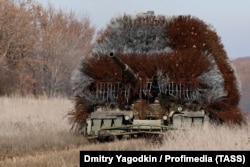
Iryna Rybakova, a press officer with Ukraine’s 93rd Mechanized Brigade, told RFE/RL the “fluffy” armor is designed “to get drones tangled and not detonate, or detonate at a distance” from the vehicle hull.
Most kamikaze first-person view (FPV )drones are fitted with a fuse that protrudes from its warhead and detonates on impact. The spiky new armor could potentially entangle such a drone before its fuse reaches a solid surface.
Rybakova says one Russian hedgehog tank operating near Toretsk in the Donetsk region absorbed dozens of hits from Ukrainian FPV drones before it was finally destroyed. She adds that against larger and faster kamikaze drones, such as the Russian Lancet, hedgehog armor offers little protection.
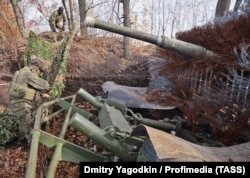
Carlo Masala, a professor and military expert at the Bundeswehr University in Munich, told RFE/RL the latest anti-drone measure “seems to be a new tactic to bring maneuver back into warfare.”
With the effectiveness of cheap FPV drones capable of destroying tanks worth up to millions of dollars, both sides in the conflict have struggled to carry out the kind of armored assaults that were once a cornerstone of military tactics.
In recent months, Masala says, “we have only seen incursions by a few soldiers behind enemy lines.” Large troop and vehicle movements have been largely limited to foggy days when poor visibility reduces the threat of reconnaissance and FPV drones.
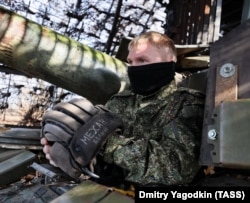
The unusual new armor reportedly comes with drastic tradeoffs for tank crews.
A Russian tank driver recently gave a media interview in which he described a tank being fitted with hedgehog armor. As a result of the added weight, the tank “didn’t even make it 10 kilometers before one of the [drivetrain components] failed.” The tank driver added that the bulk of the hedgehog armor means the “stress on the components [of the tank] is immense.”
Masala says such drawbacks “seem to be accepted in order to bring more maneuver warfare back.”
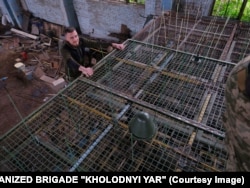
Press officer Rybakova was witness to an early iteration of hedgehog armor when a Ukrainian team attached plastic cables designed to snag drone propellors through a metal tank cage (seen in photo above) in May.
The cumbersome vehicle was used as a decoy to draw attention away from Ukrainian troops withdrawing from their positions. “Enemy FPVs flew into the tank. There were about 5 or 6 hits, which the crew almost did not feel,” Rybakova says, “but then the enemy dropped an anti-tank mine,” which set the vehicle’s engine ablaze.
“It’s a pity about the tank, but the people remained alive and the task was accomplished,” she says.


