


Certain Swiss cities typically attract more newcomers from abroad than others and the latest data reveals which parts of Switzerland have the highest and lowest number of foreigners.
Unsurprisingly, the largest number of foreigners are living in and around large Swiss cities, which are close to economic centres and job opportunities.
This is confirmed by the figures from the Federal Statistical Office (FSO) – see the charts below.
The data is from 2023, but it is the most recent available.
The FSO analysed the proportion of foreign population in each of Switzerland’s 10 largest cities, breaking them down by whether the residents came from the EU or third countries.
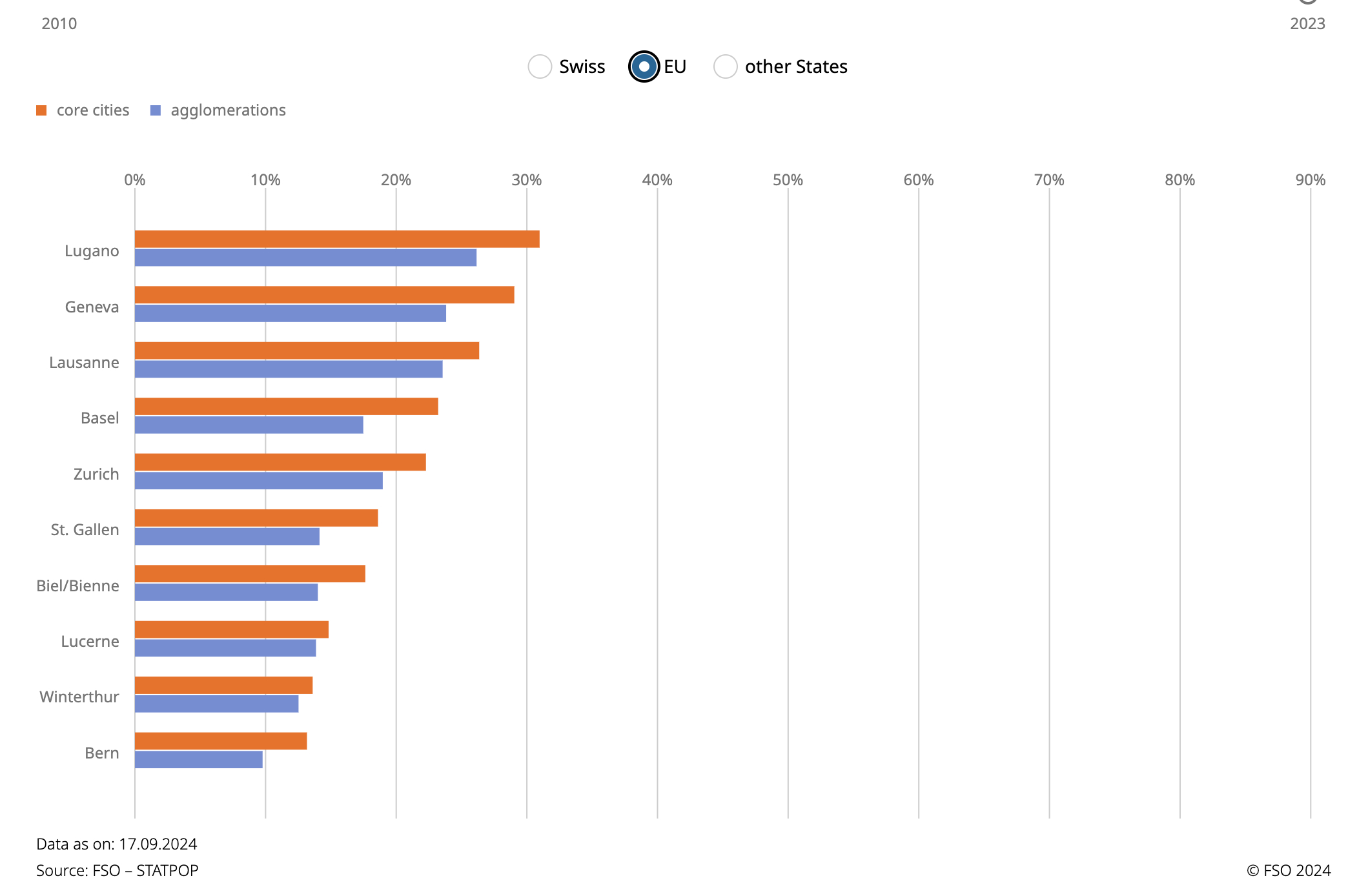
In terms of the proportion of the city’s inhabitants from the European Union, Lugano is in the first place, with nearly 31 percent of the city’s population made up of EU citizens.
Some 26 percent of the population of permanent residents in Lugano’s surrounding suburbs are from the EU.
Next is Geneva with 29 percent of the city’s population being EU citizens although the percentage drops to around 24 percent for the proportion of EU residents in the surrounding suburbs.
Lausanne is in the third place with the proportion of the population being EU residents standing at 26 percent.
Switzerland’s Bern has fewest foreigners EU nationals living in both the city (13 percent) and its agglomeration (10 percent).
You can see the entire chart here:
Source: FSO
Advertisement
What about the proportion of the population from third countries?
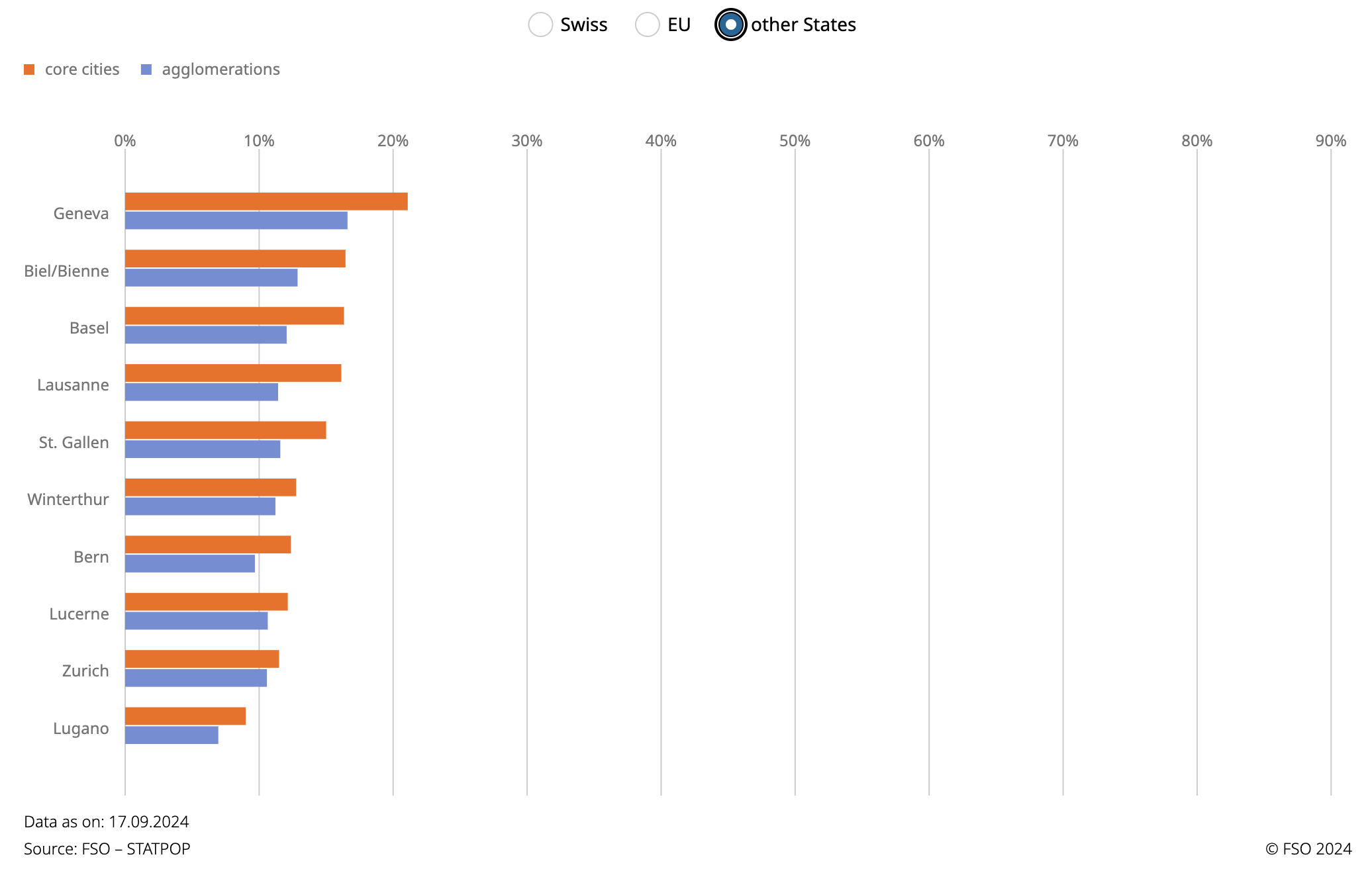
In the category of the percentage of a city’s population being from non-EU third countries, it was the border city of Geneva that topped the table.
Some 21.09 percent of the city’s population are non-EU nationals, whilst the percentage drops to 16.59 for the Geneva’s suburbs.
Biel/Bienne is in the second place, with 16.45 percent of the city’s population being third-country citizens.
Basel, the city that stands on the border with Germany and France is ranked third with around 16 percent of the city’s permanent residents being non-EU foreigners.
Contrary to the statistics for EU nationals, Lugano counts the lowest proportion of non-EU citizens among its population – only 9 percent.
Source : FSO
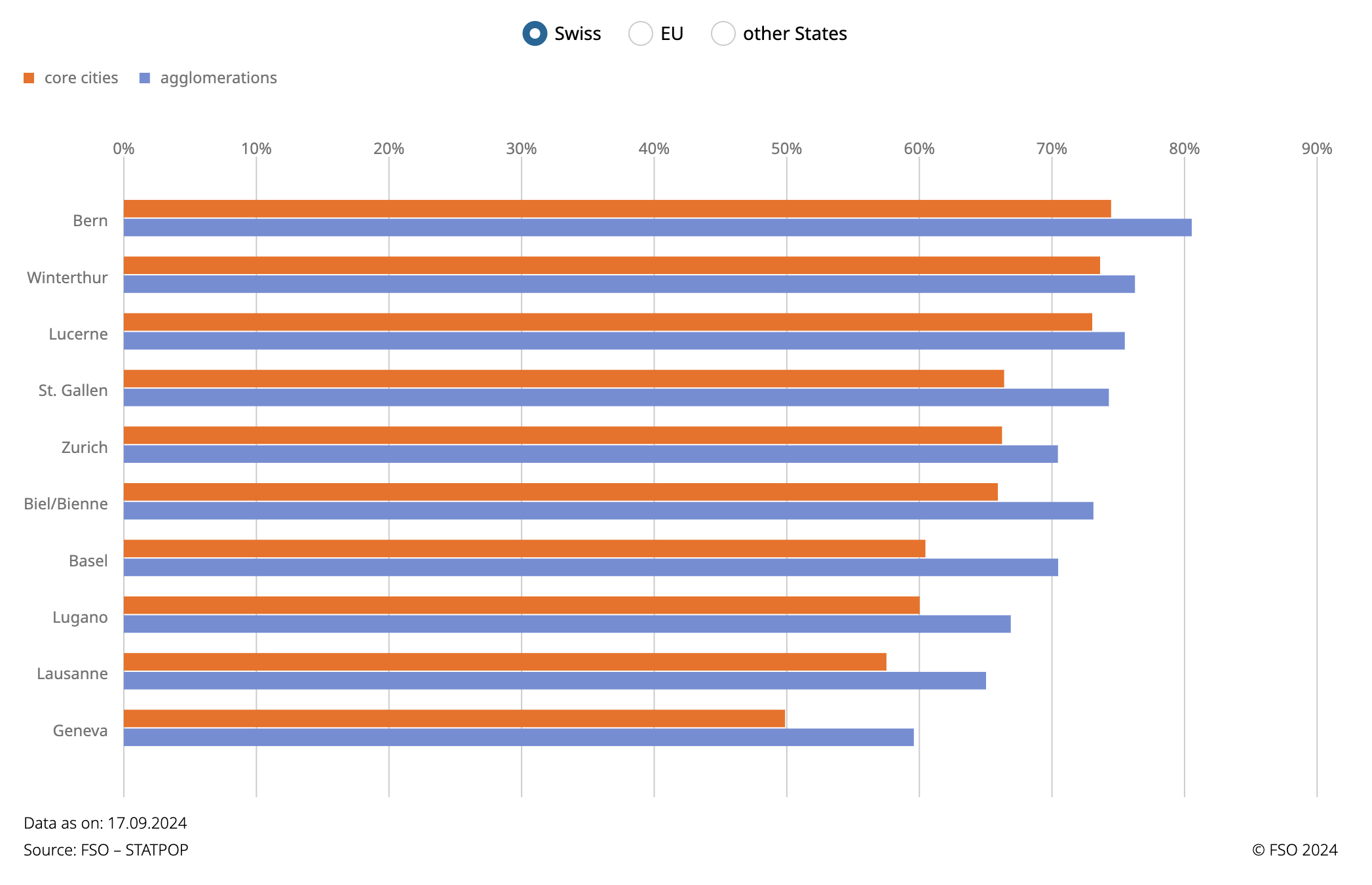
This brings us then to the question of which city in Switzerland is the most “Swiss” in terms of the make up of its population.
And the answer is: Bern. Perhaps not surprisingly the country’s capital has the largest proportion of Swiss residents among its population – around 74 percent. Bern is followed by Winterhur, where 73 percent of the local residents are Swiss. In third place is Lucerne where a similar proportion of the city’s permanent residents are Swiss.
At the other end of the ranking is Geneva, where only 50 percent of residents are Swiss nationals, perhaps not surprising given it’s location next to France and the high number of international organisations based there.
Source: FSO
What do other statistics show?
Interestingly, findings vary, even from the same source, primarily because different categories of foreigners are being analysed.
For instance, another FSO study, focusing on “people with the migration background,” revealed that their proportion “is higher than 65 percent in the canton of Geneva.”
“The rates are also particularly high in Basel-City, Ticino and Vaud (50 percent and above).
In terms of individual cantons, this is what the numbers show when it comes to the percentage of the population with a migration background:
Advertisement
In some communities in Switzerland the number of foreign residents far outnumber the Swiss
Take, Täsch, for instance.
The proportion of foreigners in this tiny Valais village has grown by more than 30 percent in the last two decades. In 2022 60.5 percent of the population there were non-Swiss.
It can be explained the fact many foreigners, mainly Portuguese, work in neighbouring Zermatt, the wealthy resort that is too expensive for many of them to live in.
In the second place is the Vaud village of Leysin, where 57.7 percent of residents are foreign nationals.
It is followed by the Geneva commune of Pregny-Chambésy (54 percent), and the Lausanne suburb of Renens (just over 51 percent).
READ ALSO: Which parts of Switzerland have more foreign residents than Swiss?


