


Discover the surprising connection between a small town near Seville and the samurais of Japan.
Japan – or Japón in Spanish – isn’t your typical Spanish surname as is García, Rodríguez or Martínez. In fact, there’s a chance you’ve never met a Spaniard with the Asian country as their surname.
But in the small town of Coria del Río near Seville, there are more than 700 people with this apellido (surname).
Search for the name ‘Japón’ on Spain’s National Statistics Institute (INE) and you’ll find there a total of 1,924 results, but the majority of them – 711 to be precise – live in Coria del Río, which is home to 30,657 inhabitants, according to the latest City Council census.
Many residents of the town in that their rare surname came about because they are descendants of Japanese people.
This isn’t clear as no strong traces of Japanese DNA have been found in the residents in Coria del Río, but the roots of their odd last name could be connected back to an event that took place back in 1614.
It was in this year that the Japanese samurai Hasekura Tsunenaga, along with 21 other companions and the Spanish Franciscan friar Luis Sotelo, undertook an expedition to Europe called Keicho.
Their objective was to negotiate Japan’s role in the Manila Galleon trade route, which is the Pacific route that linked the Spanish Philippines with the Viceroyalty of New Spain, or present-day Mexico.
It is believed that they travelled to Seville for a meeting with King Philip III, as well as to Rome for a blessing from Pope Paul V. The expedition stopped on the banks of the Guadalquivir River in Coria, before continuing upriver on its way to Seville.
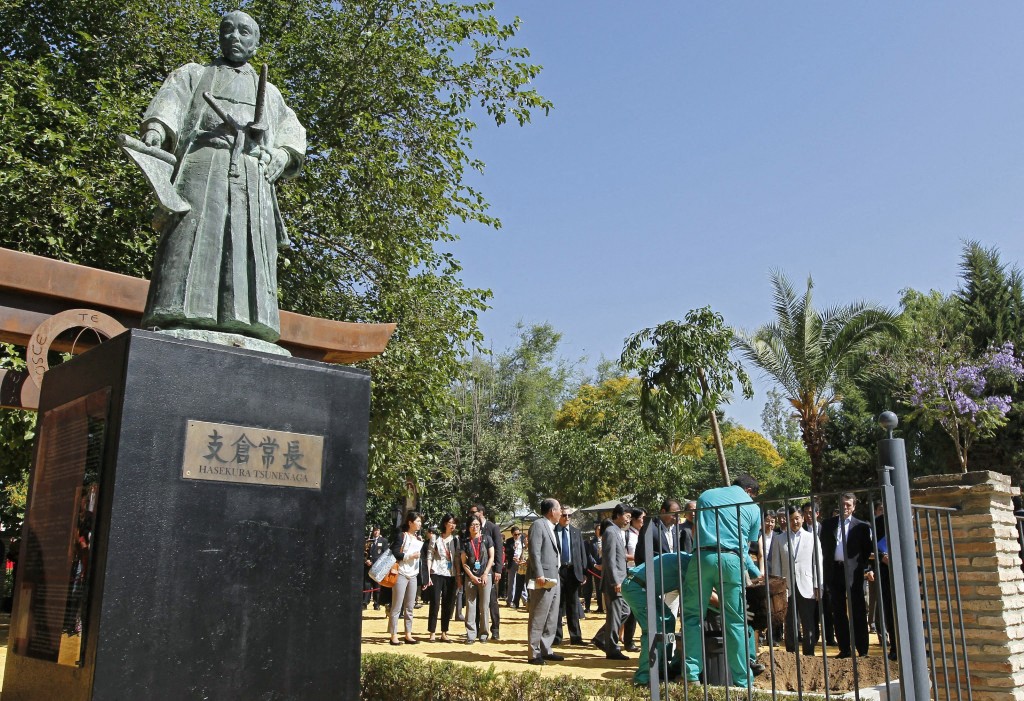
In 2013, Japan’s then Crown Prince Naruhito honoured the 17th-century samurai who established the first ties between his country and Spain 400 years ago. Manuel Vidal/AFP
Hasekura and some of his companions went to visit the nearby Monasterio de Nuestra Señora de Loreto and liked it so much that they decided to stay for a year.
Hasekura returned to Japan in 1620 and died in two years later, but some of his fellow travellers stayed in Coria del Río for much longer. One of them is said to have remained in the Andalusian town for 30 years, only leaving in 1644.
Advertisement
Historians are not sure whether any of these Japanese travellers had any descendants with the locals as there is no evidence of this, but what is clear is the cultural mark they left on the town, along with the bestowal of the Japón surname.
There’s also another theory about the name, which has been put forward by historian José Contreras, who studied the Keicho expedition. He gathered together a genealogical report based on 16,000 documents which helps prove his argument.
He believes the surname can be traced back to just one man – Bartolomé Rodríguez Japón, who was given the nickname Japón after travelling to America and trading with the Japanese, several years before the arrival of the samurai in Coria del Río.
He discovered that the first person baptised with this surname was Catalina Japón, a woman from the town born in the mid-17th century.
Whatever the theory, it’s obvious that over 400 years later Coria del Río’s connection to the Land of the Rising Sun is still going strong.
Advertisement
Today, a traditional torii gate (signifying the the transition from the everyday to the sacred) sits on the riverbank here, along with a statue of Hasekura and several tiles depicting samurai wielding swords.
As well as the 700 plus people who the Japan surname, the town celebrates Japanese festivals, publishes books about Japanese history even and distils its own sake – Keicho Sake.
Furthermore, the town has a ‘Hasekura Tsunenaga’ association which manages all its Japanese events and promotes friendship between Spain and Japan.
One of the most interesting events they organise is Toro Nagashi, a ceremony which is like the equivalent of the Japanese Day of the Dead held on August 15th. During the festival the Guadalquivir River fills with over 3,000 floating lanterns.
In 2013 Japan showed that they recognised this Spanish connection when the country’s Emperor Naruhito visited the small town to commemorate the 400th anniversary of Hasekura Tsunenaga’s arrival.


