


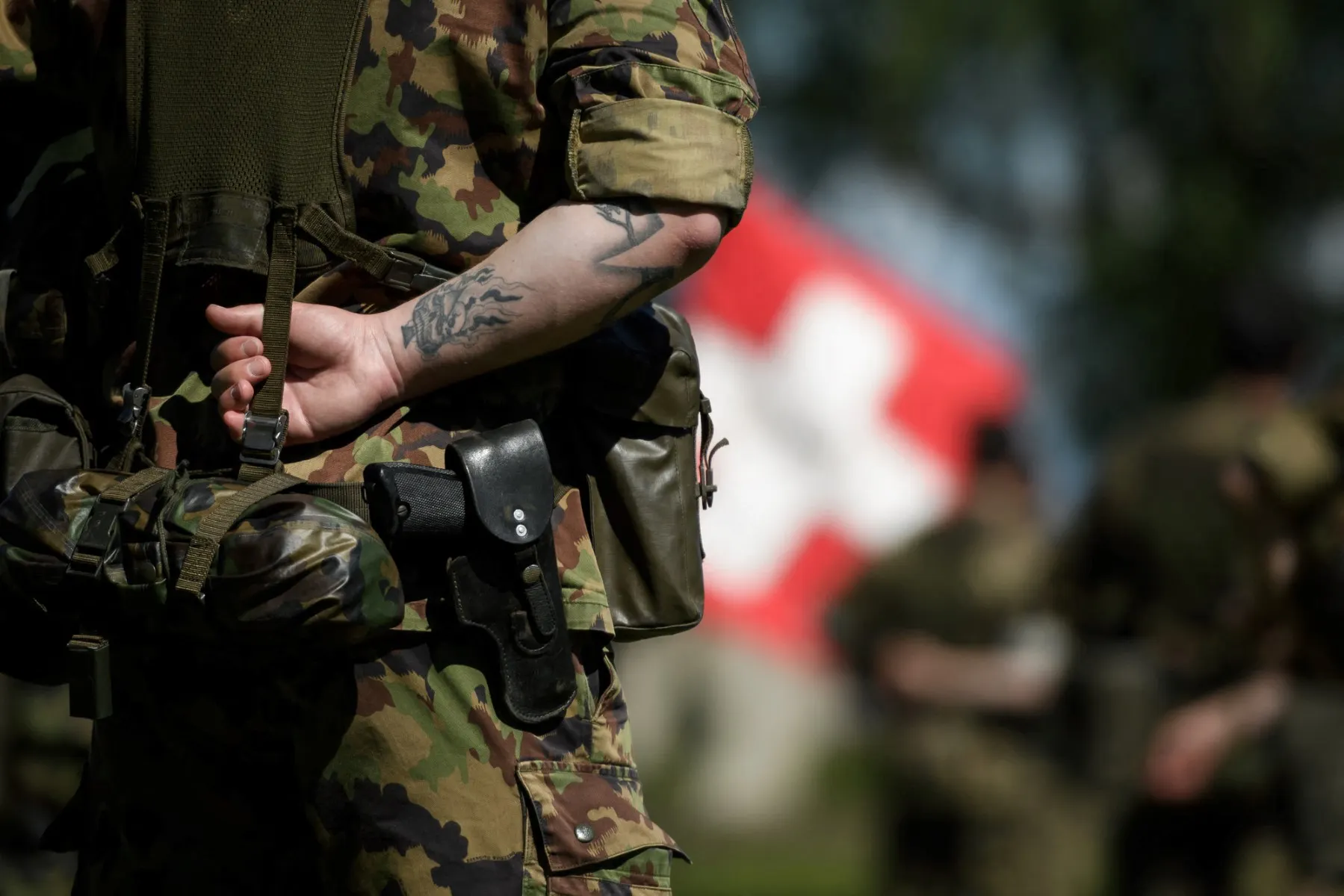
As both chambers of Switzerland’s parliament wrap up their two-week-long autumn session, we look at some of the issues they dealt with including the ‘No to 10 million’ anti-immigration proposal.
Massive opposition to anti-immigration proposal
The National Council not only voted against the SVP initiative “No Switzerland of 10 Million,” but scores of deputies actually stood up and criticised this move, in what was, according to media reports, “the longest parliamentary debate ever held.”
However, regardless of lack of parliamentary support, the initiative will still go to a referendum sometime in 2026.
READ ALSO: Will Swiss voters back the anti-immigration proposal?
Council of States committee to abolish the exemption from military service for Swiss-French nationals
Currently, these dual citizens fulfil all their military obligations with a simple initiation day in France.
Each year, about 800 Franco-Swiss take advantage of this law to dodge the Swiss army.
However, MPs argue that the only way under the law for foreign army service to replace Swiss one, is if dual citizens’ military stint abroad is up to Switzerland’s standards — which is not the case in France.
READ ALSO: Switzerland to crack down on dual-nationals who skip military service
And also relating to the army…
Tighter access to civilian service
In the hope of boosting the number of much-needed military personnel, MPs followed the advice of the Federal Council in making access to civilian service as an alternative to the army more restrictive.
The objective of this move is to reduce the number of recruits leaving the barracks for civilian service.
Currently, a simple request is all that is required to be transferred from military to civilian service, and the government wants to make this process more difficult.
READ ALSO: The Swiss army’s growing problem with civilian service
Advertisement
Council of States approves the return of double names
Married couples or registered partners should be able to have a double-barrelled surnames again- with or without a hyphen.
However, more than two names will not be permitted.
This means that divorced or widowed people can no longer use their previous surname in a new marriage
The right to double-barrelled names was abolished in 2013, but moves toward re-instating them have finally paid off.
National Council rewrites the home office rules
These are: the right not to be reachable during the daily rest period and on Sundays (the so-called ‘right to disconnect’), which has been implicit until now, will be explicitly included in the labour law, including for those who work in the office.
The maximum period during which daily teleworking must be provided will be 17 hours, compared to the current 14.
The minimum daily rest period would be reduced to nine hours, provided that, over a four-week period, the current 11 hours are respected.
This rest period may also be interrupted to perform an urgent task, if necessary.
Working from home on Sundays will also be permitted for five hours a day, on a voluntary basis, during nine Sundays per year.
Advertisement
Tourist transit tax
The Council of States has unanimously accepted a motion submitted by deputy Marco Chiesa, who wants tourists using Swiss motorways for transit to be subject to a ‘transit tax’.
It would apply to vehicles entering Switzerland from a neighbouring country and exiting in another, without stopping on the way.
The tax would be based on traffic density, time of day, and day of the week, to encourage vehicles to travel at certain times rather than others.
The objective of this move is to achieve a better flow of traffic on the national road network, particularly on north-south routes.
End to widows’ pension
On Wednesday, The National Council has approved a controversial reform of the first-pillar state pension (AHV/AVS), which deprives widows of lifelong pensions.
This move primarily affects childless women, who would no longer receive any pension at all. Widows with children will only be entitled to payments until the youngest child’s 25th birthday.
A transition period of three years is planned for current pensions.
The background to this measure is a ruling by the European Court of Human Rights (ECHR)in 2022, which found that Switzerland treated widows and widowers unequally – that is, granting lifelong pensions to the former but not to the latter.
Advertisement
Non-violent education is now enshrined in Swiss law
Parents in Switzerland must raise their children without the use of violence. This principle is now explicitly enshrined in the Swiss Civil Code, after the Council of States approved this amendment .
The National Council had already accepted it during the previous session of the parliament, in May.
The cantons will have to ensure that parents and children can contact counselling centres together or individually in the event of conflicts or difficulties in child-rearing.


