


Vitalii Syniakov once ran tours to Kyiv’s golden-domed churches and the beaches of Odesa. But after the first Russian missiles hit Kyiv in February 2022, “tourism died for about a year,” he says.
Now the industry veteran is one of several operators offering what he calls “dark tours” to sites made notorious by the Russian invasion.
“Frankly, now about 80 percent of all the tours we provide are dark tours,” he tells RFE/RL.
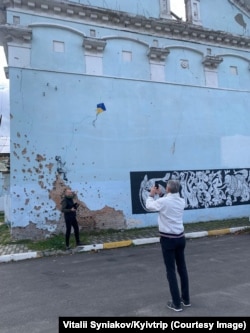
Tourists at the war-damaged House of Culture in Irpin
Even before Russia’s full-scale invasion, tourism in Ukraine had been buffeted by consecutive crises.
In 2013, over 24 million tourists visited Ukraine — nearly half of them Russians. “There was a real boom,” Syniakov says of the early 2010s. But numbers plummeted in 2014 as the Kremlin’s annexation of Crimea and conflict in the Donbas region opened a rift between the neighboring countries.
Then came the COVID pandemic, stifling virtually all international travel.
But shortly before February 2022, “there was another boom and we had many tourists from the [United] Arab Emirates and from India,” Syniakov says. “Frankly, they were looking for beautiful Ukrainian girls.”
Then the Kremlin launched its invasion. The reported 2.1 million visitors that arrived in Ukraine throughout 2022 marked a more than 90 percent drop in tourist numbers from pre-2014 highs.
Several travelers who did arrive to Ukraine booked tours of war sites that were already being advertised in the summer of 2022.
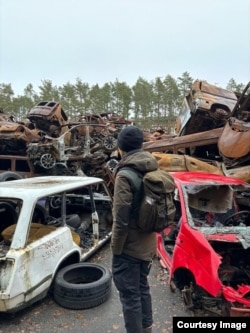
Thomas, a Canadian nurse, photographed while on a war tour in Ukraine
Thomas, a Canadian nurse, was one of those who wanted to see the conflict in Ukraine for himself.
He travelled to Ukraine’s eastern city of Kharkiv for a tour in 2024 because, he says, unlike in areas around Kyiv, where donations and government funds have helped to revamp some war-affected locations, “there’s less money to carefully curate the sites [in eastern Ukraine].”
He says Kharkiv offered a glimpse into a raw, wartime reality that contrasted with the capital, where in some cases, “you’re reading a plaque or some kind of script in front of you.”
The Canadian, who declined to give his surname, recalls being deeply affected by the sight of life enduring in war-ravaged suburbs of Kharkiv. “In one building there was a massive hole from a rocket or something and then immediately adjacent to that the lights were on and I saw some man just making dinner,” he recalled.
His experience in Kharkiv, he says, changed the trajectory of his life. After the tour he volunteered as a medic in the Donbas. Later he enrolled at a Ukrainian medical school. He spoke to RFE/RL from the UK, where he is preparing his Ukrainian residency documents.
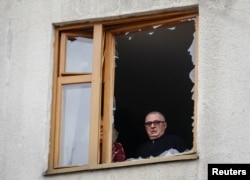
A resident of Kharkiv looks out of a window broken by a Russian drone strike in March.
When tourists first began visiting sites of tragedy and destruction in Ukraine, there was some hostility over what commentators slammed as “dancing on the graves” of war victims. Tourism insiders say that has changed as foreign press packs have moved on and government efforts have been made to memorialize the dead in towns such as Bucha and Irpin.
Kirill Zarubin, who leads tours of war-affected sites in Kharkiv, admits facing some negative reactions from locals when leading film crews carrying conspicuous camera equipment. Otherwise, he says, tourists have been treated as ambassadors of their countries by a grateful Ukrainian public.
Locals he says, “appreciate the support given by different countries, so for them to see a person from those countries, they can thank them personally.”
Most of Zarubin’s clients hail from the US and Japan.
On one tour, the guide was showing a Japanese tourist a strike-ruined residential building when an apartment owner approached. “He invited us into his destroyed flat to show us everything, like how it looked before, the backstory, and what he plans to do next,” Zarubin says, “he was a really great guy.”
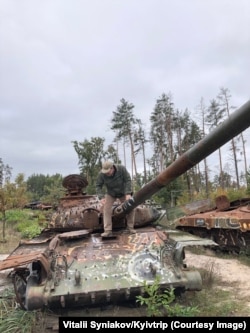
A war tourist explores a tank in the Kyiv region
As foreign visitors begin to trickle back into Ukraine in increasing numbers, there are indications that war-themed tours will become a permanent fixture of Ukraine’s tourism landscape. Ukraine’s State Agency for Tourism Development of Ukraine recently updated its website to acknowledge a “new tourism paradigm” it is developing, “establishing destinations and routes that commemorate the sacrifices made by the Ukrainian people in the pursuit of freedom, peace, and security.”
For now, the numbers of tourists booking trips to war sites remain small. In Kharkiv, Zarubin says he hosted just four tourists in April. Kyiv-based Syniakov says overall numbers remain around one-third of what they were before the Russian invasion.
With countries throughout the world warning their citizens not to travel to wartime Ukraine, many who do arrive are keeping their plans to themselves.
“Everybody I provided a [war] tour for, they didn’t tell their mothers that they were visiting Ukraine,” Syniakov says. “They told their fathers, but not their mothers.”


