


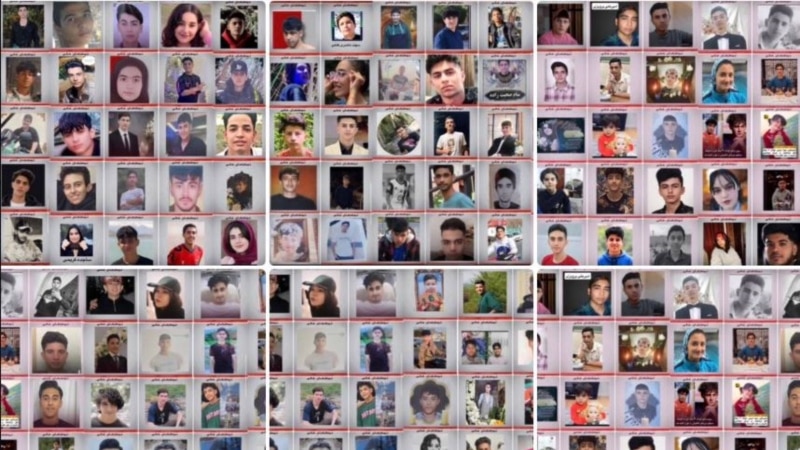
Recent reports from Iran suggest that an intense crackdown on political opposition within the country that began during mass protests in January is continuing unabated.
On June 13, the Iranian Writers’ Association announced Yousef Ansari, a poet and novelist arrested on January 8, had received a sentence of four months in prison plus another eight months suspended.
RFE/RL’s Radio Farda learned that Fereydoun Farahani, a music professor and visiting professor of architecture at Pars University, had been arrested for social media posts he made during the demonstrations.
He had posted a song called In Praise Of The Nation’s Desire For Freedom on his Instagram.
In Isfahan Province, the judiciary announced that 100 “traitors” would have their property confiscated, without providing any further details.
For several weeks now, the Iranian authorities have announced similar measures against hundreds of people.
The Iran Human Rights Group, a watchdog based in Norway, reported on June 8 that at least 40 prisoners, including 19 protesters, had been hanged on politically motivated charges so far this year.
Also on June 13, the Tasnim news agency, which is affiliated with the Islamic Revolutionary Guards Corps, reported that a suspect had been arrested for being “in contact with foreign espionage elements.”
Separately, the Coordination Council of Iranian Teachers’ Unions released in a statement on June 13 condemning the security pressure, arrests, judicial rulings, and restrictions imposed on teachers’ union activists, saying they cannot be considered isolated incidents.
Such actions are “a clear and organized pattern to weaken independent teachers’ unions and silence the voice of society’s demands,” the statement said.
Another part of the crackdown has been the increasing use of a new law introduced following the 12-day war with Israel last year, expanding penalties for alleged espionage.
Some of those charged with spying have been hanged, along with dozens of other political prisoners, in recent weeks.
The scale of the repression, which began with security forces killing thousands of protesters in January, has drawn widespread international condemnation.
In recent days, a number of Nobel laureates have raised their voices on this.
Some 16 laureates told RFE/RL that they were among the 75 prize winners listed on a letter organized by the National Council of Resistance of Iran (NCRI) as belonging to the Mojahedin-e Khalq (MEK), an exiled opposition group that Iran considers a terrorist organization but which was removed from US and EU terrorism lists more than a decade ago.
These included Barry Barish and Reinhard Genzel, prize winners for physics in 2017 and 2020 respectively, Oliver Hart, prize winner for economics in 2016, and Brian Kobilka, the winner for chemistry in 2012.
The letter expresses “deep and urgent concern regarding the widespread, systematic, and ongoing violations of human rights in Iran.”
“I signed it to protest the execution of political prisoners,” Jack Szostak, Nobel laureate for medicine in 2009, told RFE/RL in an e-mail.
Another signatory, 2014 medicine laureate May-Britt Moser, told RFE/RL she signed “because I think it is horrible to kill people, and most of these people are completely innocent.”
In a report from late May, Amnesty International announced that at least 78 protesters and political prisoners sentenced sentenced to death were at risk of execution, including at least 41 people who were arrested in relation to the January protests.


