


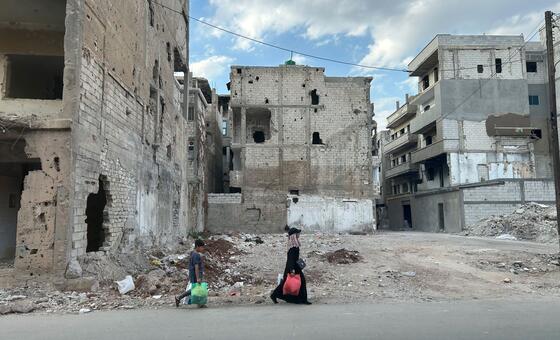
Across Syria, the scars of war remain etched into communities that have endured years of violence, displacement and loss.
Yet amid the devastation, hopes are also taking root, hopes for security, decent jobs, functioning schools and hospitals, and a future in which people from every background feel they belong.
During a landmark visit to Damascus, UN Secretary-General António Guterres encountered both realities.
He visited the notorious Sednaya prison, where thousands were tortured and killed during the conflict, listened to accounts of fear and suffering, and met representatives of Syria’s diverse communities, civil society groups, women and young people seeking a stake in their country’s future.
As he wrapped up his visit, the UN chief said political change must now deliver tangible improvements for all Syrians, backed by sustained international support.
This comes a day after the Secretary-General met President Ahmad Al-Sharaa and reaffirmed the United Nations’ commitment to supporting the Syrian people and working closely with the country’s authorities during a critical period of transition.
A pivotal moment
“After so much suffering, this period of transition is a rare moment in the life of a nation,” Mr. Guterres told journalists on Sunday as he concluded the second day of his visit.
“A moment of responsibility, possibility and choice.”
Describing Syria as a country at a historic turning point, the Secretary-General said people across the nation were drawing on their own experiences and aspirations to shape a new future after years of conflict.
Over the course of his visit, he said he witnessed both the deep wounds left by war and the determination of Syrians to move forward.
“During these past days, I have seen the scars left by years of conflict. I have heard about pain, loss, displacement and fear.”
But alongside those experiences, he said, he had also encountered resilience and optimism.
“I have felt a profound sense of hope.”
Secretary-General António Guterres speaks at a press conference in Damascus, Syria.
Diversity a source of strength
Throughout his remarks, the Secretary-General repeatedly emphasized Syria’s rich diversity, describing it as one of the country’s defining characteristics and a foundation for lasting peace.
“This country has long known what it means to be a crossroads – of civilizations, cultures, faiths and ideas,” he said.
“That diversity is not incidental to Syria. It is one of this country’s greatest strengths.”
Mr. Guterres stressed that the success of the transition would depend on ensuring all Syrians feel represented in the country’s future and can participate meaningfully in shaping it.
He said the aspirations he heard during the visit were universal: security and stability, economic opportunity, accountable institutions and respect for rights.
The United Nations, he added, stands ready to support efforts to promote accountability, reconciliation, human rights and confidence-building among communities while ensuring the participation of women, young people and all components of Syrian society.
Secretary-General Antonio Guterres (right) is briefed during his visit to Saydnaya, site of the infamous military prison maintained by the former Assad regime.
Recovery cannot be Syria’s burden alone
The Secretary-General also used the visit to deliver a strong appeal to international partners, arguing that political change would need to be matched by significant economic support if Syrians are to see tangible improvements in their daily lives.
“The task now is to translate political change into tangible improvements in people’s daily lives,” he said and added: “Every Syrian must feel equally invested in the future of the country.”
While welcoming recent steps that have eased sanctions and opened new possibilities for economic recovery, Mr. Guterres called for all remaining sanctions to be lifted immediately.
He argued that rebuilding Syria would require sustained international engagement, investment and practical assistance.
“The Syrian people have shown extraordinary resilience through years of hardship,” he said.
“They should not have to carry the burden of recovery alone.”
The Secretary-General said support was needed to restore services, rebuild infrastructure, revive livelihoods and strengthen education and healthcare systems.
International assistance would also be essential to help refugees and displaced people return home safely, voluntarily and with dignity, he added.
A steadfast partner
Looking ahead, Mr. Guterres said the road forward would not be easy and warned that setbacks were inevitable.
Yet he insisted that a rare opportunity exists to build a more inclusive and peaceful future.
“There is also a real and extraordinary opportunity,” he said, “to help build a Syria where women and men participate fully in shaping their country’s future … where young people can fulfil their aspirations … and where every person can live in dignity, equality, security, and peace.”
“The United Nations will be a steadfast partner of the Syrian people in that journey.”


