



Domestic violence is a growing problem that generates direct costs of nearly CHF300 million a year in Switzerland.
Keystone-SDA
Switzerland is planning to step up its fight against domestic violence by introducing round‑the‑clock, real‑time electronic monitoring of perpetrators, 24 heures and Tribune de Genève reported. Canton Vaud is set to launch a pilot project in the second half of 2026.
+Get the most important news from Switzerland in your inbox
At a meeting in Bern on Thursday, members of the Electronic Monitoring (EM) association, which brings together all 26 cantons except Valais and Ticino, confirmed plans to introduce an active system by 2027. Nearly half of the cantons will be launching tests in the coming months. Currently, monitoring in most cantons is passive, with checks carried out following an incident.
President of the association, Vassilis Venizelos, is leading this initiative.
“In concrete terms, what is planned is the creation of a central unit that will ensure at all times that the prohibition perimeters defined by the courts are respected,” the Vaud government minister explained.
Thanks to an electronic bracelet’s geolocation system, any intrusion into a prohibited area will immediately trigger an alert. A centre will then contact the perpetrator to order him to leave the vicinity. “If they don’t comply, the police intervene,” Venizelos told the newspapers.
Towards ‘dynamic’ surveillance
The current system will eventually develop into so-called “dynamic” surveillance, with a device also worn by the victim to constantly measure the distance between the two individuals.
More

More
New Swiss national hotline for domestic violence victims to launch after delays
“This device makes it possible to track the movements of perpetrators and victims in real time and monitor them simultaneously,” he said. “There is no question of imposing this type of device on a victim. If someone doesn’t feel comfortable with the idea, it won’t be proposed. The aim is also to go beyond cantonal boundaries and provide continuous protection throughout Switzerland.”
Canton Vaud will introduce a pilot project in the second half of 2026 with six to twelve electronic bracelets. The test phase will enable an evaluation to be conducted of both active and dynamic surveillance.
“The aim is to roll out the tool across the board in 2027,” said Venizelos. However, the project will require special training for police officers and the introduction of harmonised intervention protocols.
More

More
Are initiatives to combat gender-based violence having an impact?
The EM association has developed a “toolbox” for the cantons. “Our aim is to present a concrete project by spring 2027,” said the Vaud official. Lausanne could host this future structure thanks to an existing facilities at La Grangette.
A cost-effective solution
The cost of the system remains relatively minimal. In Zurich, a pilot project cost CHF60,000 over eighteen months. In canton Vaud, monitoring six to twelve bracelets would cost between CHF7,500 and CHF15,000 a year.
Venizelos says “the cost of inaction is much higher”. Domestic violence is estimated to generate direct costs of nearly CHF300 million a year in Switzerland. In canton Vaud, the police intervene three to five times a day for such cases.
However, the Venizelos insists that the bracelet is not a “magic” solution. The technology must form an integral part of a comprehensive strategy that includes prevention, education, support for victims and follow-up for perpetrators.
More
More
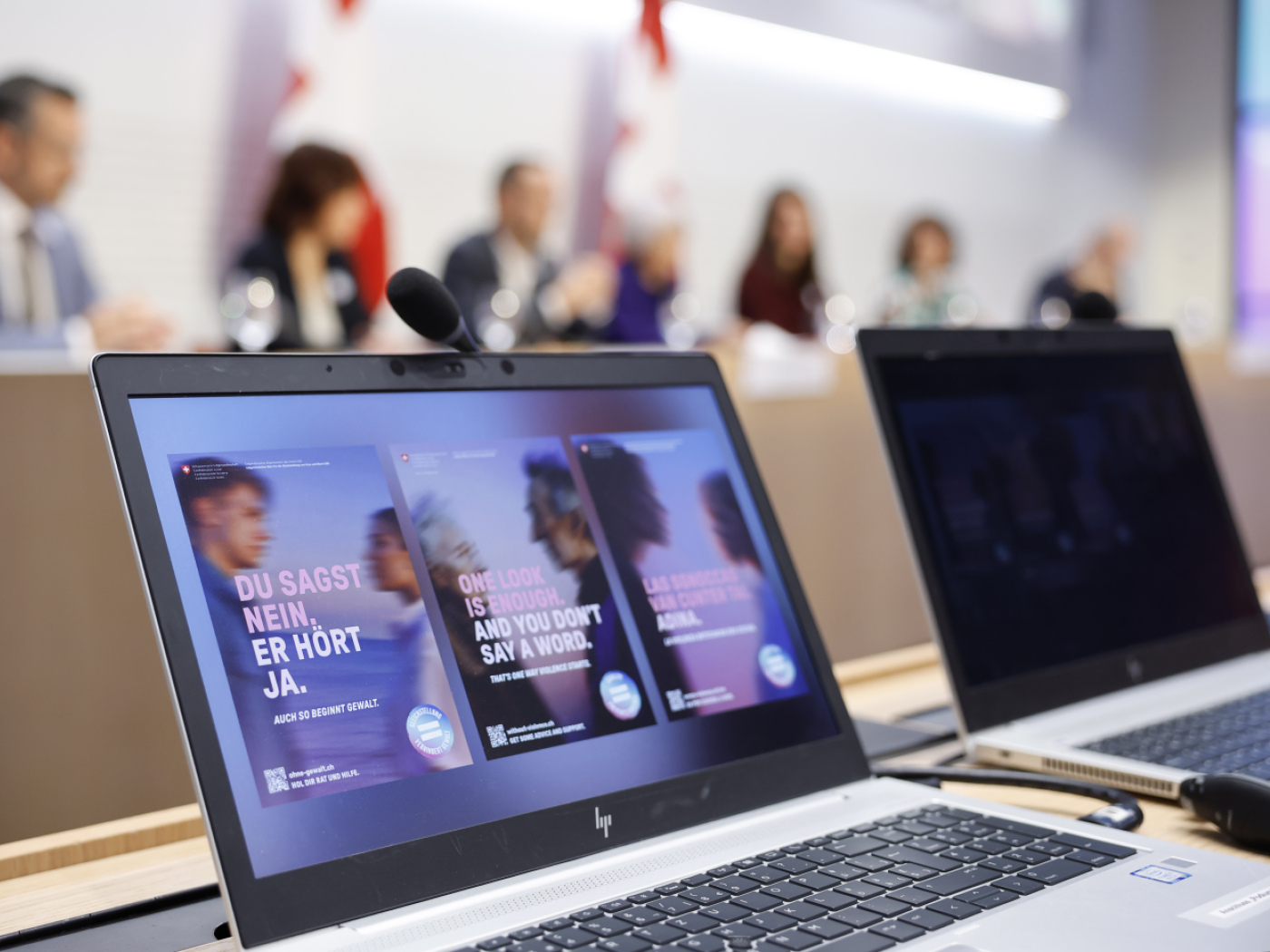
Swiss launch first national campaign against domestic violence
Adapted from French by AI/sb
We select the most relevant news for an international audience and use automatic translation tools to translate them into English. A journalist then reviews the translation for clarity and accuracy before publication.
Providing you with automatically translated news gives us the time to write more in-depth articles. The news stories we select have been written and carefully fact-checked by an external editorial team from news agencies such as Bloomberg or Keystone.
If you have any questions about how we work, write to us at english@swissinfo.ch.


