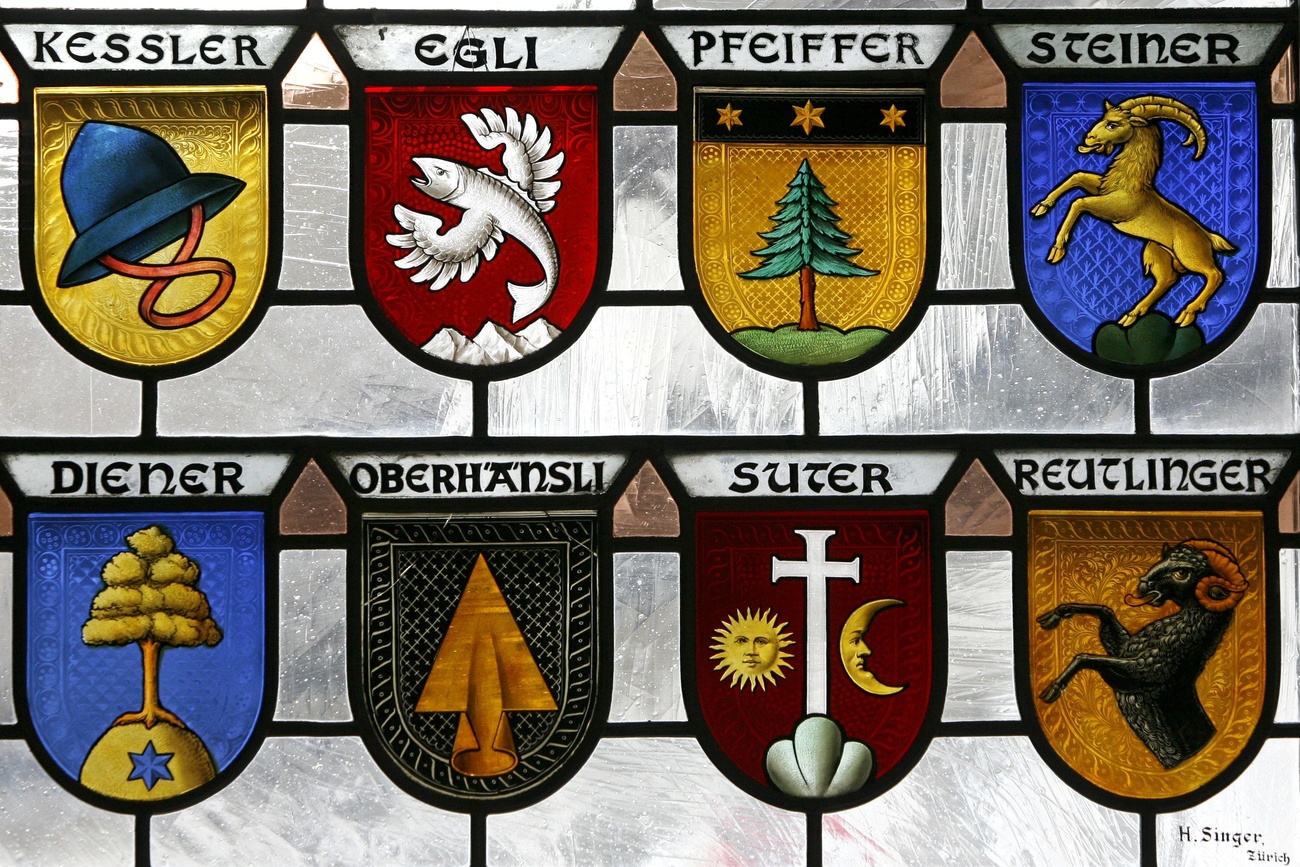
In Zurich, the coats of arms of eight families adorn the windows of the guild house “zur Waag”, now a restaurant.
Keystone / Alessandro della Bella
Most Swiss families have a coat of arms. This may come as a surprise abroad, where heraldry is often the preserve of nobility. However, this enthusiasm can be explained not only by tradition, but also by fashion.
“The proportion of families with their own coat of arms varies from canton to canton, but it’s always significant. For example, 80-90% of families from canton Fribourg have their own coat of arms,” explains Heribert Bielmann, president of the Institut fribourgeois d’héraldique et de généalogieExternal link.
Heraldry originated in the Middle Ages, when coats of arms had become necessary “as a distinctive sign for knights, who had become unrecognisable under their armour”, notes the Historical Dictionary of Switzerland. But over the centuries the practice spread to other strata of society, and even to commoners.
For a long time, having a coat of arms was a way for individuals or groups to demonstrate their importance or autonomy. This was particularly true of patrician families, wealthy farming or middle-class families, or members of guilds. “Having a coat of arms was a way of showing that you were somebody,” Bielmann says.
More
More
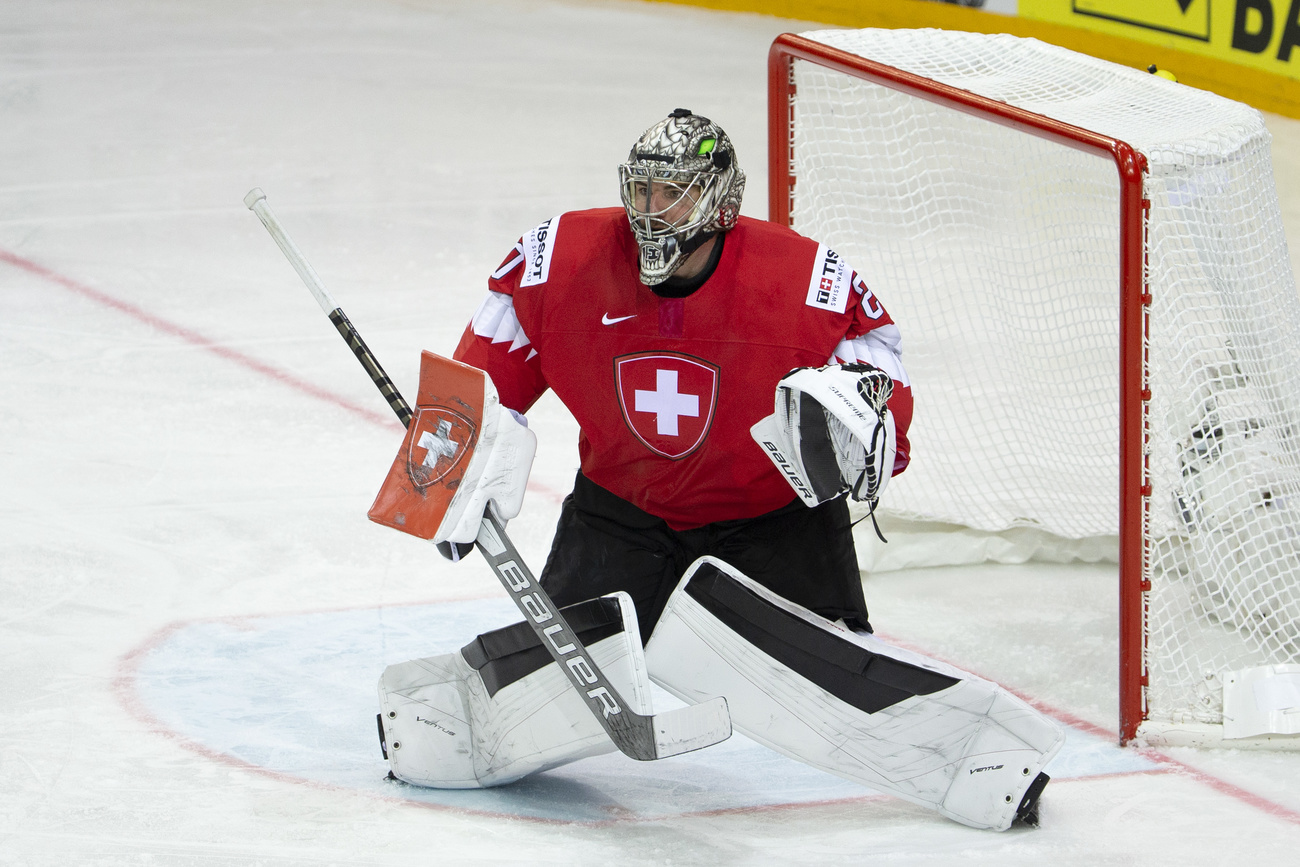
Swiss coat of arms on national team jerseys – legal at last?
“But it was mainly in the 20th century that heraldry became a fashionable phenomenon that spread far and wide,” he continues. “In the middle of the century, for example, you could still see heraldic artists offering their services at jumble sales. And people willingly agreed to create their own coats of arms, because it was fashionable, and they felt it was important for their sense of family identity.”
No official value
Family coats of arms can be registered with armorials. In most cases, these are kept by the archives of the various cantons, towns, municipalities or regions.
However, registering a coat of arms does not give it official status, because in Switzerland, coats of arms are not granted by an authority. “They are a personal mark with no official value,” says the City of GenevaExternal link.
As armour has long since disappeared from the Swiss arsenal, coats of arms are of little practical use either. It might be possible to engrave them on a ring to seal mail, but here again, this seems somewhat outdated.
For a long time, coats of arms have been used primarily for decorative purposes. The range of applications is vast: on a front door, pewter cane, stained-glass window, business card, writing paper or even an iron for making bricelets (a type of waffle). Once again, it’s a question of fashion.

An original use, to say the least, with this bricelet embossed with a coat of arms.
Institut fribourgeois d’héraldique et de généalogie
Strict rules and language
For families without a coat of arms, nothing is lost: it’s still possible to create one. You can, of course, do it yourself, but it’s always advisable to turn to specialists, as heraldry follows a specific language and set of rules.
There are many rules and restrictions that must be taken into account. The main rule concerns the superimposition of colours. Coats of arms are also translated into an arcane language (blazoning). For example, the coat of arms of the author of this article is “silver with a gules [red] saltire accompanied at the top by an azure dove, at the base a gules rose and flanked dexter [right] and sinister [left] by a sable [black] demi-vol [single wing]”.
But perhaps in this particular case, a drawing is better than words…

With the rules established, the next step is to determine the theme. You can then look for symbolic elements that might illustrate the name, origin or activity of the person for whom the new coat of arms is intended. And sometimes you don’t have to look far. “The colour red for a family called Roth, or an arm holding an axe (Beil in German) for a family called Bielmann,” says Heribert Bielmann.
An endangered tradition
In Switzerland, heraldry has survived over the centuries. But this tradition is now in danger.
First, there is a shortage of specialists who still know the art. In French-speaking Switzerland, for example, there is only one heraldist leftExternal link who still creates coats of arms by hand.
Perhaps more seriously, interest is waning. Young people don’t seem very interested in heraldry any more,” Bielmann laments. “It’s something that now tends to appeal to older people. As with philately, there’s a lack of fresh talent.”
But, as mentioned earlier, heraldry is a fad. Fashions are often cyclical, so perhaps it’s not yet all over for this tradition that dates back to the Middle Ages.
Edited by Samuel Jaberg. Translated from French by DeepL/ts
More