


Vehicles destroyed by devastating flash floods that struck Benetusser near Valencia, eastern Spain, on November 23, 2024.
Keystone-SDA
Protecting against floods is an expensive undertaking, but a recent analysis shows it is far more cost-effective than rebuilding after natural disasters. In Switzerland, where a large share of the population faces flood risks, the state invests heavily in prevention.
Last autumn, cars piled in mud and rubble filled the streets of Valencia, Spain. These scenes of destruction and confusion followed similar ones in Italy, France, Germany and other European countries hit by violent floods in the preceding weeks.
Switzerland, with its many rivers and streams, has also faced such disasters. Last summer, heavy rain claimed lives and caused severe damage in the south of the country.
Climate change is making such exceptional events more frequentExternal link. There is good news, however: flood protection works. It prevents damage and saves money – to the tune of ten times the cost of rebuilding, according to a studyExternal link by the Swiss Re Institute, an in-house division of the reinsurer Swiss Re that does risk analysis and research.
More

More
Newsletters
Flood damage reduced by up to 90%
In 2023, floods caused global economic losses of $52 billion (about CHF45 billion), the Swiss Re Institute estimates. Extreme weather events exacerbated by climate change and urban sprawl in potentially flood-prone areas are likely to increase these costsExternal link, some experts say.
However, if built properly, levees and flood banks can reduce coastal damage in densely populated areas by between 60% and 90%. For example, measures in the United Kingdom were taken to protect 100,000 properties during Storm Babet in October 2023, according to the UK’s Environment AgencyExternal link.

Concrete walls to protect railway tracks from flooding, Biasca, Switzerland, 2018.
Keystone / Gaetan Bally
Veronica Scotti, a sector manager at Swiss Re, said in a statement that investments in climate adaptation promote economic stability and help to keep people safe. Limiting land use also protects people from flooding. For instance, forests and wetlands can absorb large amounts of rainwater and lower the risk of flooding.
One-fifth of the Swiss population at risk of floods
Among natural disasters, flooding causes the greatest damage in Switzerland, according to a 2021 reportExternal link by the Swiss Federal Institute for Forest, Snow and Landscape Research. Over the past 40 years, floods have affected four out of five Swiss municipalities, and today, one-fifth of the populationExternal link faces this risk.
Many buildings are located in the so-called “yellow flood zone”, says Olivia Romppainen, co-director of the Mobiliar Lab for Natural Risks at the University of Bern.
In the yellow zone, the risk is still considered low, but serious damage remains possible. For buildings in this zone, local measures such as barriers to stop water from flooding car parks could help to minimise damage, she says.
Floods cause fewer victims, but more damage
In Europe, one-tenth of the populationExternal link live in areas at risk of flooding. The Netherlands has the highest percentage, facing not only the threat of flooding from large rivers such as the Rhine but also from the sea.
“In recent decades, all European countries have made numerous investments to reduce the impacts of flooding, both in structural works and in warning systems,” says Francesco Dottori, a professor of hydrology at the Pavia University of Applied Sciences in Italy. He is the author of a recent studyExternal link on mitigation strategies in Europe.
At the same time, urban areas in flood-prone zones have grown sharply. The consequence is that today’s catastrophic floods cause on average fewer casualties than in the past, but they are leading to greater economic damage, he says.
Many existing defences may no longer offer adequate protection against increasingly frequent and destructive floods. Dottori highlights this issue, noting the recent floods in Emilia-Romagna, a region in northern Italy, where several areas were flooded repeatedly in less than two years after decades of experiencing no major floods.

Flooding in Castenaso, northern Italy, on October 20, 2024.
Keystone-SDA
Millions of francs per year to prevent flooding in Switzerland
The European Environment Agency says it has no statistics on national investments in flood protection measures. However, the European Commission estimates that EU member states spend around €3 billion (CHF5.6 billion) per yearExternal link on such measures, based on the average for the period 2011-2015 and other partial data. This works out to roughly €6 per person.
The Netherlands stands out, with an expenditure of more than €700 million per year. Meanwhile, Germany, France, Italy and Austria each allocate between €220-350 million.

SWI swissinfo.ch
For its part, Switzerland (which is not a member of the EU) invests around CHF300 million per year in flood protection, the Federal Office for the Environment told SWI swissinfo.ch. That’s an average of CHF33 per inhabitant. The federal government covers around CHF120 million, with the rest coming from the cantons and municipalities.
More
More
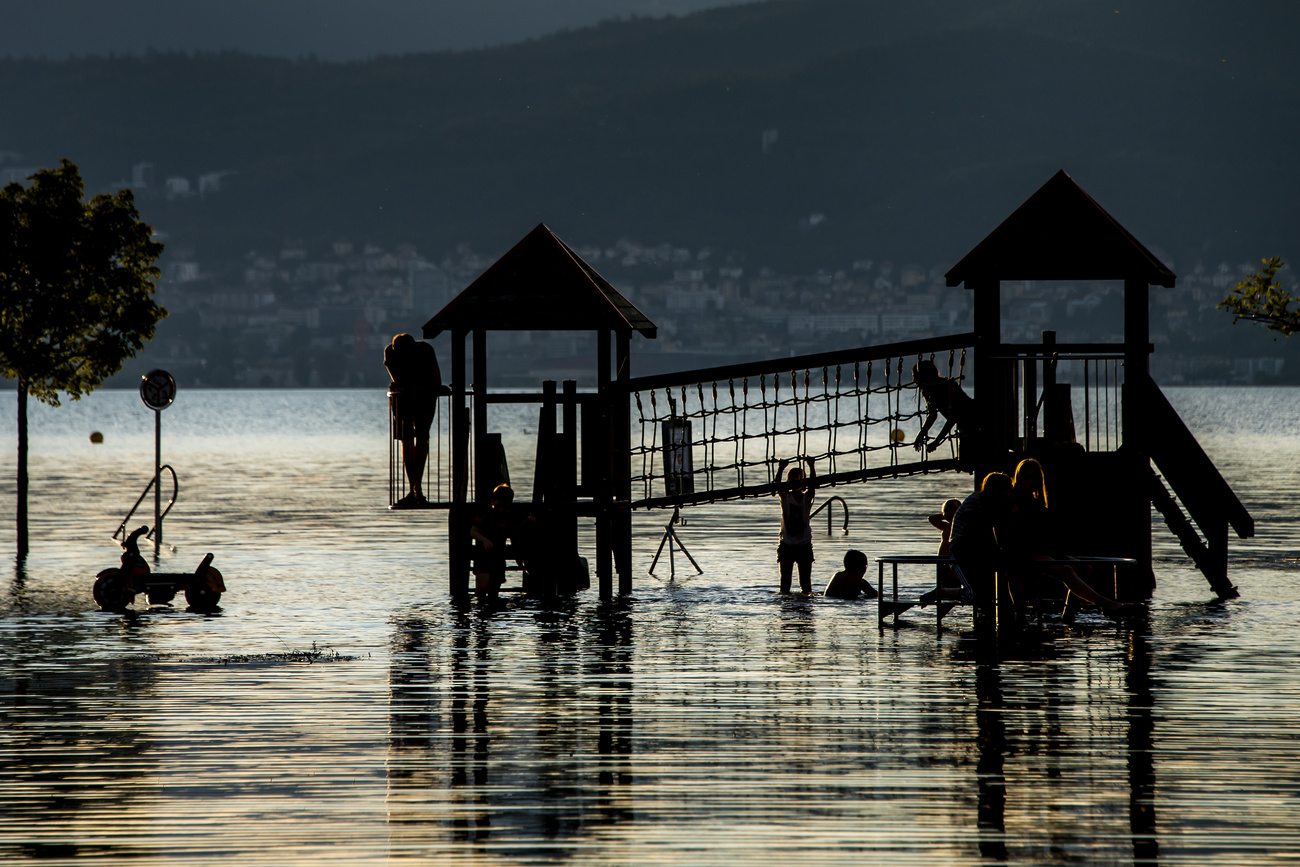
Urban flooding slowly becomes a priority issue for Switzerland
Raising awareness and issuing life-saving alerts
For Dottori, the priority isn’t just building new flood defences or reassessing protection using existing structures in the light of climate change. “The most urgent aspect is to make the population aware and inform them about the flood risks in the area where they live,” he says.
While all EU member states have developed risk maps, he adds, many people still don’t realise that they live in flood-prone areas or under-estimate the risks. An informed population can take the right actions, such as setting up protective barriers around their home, moving to higher ground during heavy rains, and taking out insurance against damage.
Setting up effective alert systems is equally crucial, says Dottori: “Knowing that a flood could happen soon and knowing what to do about it can save many lives.”
More
Edited by Sabrina Weiss. Adapted from Italian lj/gw.


